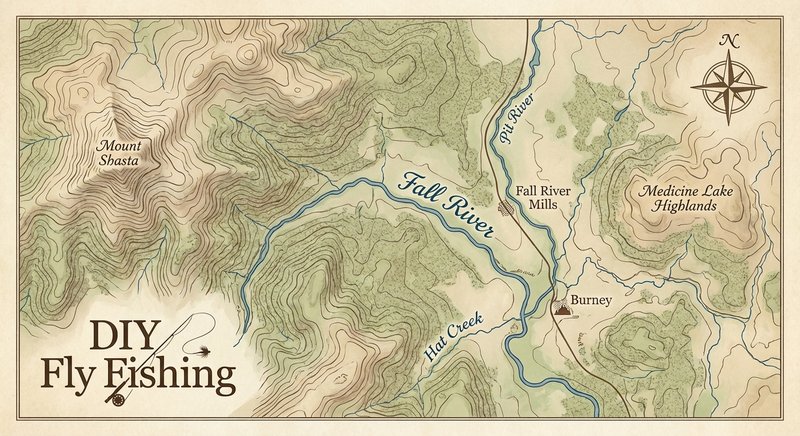
Fall River
Fly fishing in California · Advanced · Best seasons: Spring, Summer, Fall
Target Species
Rainbow Trout
About This Water
A classic spring creek with crystal-clear water and large rainbow trout. Technical dry fly fishing.
Fishing Recommendations
Welcome to the "PhD of Fly Fishing." The Fall River in Northern California is one of the largest spring-fed systems in the world and represents the pinnacle of technical spring-creek angling. As your guide, I’m going to walk you through how to tackle this beautiful, frustrating, and incredibly rewarding fishery.
🎣 Location Overview
The Fall River is a massive, slow-moving spring creek meandering through a lush valley near the town of Fall River Mills. Unlike the tumbling freestones of the nearby Pit or McCloud rivers, the Fall is glassy, flat, and remarkably consistent.
What makes it special:
- Constant Temperature: Being spring-fed, the water stays around 52–54°F year-round, creating an incredibly productive biomass.
- The "Flat Water" Challenge: The surface is often like a mirror. If you can catch fish here, you can catch them anywhere.
- Boat Access Only: Because the river is surrounded by private land and the banks are thick with tules and marsh, you must fish from a boat (prams are the local standard).
🐟 Target Species & Behavior
The primary prize is the Wild Rainbow Trout, specifically the "McCloud River" strain. These fish are known for their strength, vibrant colors, and extreme selectivity.
- Behavior: These trout are "lane feeders." They sit in the channels between dense undulating weed beds.
- Feeding: They are highly keyed into specific life stages of insects. If a hatch of PMDs is size #18, they will often ignore a size #16.
- Spook Factor: Because the water is so clear and still, these fish have a wide "window" of vision. A heavy foot on a boat floor or a thick fly line landing overhead will send them into the weeds instantly.
📅 Best Times to Fish
The Fall River has a specific season (usually the last Saturday in April through November 15).
- Spring (May – June): This is prime time for Pale Morning Duns (PMDs). You’ll see heavy morning hatches. This is also when the famous Damselfly migration begins.
- Summer (Late June – July): The Hexagenia hatch. This is the "Main Event." Massive yellow mayflies (size #4-6) hatch at dusk. It’s chaotic, exciting, and the best chance to catch a trophy-sized trout on a dry fly.
- Fall (September – October): The crowds thin out. You’ll see Tricos in the morning (tiny #22 flies) and Mahogany Duns. The fish are wary but the weather is spectacular.
🪰 Recommended Flies & Techniques
Top Fly Patterns
- Dry Flies:
- PMD Sparkle Dun (#16-18)
- Mercer’s Missing Link (#14-18)
- Trico Spinner (#20-22)
- The Hex (#4-6, specifically the Cripple or Sparkle Dun patterns)
- Braided Butt Damselfly (#10-12)
- Nymphs:
- Hogan’s S&M Nymph (#16-18)
- Zebra Midge (#18-22, Red or Black)
- Frenchie (#16-18)
- Beaded Zebra Midge (Silver/Black)
Essential Techniques
- The Downstream Dry Fly: This is the local secret. Position the boat above the fish, cast downstream, and use a "stack mend" to let the fly drift toward the fish before the leader or line. This prevents the fish from seeing your tippet.
- The "Fall River Twitch": When fishing nymph or damselfly patterns, use an extremely slow, rhythmic retrieve to mimic the swimming motion of the larvae over the weed beds.
- Long Leaders: You need 12-to-15-foot leaders tapering down to 6X or 7X fluorocarbon tippet.
💡 Pro Tips & Local Knowledge
- Electric Only: Gas motors are strictly prohibited on the upper sections. Most anglers use a small pram with an electric trolling motor and a "quiet" anchoring system (like a mushroom anchor or a Pole Anchor).
- The "Gasline" and "Island Road": These are the two most famous stretches. The Gasline area is known for great hatches, while the Spring Creek confluence offers some of the coldest, clearest water.
- Watch the Tules: In the heat of the day, trout will often tuck right against the shadows of the tule reeds on the bank.
- Stealth over Distance: You don't need a 60-foot cast. You need a 30-foot cast that lands like a feather.
⚠️ Important Information
Access Information
There are very few public launch points. The two primary spots are:
- Caldwell (Cal Eco) Launch: Near the headwaters (requires a small fee/donation).
- Island Road Bridge: A public launch further downstream.
Regulations & Permits
- Barbless Hooks Only: Strictly enforced.
- Check Seasons: The river is not open year-round. Always check the CA Dept. of Fish and Wildlife "Sierra District" regulations before heading out.
- Wind: The Fall River Valley can get incredibly windy in the afternoon. If you see the wind picking up, start heading back to the ramp—rowing a flat-bottom pram against a 20mph headwind is grueling.
Guide's Final Word: The Fall River rewards patience and observation. Spend the first 20 minutes on the water just watching the surface. Once you time the rise of a specific fish, you’re halfway to a memory you'll never forget. Tight lines!
Bug Hatches & Matching Flies
| Hatch | Type | Peak months | Time of day | Hook sizes | Matching flies |
|---|---|---|---|---|---|
| Pale Morning Dun (PMD) Ephemerella excrucians | mayfly | May, June, July | Late Morning/Early Afternoon | #16-18 | Last Chance Cripple #16-18, Thorax PMD #16-18, Split Case PMD #16-18 |
| Hexagenia Hexagenia limbata | mayfly | June, July | Dusk/Last Light | #6-8 | Paradrake Hex #6-8, Hexagenia Nymph #6-8, Crippled Hex #6-8 |
| Blue Winged Olive (BWO) Baetis | mayfly | March, April, October, November | Afternoon | #18-22 | RS2 #20-22, BWO Sparkle Dun #18-20, Pheasant Tail #18-22 |
| Callibaetis Callibaetis ferrugineus | mayfly | May, June, September | Morning | #14-16 | Callibaetis Spinner #14-16, Mercer's Missing Link #14-16, Bird's Nest #14-16 |
| Trico Tricorythodes | mayfly | August, September | Early Morning | #20-24 | Trico Spinner #20-24, Griffith's Gnat #20-22, Trico Emerger #22-24 |
| Damselfly Enallagma | other | June, July | Mid-day | #10-12 | Braided Butt Damsel #10-12, Marabou Damsel Nymph #10-12, Adult Damsel #10-12 |
| Cinnamon Caddis Hydropsyche | caddis | June, July, August | Evening | #14-16 | Elk Hair Caddis #14-16, LaFontaine Sparkle Pupa #14-16, Z-Wing Caddis #14-16 |
| Midges Chironomidae | midge | January, February, March, December | All Day | #20-24 | Zebra Midge #18-22, Morgan's Midge #20-22, Hanging Midge #20-22 |
| Black Ants Formicidae | terrestrial | August, September | Afternoon | #14-18 | Cinnamon Ant #16-18, Parachute Black Ant #14-16, Chernobyl Ant #12-14 |