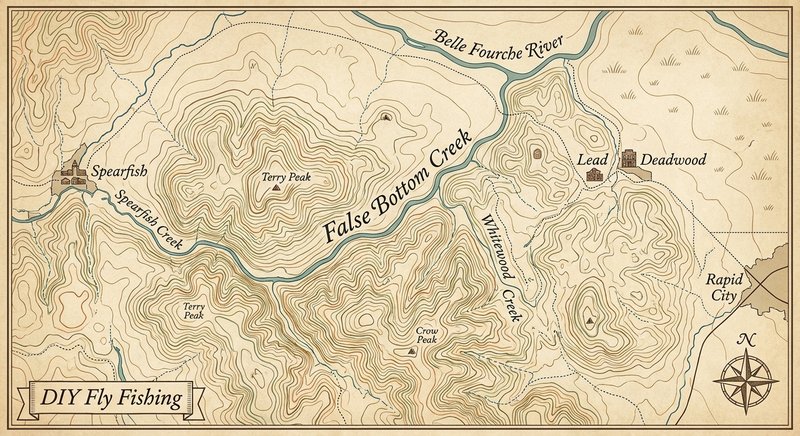
False Bottom Creek
Fly fishing in South Dakota · advanced · Best seasons: summer
Target Species
Brook Trout
About This Water
Black Hills stream with wild brook trout. Remote headwaters fishing.
Fishing Recommendations
False Bottom Creek is one of the Black Hills' best-kept secrets for the angler who values solitude and wild fish over size and easy access. Located in the northern Black Hills near Spearfish and Maitland, this is a quintessential "blue line" stream. It is a small, high-gradient tributary that offers a pure backcountry experience for those willing to hike and crawl through the brush.
Here are my professional recommendations for fishing False Bottom Creek.
🎣 Location Overview
False Bottom Creek is a rugged, intimate mountain stream that drains the limestone plateau of the northern Black Hills. What makes it special is its resilience; while many Black Hills streams can suffer during drought, the cold-water springs feeding False Bottom keep it productive and chilly.
The water is characterized by tight "pocket water," small plunge pools, and undercut banks. It is heavily forested, meaning you’ll be fishing under a dense canopy of ponderosa pine, birch, and willow. This is not a place for long, elegant loops; it is a place for roll casts, bow-and-arrow casts, and stealth. Anglers love it because you can spend an entire day here without seeing another soul, catching wild, vibrant fish that have likely never seen a synthetic fly.
🐟 Target Species & Behavior
The primary inhabitant of False Bottom Creek is the Brook Trout. These are wild, self-sustaining populations.
- Behavior: These fish are opportunistic but incredibly spooky. In such small water, they are acutely aware of vibrations on the bank and shadows overhead.
- Holding Patterns: Look for them in the "heads" of pools where oxygen is highest, or tucked deep under the undercut banks and fallen timber. In the summer, they will often sit right at the tail-out of a plunge pool, waiting for insects to be washed down.
- Feeding: They aren't picky, but they are fast. Because the current is quick and the windows are small, a Brookie here has a "strike or starve" mentality. They feed heavily on terrestrial insects (ants, beetles) and small stonefly nymphs.
📅 Best Times to Fish
While the creek can be fished from late spring through autumn, Summer (June – August) is the undisputed prime time.
- Optimal Months: July and August are peak. This is when the water levels stabilize, and the terrestrial activity is at its height.
- Best Time of Day: Unlike the bigger rivers (like Rapid Creek or Spearfish Creek) where you want the evening hatch, False Bottom is often best from 10:00 AM to 4:00 PM. The high sun helps you see into the dark pools, and the warmth triggers the terrestrial insects the trout crave.
- Prime Conditions: A slightly overcast day is a gift here, as it cuts down on the shadows that spook these wary fish. If there has been a brief afternoon thunderstorm, the fishing immediately following can be legendary.
🪰 Recommended Flies & Techniques
You don't need a giant fly box here. You need high-visibility flies that float well.
Top Fly Patterns
- Dry Flies:
- Royal Wulff (#14-16): The white wings are easy to see in the shadows.
- Parachute Adams (#16-18): The ultimate "bug" imitation.
- Elk Hair Caddis (#14-16): Great for skittering across the surface.
- Foam Beetles or Ants (#14-16): Essential for summer. Brookies love "protein" drops.
- Nymphs (if needed):
- Gold-Ribbed Hare’s Ear (#16-18): A classic that mimics almost anything.
- Pheasant Tail (#18): Best for the deeper, slower pools.
Techniques & Presentation
- The Bow-and-Arrow Cast: This is your primary weapon. The brush is too thick for a backcast in most spots.
- High Sticking: Keep as much fly line off the water as possible to avoid drag in the complex currents.
- Stealth: Always fish upstream. Approach each pool on your knees if you have to. If you see the fish before you cast, you’ve probably already spooked them.
💡 Pro Tips & Local Knowledge
- Light Tackle is Key: Leave the 5-weight at home. A 2-weight or 3-weight rod (7’ to 7’6” in length) is perfect. It makes a 7-inch Brookie feel like a trophy and allows for easier maneuvering in the brush.
- Blue-Lining Strategy: Start at the lower public access points and hike upstream. The further you get from the road, the more aggressive the fish become.
- Shorten Your Leader: A standard 9-foot leader is often too long for this tight water. Cut it down to 6 or 7 feet to help with accuracy and turning over flies in tight quarters.
- The "Splat" Factor: When fishing foam terrestrials, don't be afraid to let the fly hit the water with a bit of a "splat." This mimics a beetle falling from a branch and often triggers an immediate reaction strike.
⚠️ Important Information
- Access: Much of the creek runs through the Black Hills National Forest, but there are private in-holdings. Use an app like OnX Maps to ensure you are on public land. Most access is found off False Bottom Road or via forest service trails near Central City/Maitland.
- Regulations: A South Dakota fishing license is required. Most of this creek falls under general Black Hills trout regulations (5 fish limit), but I strongly advocate for Catch and Release here to preserve these fragile wild genetics.
- Safety: This is mountain lion and northern rattlesnake country. While rare, keep your eyes open. Also, the "False Bottom" name is literal—the geology of the area can lead to "losing" water into the limestone, meaning sections can run dry while others are full.
- Gear: Wear sturdy wading boots with felt or studs; the rocks are incredibly slick. Long sleeves and pants are recommended to protect against stinging nettles and wild raspberries that line the banks.
False Bottom Creek is for the angler who wants to earn their fish. Respect the resource, stay low, and enjoy one of South Dakota’s most beautiful hidden gems.
Bug Hatches & Matching Flies
| Hatch | Type | Peak months | Time of day | Hook sizes | Matching flies |
|---|---|---|---|---|---|
| Blue-Winged Olive (BWO) Baetis spp. | mayfly | April, May, September, October | Late Morning/Afternoon | #18-22 | RS2 #20-22, Parachute Adams #18-22, Pheasant Tail Nymph #18-20 |
| Pale Morning Dun (PMD) Ephemerella excrucians | mayfly | June, July | Morning/Early Afternoon | #16-18 | PMD Sparkle Dun #16-18, Frenchie #16-18, Split Case PMD #16-18 |
| Trico Tricorythodes | mayfly | July, August, September | Early Morning | #20-24 | Trico Spinner #20-24, Zebra Midge #20-22 |
| Little Brown Sedge Brachycentrus occidentalis | caddis | April, May | Afternoon/Evening | #14-16 | Elk Hair Caddis #14-16, Deep Sparkle Pupa #14-16 |
| Cinnamon Caddis Hydropsyche | caddis | June, July, August | Evening | #14-18 | Godzilla Caddis #16, Hydropsyche Larva #14-18, Iris Caddis #16-18 |
| Midges Chironomidae | midge | February, March, November, December | All Day | #18-24 | Zebra Midge (Red or Black) #18-22, Griffith's Gnat #20-22, Top Secret Midge #20-22 |
| Grasshoppers Orthoptera | terrestrial | July, August, September | Late Morning/Afternoon | #8-12 | Hippie Stomper #10-12, Morrish Hopper #8-12 |
| Yellow Sally Isoperla spp. | stonefly | June, July | Afternoon/Evening | #14-16 | Yellow Sally Foam Dry #14-16, Iron Lotus #16 |
| Beetles and Ants Coleoptera/Formicidae | terrestrial | June, July, August | All Day | #14-18 | Foam Beetle #14-16, Cinnamon Ant #16-18 |