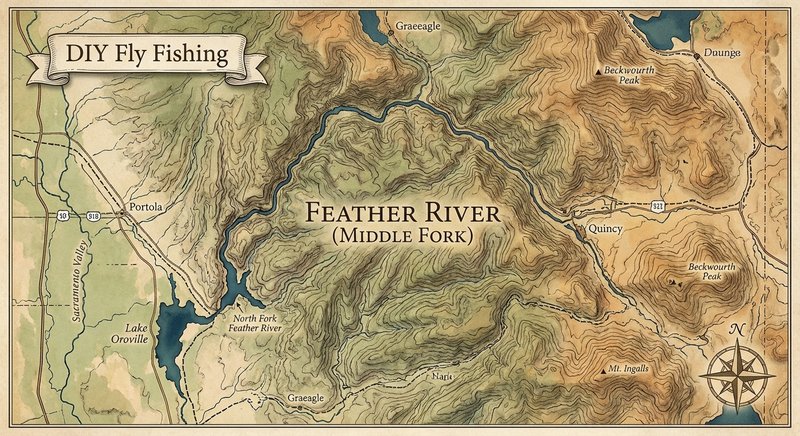
Feather River (Middle Fork)
Fly fishing in California · Advanced · Best seasons: Summer, Fall
Target Species
Rainbow Trout
About This Water
Wild and Scenic River with native rainbow trout. Remote canyon fishing in Plumas National Forest.
Fishing Recommendations
The Middle Fork of the Feather River is one of the crown jewels of the Sierra Nevada. Designated as one of the original eight rivers in the National Wild and Scenic Rivers Act of 1968, it remains one of the few undammed rivers in California. This is a rugged, beautiful, and demanding fishery that rewards the adventurous angler with wild, hard-fighting rainbow trout in a spectacular wilderness setting.
🎣 Location Overview
The Middle Fork of the Feather flows through high alpine meadows near Blairsden and Graeagle before plunging into deep, inaccessible granite canyons on its way toward Lake Oroville.
What makes it special is the diversity of water. You can fish meandering meadow streams in the morning and steep, boulder-choked pocket water in the afternoon. Because there are no dams on this fork, the river breathes with the seasons—heavy runoff in the spring and low, technical water by late summer. Anglers love it for the solitude; once you hike a mile away from the road access points, you are often the only person on the water.
🐟 Target Species & Behavior
- Species: Primarily Wild Rainbow Trout, with occasional Brown Trout (more common in the slower meadow reaches).
- Behavior: These are 100% wild fish. They are smaller on average (8–12 inches) than tailwater fish, but a 16-inch Middle Fork rainbow is a "trophy" that will fight like a fish twice its size.
- Holding Patterns: In the summer, look for fish in "oxygenated water"—the heads of pools, riffles, and behind large boulders. In the fall, they move into deeper runs and the tail-outs of pools as water temperatures drop.
- Feeding: They are opportunistic. Because it is a freestone river with limited nutrients compared to a spring creek, they can't afford to be too picky. If a bug looks natural and the drift is drag-free, they will usually eat.
📅 Best Times to Fish
Summer (Late June – August)
- Conditions: As the snowmelt recedes, the canyon becomes accessible.
- Prime Window: Early morning and the "Golden Hour" before sunset. During the heat of the day (12 PM – 4 PM), fishing can slow down unless you find shaded canyon pockets.
- Why: This is the season of the Dry Fly. High metabolism and high insect activity make for aggressive surface takes.
Fall (September – November)
- Conditions: The water cools, and the scenery turns spectacular with the changing leaves.
- Prime Window: 10 AM to 4 PM. As the mornings get frosty, you don't need to be on the water at dawn.
- Why: The October Caddis hatch. This is arguably the best time for "quality" fish, as larger rainbows gorge themselves before winter.
🪰 Recommended Flies & Techniques
Dry Flies (The Star of the Show)
- Hopper-Dropper: This is the standard summer rig. Use a Parachute Hopper (Size 8-12) or a Chubby Chernobyl as your indicator.
- Specific Patterns:
- Summer: Elk Hair Caddis (14-16), Yellow Humpy (14-16), Parachute Adams (14-18).
- Fall: October Caddis (Size 8-10), Blue Winged Olives (18-20) on cloudy days.
Nymphing
- Technique: "Short-line" or European-style nymphing is incredibly effective in the pocket water.
- Patterns: Bead-head Prince Nymphs (14-16), Pheasant Tails (16-18), and Golden Stonefly nymphs (8-12) to crawl along the bottom of deep holes.
Streamers
- Technique: Swinging a small woolly bugger through deep slots or under overhanging banks.
- Patterns: Olive or Black Woolly Buggers (8-12), Sculpzilla.
💡 Pro Tips & Local Knowledge
- The "Granite Burn": The rocks in the Middle Fork canyon are notoriously slippery. Studded wading boots and a wading staff are not optional—they are safety equipment.
- Go Small for Stealth: In the meadow sections (near Graeagle), the water is slow and clear. Use 5x or 6x fluorocarbon tippet. In the canyon, you can get away with 4x because the broken water hides your line.
- The "A-Zone": Focus on the area between Graeagle and Sloat. It offers a great mix of access and quality water. For the truly adventurous, the hike down from Nelson Point or Penny Pines into the deep canyon is legendary, but requires high physical fitness.
- Shadow Fishing: In the summer, the trout will hug the shadows cast by the canyon walls. If a pool is half-sun and half-shade, 90% of the fish will be in the shade.
⚠️ Important Information
- Access: Much of the river is accessed via the Plumas National Forest. Road conditions can vary; high-clearance vehicles are recommended for canyon access roads.
- Regulations: The Middle Fork has specific regulations that can change. Generally, it is Catch and Release only (barbless hooks) from the Mohawk Bridge downstream to Lake Oroville. Always check the current California Department of Fish and Wildlife (CDFW) regulations before your trip.
- Rattlesnakes: The canyon reaches are prime habitat for Western Rattlesnakes in the summer. Watch your step and your hand placements when scrambling over boulders.
- Wildfire Safety: This region is prone to wildfires in late summer and fall. Always check for forest closures and fire restrictions (especially regarding campfires or smoking).
Guide’s Final Word: The Middle Fork isn't about counting fish or chasing 20-inchers; it’s about the wildness of the experience. Bring a 4-weight rod, a box of dry flies, and plenty of water, and you’ll have one of the best days of fishing California has to offer.
Bug Hatches & Matching Flies
| Hatch | Type | Peak months | Time of day | Hook sizes | Matching flies |
|---|---|---|---|---|---|
| Salmonfly Pteronarcys californica | stonefly | May, June | All day | #4-8 | Rogue River Stone #4-8, Pats Rubber Legs #4-8 |
| Golden Stonefly Hesperoperla pacifica | stonefly | June, July | Morning/Evening | #8-12 | Chubby Chernobyl (Gold) #8-12, Iron Lotus #10-14 |
| Pale Morning Dun (PMD) Ephemerella spp. | mayfly | June, July, August | Late Morning/Afternoon | #14-18 | Sparkle Dun #16-18, Pheasant Tail #14-18 |
| Blue Winged Olive (BWO) Baetis spp. | mayfly | March, April, October, November | Mid-day | #18-22 | RS2 #18-22, Parachute Adams #18-22 |
| Spotted Sedge Hydropsyche spp. | caddis | June, July, August | Evening | #14-16 | Elk Hair Caddis #14-16, LaFontaine's Deep Sparkle Pupa #14-16 |
| October Caddis Dicosmoecus atripes | caddis | September, October | Afternoon/Evening | #8-10 | Stimulator (Orange) #8-10, Peeping Caddis #8-12 |
| Little Yellow Stonefly (Yellow Sally) Isoperla spp. | stonefly | June, July | Afternoon/Evening | #14-16 | Yellow Sally Foam #14-16, Little Yellow Sloan #14-16 |
| Grasshopper Orthoptera | terrestrial | July, August, September | Late Morning/Afternoon | #8-12 | Morrish Hopper #8-12, Parachute Hopper #10-14 |