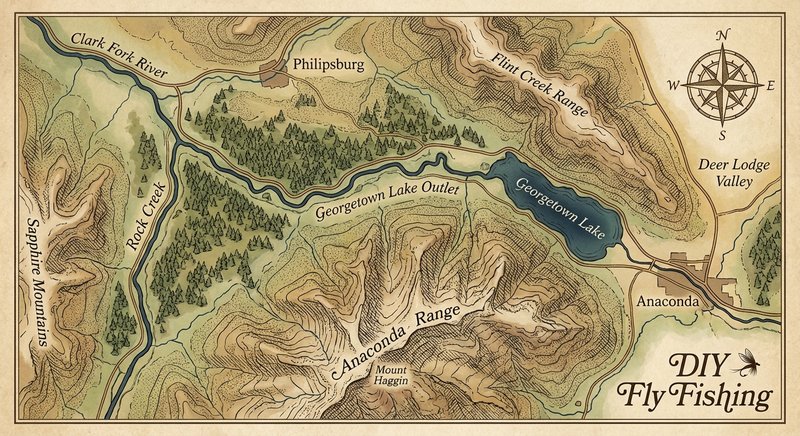
Georgetown Lake Outlet
Fly fishing in Montana · Beginner · Best seasons: Summer, Fall
Target Species
Rainbow Trout, Brook Trout
About This Water
Below Georgetown Lake with wild rainbow and brook trout. Popular fly fishing spot.
Fishing Recommendations
As an expert guide who has spent many seasons navigating the high-country waters of the Treasure State, I can tell you that the Georgetown Lake Outlet—which marks the beginning of Flint Creek—is one of Montana's most unique fisheries.
Sitting at over 6,000 feet in elevation between the Pintler and Sapphire Mountains, this tailwater section offers a distinct experience compared to the sprawling rivers like the Madison or Missouri. It is intimate, challenging, and incredibly rewarding for those who appreciate technical small-water angling.
🎣 Location Overview
The Georgetown Lake Outlet is where the rich, nutrient-dense waters of Georgetown Lake spill over to form the headwaters of Flint Creek. Because it is a tailwater, the water remains relatively cool and stable, even during the heat of mid-summer.
What makes this spot special is the "Nutrient Kick." Georgetown Lake is shallow and incredibly productive, acting like a giant stew of scuds, damselflies, and midges. When these insects and crustaceans wash over the spillway, the trout in the outlet become exceptionally healthy and girthy. The water is characterized by tight bends, deep undercut banks, and glassy tail-outs. It requires a stealthy approach and precise presentations.
🐟 Target Species & Behavior
The outlet is a "quality over quantity" game for Rainbows, while Brook Trout provide constant action.
- Rainbow Trout: These are often "lake-run" fish or residents that have grown fat on the lake's bounty. Expect "footballs"—short, deep-bodied fish with incredible strength. They hold in the deeper oxygenated slots right below the dam and tucked deep under the overhanging willows.
- Brook Trout: You will find stunningly colored Brookies here. They tend to congregate in the slower side pockets and the smaller plunge pools. During the fall, the males turn a fiery orange and become highly aggressive.
- Behavior: These fish are wary. Because the water is often clear and the stream is narrow, they are easily spooked by shadows or heavy footsteps. They are opportunistic but "micro-focused" on specific hatches.
📅 Best Times to Fish
Optimal Seasons
- Summer (July – August): This is prime time. While other Montana rivers might be facing "Hoot Owl" heat restrictions, the high-elevation outlet stays cool. This is the window for peak dry fly action.
- Fall (September – October): My personal favorite. The crowds thin out, the Brook Trout are in their spawning colors, and the Rainbows are aggressively feeding to bulk up for winter.
Best Times of Day
- Morning (8:00 AM – 11:00 AM): Great for nymphing before the sun hits the water.
- Evening (6:00 PM – Dark): The "Magic Hour." Look for massive midge or caddis swarms. The fish will move from the undercuts into the riffles to feed.
🪰 Recommended Flies & Techniques
Top Fly Patterns
- Nymphs:
- Ray Charles (Grey or Pink, size 16-18): A legendary local pattern that mimics the scuds washed down from the lake.
- Zebra Midge (Red or Black, size 18-22): Essential year-round.
- Pheasant Tail (Flashback, size 16-20): Standard tailwater fare.
- Dry Flies:
- Parachute Adams (size 16-20): The gold standard for these picky fish.
- Elk Hair Caddis (Tan, size 14-16): Effective in the summer evenings.
- Hi-Vis Beetle or Ants (size 14-16): Terrestrials are deadly in August when blown off the surrounding meadows.
- Streamers:
- Wooly Bugger (Olive or Thin Mint, size 10-12): Swing these through the deeper pools below the spillway.
Effective Techniques
- Tight-Line Nymphing: Because the water is narrow, a traditional indicator can often spook fish. Use a dry-dropper or a Euro-style nymphing rig to keep the presentation subtle.
- The "Side-Cast": You will often be casting under overhanging willows. Master the side-arm cast to keep your fly low to the water and avoid the "tree trout."
- Stealth Approach: Fish from your knees if you have to. If you can see the fish, they have likely already seen you.
💡 Pro Tips & Local Knowledge
- Focus on the "Bubble Line": In the first 200 yards below the outlet, the fish line up in the foam heart of the current. If your fly isn't in the foam, you aren't fishing.
- The Scut/Crayfish Factor: Don't be afraid to fish a slightly larger soft-shell crayfish pattern in the deeper holes. Big Rainbows in this system love protein.
- Check the Willows: In late summer, the willows are crawling with life. If you see a fish rising tight to the bank, it’s likely taking a terrestrial.
- Wading: The bottom can be "mucky" or filled with slippery bowling-ball-sized rocks. Wading boots with studs or felt (where legal) are highly recommended.
⚠️ Important Information
- Access: Access is generally good near the dam via public pull-offs. However, as you move downstream, be mindful of private property boundaries. Use an app like OnX Maps to ensure you stay in the public high-water mark.
- Regulations: This area falls under the Western District regulations. Check the current Montana FWP (Fish, Wildlife & Parks) regulations, as catch-and-release rules or bait restrictions can change seasonally.
- Bear Safety: You are in Grizzly country. Even though it's near the road, keep your bear spray accessible and be aware of your surroundings, especially when walking through thick willow patches.
- Clean, Drain, Dry: Georgetown Lake has had issues with invasive species in the past. Ensure your gear is thoroughly cleaned before moving to other waters like the Rock Creek or the Clark Fork.
Guide’s Final Word: Bring a 3-weight or 4-weight rod. Anything heavier is overkill for this water and will make your presentations too splashy. Precision beats distance every time at the Georgetown Outlet. Tight lines!
Bug Hatches & Matching Flies
| Hatch | Type | Peak months | Time of day | Hook sizes | Matching flies |
|---|---|---|---|---|---|
| Chironomids Chironomidae | midge | May, June, September | All Day | #12-20 | Ice Cream Cone #14-18, Zebra Midge #16-20, Griffith's Gnat #18-22 |
| Callibaetis Callibaetis nigritus | mayfly | June, July, August | Late Morning/Afternoon | #12-16 | Callibaetis Spinner #14-16, Hare's Ear Nymph #12-16, Quigley Cripple #14-16 |
| Pale Morning Dun Ephemerella excrucians | mayfly | July, August | Late Morning | #14-18 | Sparkle Dun #16-18, Pheasant Tail #14-18, PMD Emerger #16-18 |
| Spotted Sedge Hydropsyche | caddis | July, August | Evening | #12-16 | Elk Hair Caddis #14-16, LaFontaine's Deep Sparkle Pupa #14-16, X-Caddis #14-16 |
| Trico Tricorythodes | mayfly | August, September | Early Morning | #20-24 | Trico Spinner #20-22, RS2 #20-24 |
| Damselfly Enallagma | terrestrial | June, July | Morning/Afternoon | #10-14 | Marabou Damsel Nymph #10-12, Adult Damsel #12-14 |
| Little Olive Stonefly Alloperla | stonefly | June, July | Afternoon/Evening | #14-18 | Yellow Sally #14-16, Copper John (Chartreuse) #16-18 |
| Grasshoppers Acrididae | terrestrial | August, September | Afternoon | #8-12 | Morrish Hopper #10-12, Joe's Hopper #8-12 |