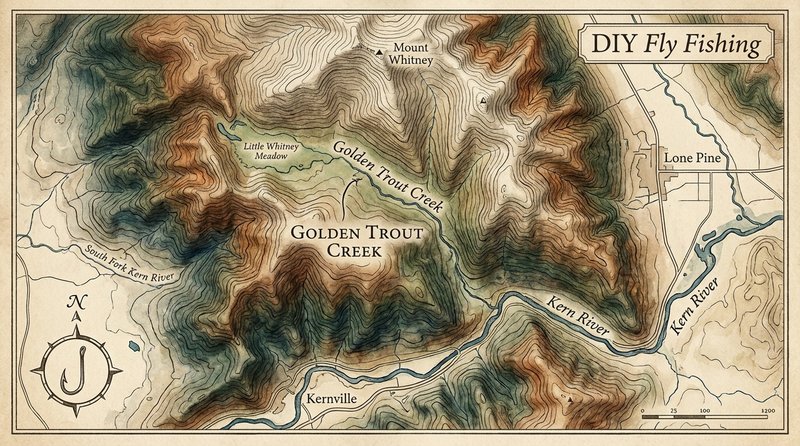
Golden Trout Creek
Fly fishing in California · Advanced · Best seasons: Summer
Target Species
Golden Trout
About This Water
Home of the California state fish. Native golden trout in remote wilderness.
Fishing Recommendations
Welcome to the high country. As your guide, I can tell you that Golden Trout Creek is more than just a fishing destination; it is a pilgrimage. Located in the heart of the Golden Trout Wilderness in the southern Sierra Nevada, this is the ancestral home of the California Golden Trout (Oncorhynchus mykiss aguabonita), the most vibrantly colored trout on the planet.
Here is your comprehensive guide to fly fishing this bucket-list water.
🎣 Location Overview
Golden Trout Creek is a high-altitude stream (sitting between 8,000 and 10,000 feet) that flows through spectacular alpine meadows and volcanic canyons. What makes this water special is its geological history. The creek was isolated from the Kern River by ancient lava flows, allowing the Golden Trout to evolve in isolation for thousands of years, resulting in their brilliant crimson bellies and gold-flaked flanks.
The water is generally small, ranging from 5 to 15 feet wide. It alternates between "meander" sections—slow-moving water snaking through grassy meadows like Tunnel Meadow—and "pocket water" sections where the creek tumbles over granite and volcanic rock. It is crystal clear, cold, and incredibly intimate.
🐟 Target Species & Behavior
The sole focus here is the California Golden Trout.
- Behavior: Because the growing season is so short (only a few months of ice-free water), these fish are generally opportunistic and aggressive feeders. However, they are extremely "spooky." In the thin, clear water of a high-altitude meadow, they can see a silhouette from twenty feet away.
- Holding Spots: In the meadows, look for undercut banks and deep bends. In the steeper sections, they hold in the "cushion" in front of rocks or in the tail-outs of small pools.
- Size: Expect fish in the 6- to 10-inch range. A 12-inch Golden here is a trophy of a lifetime.
📅 Best Times to Fish
- Optimal Season: July through September.
- July: The water is high from snowmelt, and the meadows can be boggy. This is prime time for mosquito hatches (bring heavy-duty repellent).
- August: The "Golden Month." Flows stabilize, the weather is predictable, and the fish are looking up for terrestrials.
- September: The most beautiful time. Nights get cold, but the fish feed heavily to prepare for winter.
- Best Time of Day: 10:00 AM to 4:00 PM. At this elevation, the water needs a few hours of sun to wake up the bug life. There is rarely a need for an "early start" here.
- Conditions: Clear, sunny days are the norm. Watch for "monsoonal" afternoon thunderstorms in August, which can move in quickly.
🪰 Recommended Flies & Techniques
You don't need a massive fly box, but you do need a stealthy presentation.
Top Fly Patterns
- Dry Flies:
- Parachute Adams (Size 16-18): The gold standard for any high Sierra water.
- Royal Wulff or Humpy (Size 14-16): Highly buoyant and easy to see in broken water; these mimic nothing in particular but everything in general.
- Elk Hair Caddis (Size 16): Perfect for the evening "skittering" caddis hatch.
- Ants and Beetles (Size 16-18): In August, terrestrial patterns dropped near undercut banks are deadly.
- Nymphs:
- Gold-Ribbed Hare’s Ear (Size 18): Works well when the sun is high and fish move deeper.
- Pheasant Tail (Size 18-20): Use a bead-head version to get down in the deeper plunge pools.
Techniques
- Dry-Dropper: This is the most effective method. Use a bushy dry fly (like a Humpy) with a small, unweighted nymph tied 12–18 inches below it.
- The "Kneeling" Approach: If you are fishing the meadow sections, stay low. Literally crawl to the bank. If you can see the fish, they have likely already seen you.
- Dapping: In brushy areas, you may simply poke your rod tip through the willows and drop the fly on the surface—often called "dapping."
💡 Pro Tips & Local Knowledge
- Focus on Tunnel Meadow: This is one of the most iconic stretches. The creek meanders significantly here, providing endless undercut banks.
- The "Shadow Rule": Always fish with the sun in your face when possible. If your shadow falls across a pool in Golden Trout Creek, the fishing in that pool is over for the next thirty minutes.
- Light Gear is Key: Leave the 5-weight at home. A 0-weight to 3-weight rod is ideal. A shorter rod (7 to 7.5 feet) helps when navigating the willow-lined banks.
- Color Matching: Interestingly, Goldens in this creek often have a deeper red hue when they live near the volcanic red cinder cones. Match your fly's visibility to the background of the water.
⚠️ Important Information
- Access: This is a backcountry destination. The most common access is from the Horseshoe Meadow Trailhead (near Lone Pine, CA). You will hike over Cottonwood Pass or Trail Pass. Expect a 10- to 15-mile hike one-way to reach the prime sections of the creek.
- Regulations:
- A California Fishing License is required.
- Barbless hooks only.
- Check current CDFW regulations, as most of this drainage is catch-and-release only to protect the pure strain.
- Permits: You MUST have a Wilderness Permit from Inyo National Forest for overnight stays. These are often under a lottery or quota system.
- Safety: You are in bear country. Bear canisters are mandatory for food storage. Also, be aware of Altitude Sickness; give yourself a day in Lone Pine or at the trailhead to acclimate before hiking in.
Guide’s Final Word: Treat these fish like jewels. They are small, fragile, and a state treasure. Wet your hands before touching them, and keep them in the water as much as possible. Tight lines!
Bug Hatches & Matching Flies
| Hatch | Type | Peak months | Time of day | Hook sizes | Matching flies |
|---|---|---|---|---|---|
| Carpenter Ants Camponotus modoc | terrestrial | July, August | All Day | #12-16 | Black Foam Ant #14-16, Carpenter Ant #12-14 |
| Little Yellow Stonefly (Yellow Sally) Isoperla spp. | stonefly | July, August | Late Afternoon/Evening | #14-16 | Yellow Sally #14-16, Iron Lotus #16 |
| Cinnamon Sedge Hydropsyche spp. | caddis | July, August, September | Evening | #14-18 | Elk Hair Caddis (Tan) #14-16, LaFontaine's Deep Sparkle Pupa #16 |
| High Sierra Grasshoppers Melanoplus spp. | terrestrial | August, September | Afternoon | #10-14 | Dave's Hopper #12-14, Parachute Hopper #12-14 |
| Blue Winged Olive Baetis spp. | mayfly | June, September, October | Mid-day | #18-22 | RS2 #20-22, Parachute Adams #18-22 |
| Pale Morning Dun Ephemerella excrucians | mayfly | July, August | Late Morning/Afternoon | #16-18 | PMD Sparkle Dun #16-18, Pheasant Tail Nymph #16-18 |
| Sierra Midges Chironomidae | midge | June, July, August, September | Morning/Evening | #18-24 | Zebra Midge #18-22, Griffith's Gnat #20-22 |
| Golden Stonefly Hesperoperla pacifica | stonefly | June, July | Morning/Evening | #8-12 | Kaufmann's Stimulator (Orange/Yellow) #10-12, Pats Rubber Legs #10-12 |