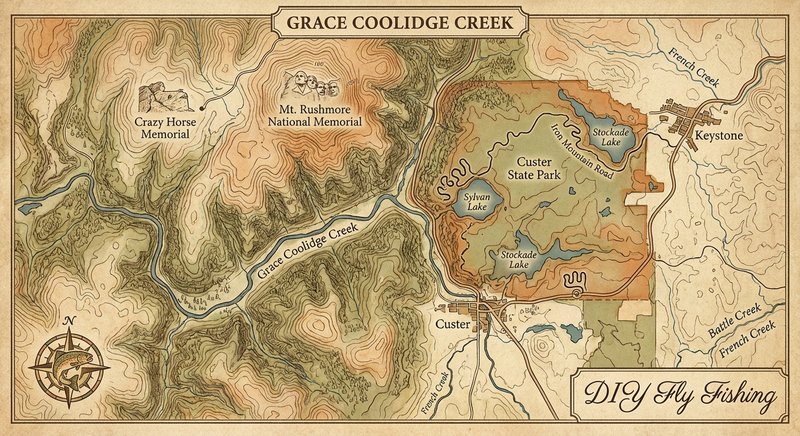
Grace Coolidge Creek
Fly fishing in South Dakota · intermediate · Best seasons: spring, summer, fall
Target Species
Brown Trout
About This Water
Custer State Park stream with wild brown trout. Historic fishing destination.
Fishing Recommendations
Welcome to the Black Hills of South Dakota. As a guide in this region, I can tell you that Grace Coolidge Creek is one of the "crown jewels" of Custer State Park. While many anglers stick to the easily accessible lakes, Grace Coolidge offers a premier small-stream experience for those willing to hike a little.
Here is your comprehensive guide to fishing Grace Coolidge Creek.
🎣 Location Overview
Grace Coolidge Creek is a classic Black Hills mountain stream that flows through a dramatic granite canyon. What makes this water special is the Grace Coolidge Walk-In Area. This is a 6-mile stretch of water accessible only by foot (no motorized vehicles), starting from the Grace Coolidge Campground and ending near Center Lake.
The water is characterized by crystal-clear plunge pools, tight pocket water, and several man-made low-head dams that have created deep, sediment-filled ponds over the decades. It offers a sense of solitude that is rare in such a popular state park. Because of the canyon walls and heavy timber, the water stays cooler here than in many other Black Hills streams, making it a reliable refuge for trout during the heat of summer.
🐟 Target Species & Behavior
The primary resident is the Brown Trout, though you will frequently encounter Brook Trout in the higher reaches and the occasional Rainbow Trout near the stocking points.
- Brown Trout Behavior: The Browns here are wild and wary. In the clear, shallow runs, they are easily spooked by shadows or heavy wading. They favor "the buffet line"—sitting just off the main current in the bubble line.
- Holding Spots: Look for them tucked under the granite undercut banks, behind large boulders in the "cushion," and at the very tail-outs of pools during evening hatches.
- Feeding: They are opportunistic but can become highly selective during a Baetis or Caddis hatch. In the summer, they transition heavily to terrestrial insects falling from the overhanging brush.
📅 Best Times to Fish
- Spring (Late April – June): This is prime time. As the ice clears and the water warms into the 40s and 50s, the fish become aggressive. You’ll see the first major hatches of Blue Winged Olives (BWO).
- Summer (July – August): While other streams might get too warm, the Walk-In Area remains viable. This is the "Terrestrial Window." Focus on the early morning or the "golden hour" before dusk.
- Fall (September – October): My personal favorite. The Brown Trout begin their spawning run and become exceptionally aggressive and territorial. The fall colors in the canyon are spectacular, and the fish take on deep, buttery hues.
- Prime Window: 10:00 AM to 3:00 PM in the spring/fall; 6:00 AM to 10:00 AM and 6:00 PM to dark in the summer.
🪰 Recommended Flies & Techniques
The creek is narrow, so leave your 6-weight at home. A 7.5' to 8.5' 3-weight or 4-weight rod is the perfect tool for the job.
Top Fly Patterns
- Dry Flies: Parachute Adams (#16-20), Elk Hair Caddis (Tan or Olive, #14-18), Stimulators (Orange or Yellow, #12-16).
- Terrestrials: Foam Beetles (#14-16), Dave’s Hopper (#10-12), and Black Ants (#16-18) are essential from July through September.
- Nymphs: Beadhead Pheasant Tails (#16-20), Zebra Midges (Red or Black, #18-22), and Prince Nymphs (#14-16).
- Streamers: Woolly Buggers (Black or Olive, #10-12) worked slowly through the deeper "dam pools."
Effective Techniques
- Dry-Dropper: This is the most effective way to prospect Grace Coolidge. Use a buoyant Stimulator or Hopper as your "indicator" and hang a small Pheasant Tail or Zebra Midge 18-24 inches below it.
- Stealth Casting: Approach pools from downstream. Stay low—sometimes you’ll need to fish from your knees to avoid being silhouetted against the sky.
- The "Dapping" Method: In the thickest brush, you may not be able to cast. Simply poke your rod tip through the branches and drop your fly onto the surface.
💡 Pro Tips & Local Knowledge
- The 2-Mile Rule: Most casual anglers fish within a half-mile of the trailhead. If you hike 2 miles into the Walk-In Area, the fishing pressure drops significantly, and the fish become much less "educated."
- Watch the Shadows: Because the canyon is narrow, the sun hits the water at high angles. If your shadow falls across a pool, the fishing in that hole is done for the next hour.
- Focus on the "Plunge": Where the water tumbles over a rock into a pool, fish the very head of the pool. Browns often sit right in the white water to grab disoriented insects.
- Check the Ponds: The small silty ponds created by the old dams hold the largest fish in the creek. Use a slow-stripped streamer along the edges of the weed beds for a chance at a 14"+ Brown.
⚠️ Important Information
- Access: The main trailhead is located across from the Grace Coolidge Campground on Hwy 16A.
- Permits: You need a valid South Dakota Fishing License. Additionally, since the creek is inside Custer State Park, a Custer State Park Entrance License (daily or annual) is required for your vehicle.
- Regulations: Check the current SD Game, Fish & Parks handbook. Generally, there are no "tackle-only" restrictions on Grace Coolidge, but catch-and-release is highly encouraged to maintain the quality of the fishery.
- Wildlife Safety: This is bison country. It is not uncommon to find a buffalo standing directly on the trail or in the creek. Give them a wide berth (at least 100 yards). Mountain lions also frequent the canyon, so stay aware of your surroundings.
- Wading: The rocks are incredibly slick. Felt soles or studs are highly recommended.
Bug Hatches & Matching Flies
| Hatch | Type | Peak months | Time of day | Hook sizes | Matching flies |
|---|---|---|---|---|---|
| Blue Winged Olive Baetis | mayfly | March, April, September, October | Late Morning/Afternoon | #18-22 | Parachute Adams #18-22, RS2 #20-22, Pheasant Tail #18-20 |
| Grannom Caddis Brachycentrus | caddis | May | Midday/Afternoon | #14-16 | Elk Hair Caddis #14-16, Peacock Caddis #16, Deep Sparkle Pupa #14-16 |
| Pale Morning Dun Ephemerella inconstans | mayfly | June, July | Late Morning/Early Afternoon | #16-18 | PMD Sparkle Dun #16-18, Split Case PMD #16-18, Quigley's PMD Hackle Stacker #16 |
| Yellow Sally Isoperla | stonefly | June, July | Late Afternoon/Evening | #14-16 | Yellow Sally Stimulator #14-16, Iron Lotus #16, Little Yellow Stone Nymph #14-16 |
| Trico Tricorythodes | mayfly | August, September | Early Morning | #20-24 | Trico Spinner #20-24, Sunken Trico Spinner #22, Griffith's Gnat #20-22 |
| Spotted Sedge Hydropsyche | caddis | June, July, August | Evening | #14-18 | Godzilla Caddis #14-16, Soft Hackle Hare's Ear #16, Caddis Green Poopa #14-18 |
| Terrestrials Formicidae / Acrididae | terrestrial | July, August, September | All Day | #10-16 | Cinnamon Ant #16-18, Dave's Hopper #10-14, Foam Beetle #14-16 |
| Midges Chironomidae | midge | January, February, March, December | Midday | #18-24 | Zebra Midge #18-22, Morgan's Midge #20-22, Top Secret Midge #20-22 |