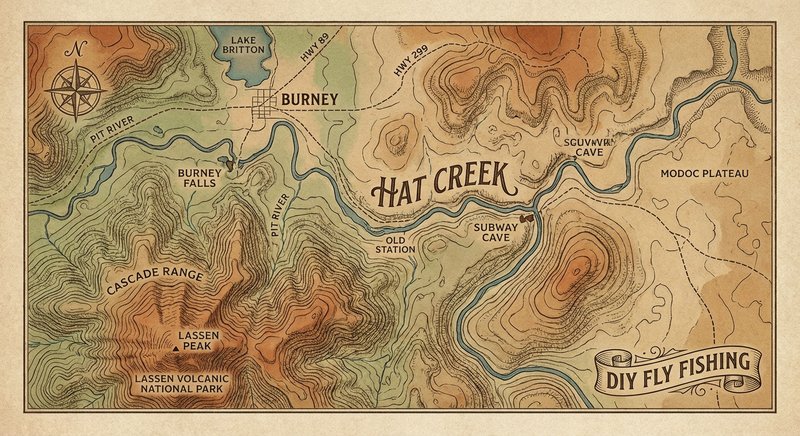
Hat Creek
Fly fishing in California · Advanced · Best seasons: Spring, Summer, Fall
Target Species
Rainbow Trout, Brown Trout
About This Water
A legendary spring creek with technical fishing for wild rainbow trout. Excellent mayfly and caddis hatches.
Fishing Recommendations
Welcome to Hat Creek, one of the most storied and challenging spring creeks in the American West. Located in Northern California’s Shasta County, Hat Creek is often referred to as the "University of Fly Fishing." If you can catch fish here, you can catch them anywhere.
As your guide, I’m going to break down how to tackle the famous 3.5-mile "Wild Trout Section" from Powerhouse #2 down to Lake Britton.
🎣 Location Overview
Hat Creek is a classic low-gradient spring creek. While it originates from snowmelt on Mt. Lassen, the section anglers prize is fed by massive underground springs that keep the water a consistent, chilly temperature year-round.
What makes it special: The water is crystal clear and moves at a deceptive "walking pace." It is characterized by lush aquatic weed beds (Elodea and Ranunculus) that create complex currents and provide incredible habitat for insects. This is technical, "match-the-hatch" fishing at its finest. It’s a place of immense beauty and immense frustration; the fish are highly educated and have Ph.Ds in detecting drag.
🐟 Target Species & Behavior
- Rainbow Trout: These are wild, hard-fighting fish. Because they live in high-oxygen, food-rich water, they are incredibly strong. They typically hold in the "lanes" between weed beds or in the riffles near the Powerhouse.
- Brown Trout: The browns here are legendary and elusive. They tend to hide under the undercut banks or deep in the weed beds during the day, becoming active during low-light periods (dusk and dawn) or during massive hatches.
Behavior: These fish are "surface-oriented" but extremely selective. They will often inspect a fly for several feet before deciding to take or refuse. They are easily spooked by heavy wading or sloppy casting shadows.
📅 Best Times to Fish
- Spring (Late April – June): Opening day (last Saturday in April) is a major event. Late May brings the Salmonfly hatch near the Powerhouse #2 riffle—one of the few times you can use big, bushy dries.
- Summer (July – August): This is the season of the "Trico." Be on the water at dawn for the Trico spinner fall. Evenings offer incredible Caddis activity.
- Fall (September – November): My personal favorite time. The crowds thin out, and the October Caddis and Blue Winged Olives (BWO) become the primary focus. The fish are aggressive, bulking up for winter.
Prime Windows:
- The Morning Trico Fall: 7:00 AM – 10:00 AM.
- The Evening Rise: The last 90 minutes of light is often when the largest fish in the creek come out to play.
🪰 Recommended Flies & Techniques
Top Fly Patterns
- Dry Flies:
- Tricos (Size 22-24): Male and female spinners.
- PMDs (Size 16-18): Sparkle Duns or CDC Honey Ants.
- Caddis (Size 14-18): Elk Hair Caddis or Harrop’s CDC Caddis.
- Blue Winged Olives (Size 18-22): Tilt-wing or Thorax Dun patterns.
- Nymphs:
- Mercer’s Micro Mayfly (Size 18-20): A local staple.
- Zebra Midge (Size 20-22): Black or Red.
- Bird’s Nest (Size 14-16): Great for the swifter riffles.
- Streamers:
- Woolly Buggers (Size 8-10): In olive or black, stripped deeply along undercut banks at night.
Effective Techniques
- The "Reach Cast": This is non-negotiable. You must be able to mend your line in the air to ensure the fly reaches the fish before the fly line does.
- Downstream Dry Fly Presentation: Often, the only way to fool these fish is to stand above them and drift the fly down to them, ensuring they see the fly before the leader.
- 6x and 7x Tippet: You will rarely use 4x or 5x here. Long leaders (12–15 feet) are standard to prevent spooking fish.
💡 Pro Tips & Local Knowledge
- The Carbon Flats: This is the long, glassy stretch. It looks easy to wade, but the silt can be deep. Stay on the edges and move slowly. If you see a "ring" on the water, don't rush. Watch for 5 minutes to determine the fish's feeding rhythm.
- The "Bubble Line": The fish live in the bubble lines. If your fly isn't tracking perfectly in that foam line, you won't get a strike.
- Sight Fishing: Don't just cast blindly. Use high-quality polarized glasses. Walk the banks slowly, look for the white of a mouth opening or the sway of a tail in the weeds.
- The Powerhouse Riffle: If the flat water is too frustrating, head to the top near Powerhouse #2. The broken water is more forgiving, and traditional nymphing techniques work well here.
⚠️ Important Information
- Regulations: The section from Powerhouse #2 to Lake Britton is Catch and Release Only and restricted to Artificial Lures/Flies with Barbless Hooks. Always check the current CDFW regulations before heading out.
- Access: There are well-maintained parking lots at Powerhouse #2 and off Highway 299 at the "Carbon Bridge."
- Safety: The area is volcanic. The "Lava Rock" is extremely sharp and can slice through wading boots and waders. Watch out for rattlesnakes in the tall grass during the summer months.
- Etiquette: Hat Creek is a "gentleman’s/lady's stream." Give other anglers plenty of space. If someone is working a rising fish, do not wade through their pool.
Guide’s Final Word: Hat Creek rewards patience over athletic casting. Slow down, observe the bugs, and treat every cast like it’s the only one you’ll get all day. Tight lines!
Bug Hatches & Matching Flies
| Hatch | Type | Peak months | Time of day | Hook sizes | Matching flies |
|---|---|---|---|---|---|
| Pale Morning Dun (PMD) Ephemerella excrucians | mayfly | June, July | Late Morning to Early Afternoon | #16-18 | Sparkle Dun #16-18, Mercer's Trigger Micro May #16-18, RS2 #16-18 |
| Trico Tricorythodes | mayfly | July, August, September | Early Morning | #20-24 | Trico Spinner #20-24, Zebra Midge #20-22 |
| Blue Winged Olive (BWO) Baetis | mayfly | March, April, October, November | Midday | #18-22 | BWO Parachute #18-22, Pheasant Tail Nymph #18-22, WD-40 #18-22 |
| Spotted Sedge Hydropsyche | caddis | June, July, August | Evening | #14-16 | Elk Hair Caddis #14-16, LaFontaine's Deep Sparkle Pupa #14-16 |
| Salmonfly Pteronarcys californica | stonefly | May, June | All Day | #4-8 | Rogue River Stone #4-8, Pats Rubber Legs #6-8 |
| Midges Chironomidae | midge | January, February, March, December | Morning/Afternoon | #20-26 | Griffith's Gnat #20-24, Black Zebra Midge #20-24 |
| Terrestrials (Ants & Beetles) Formicidae / Coleoptera | terrestrial | August, September | Afternoon | #14-18 | Cinnamon Ant #16-18, Crow Beetle #14-16 |
| Little Western Iron Blue Quill Leptophlebia | mayfly | April, May | Late Morning | #16-18 | Blue Quill Dry #16-18, Dark Hare's Ear #16-18 |