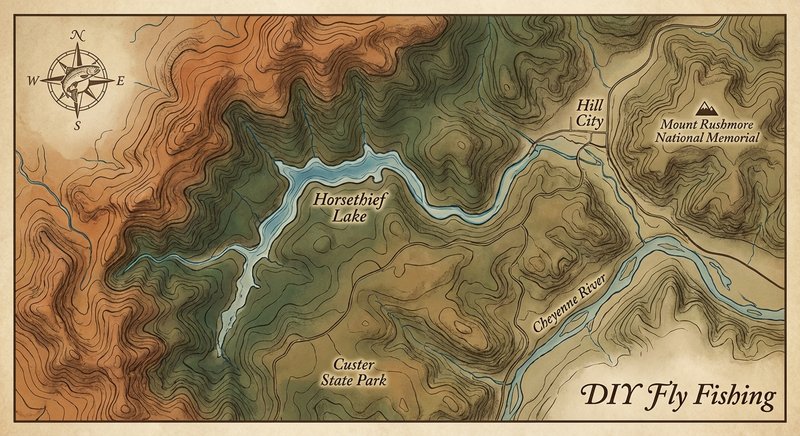
Horsethief Lake
Fly fishing in South Dakota · beginner · Best seasons: spring, summer, fall
Target Species
Rainbow Trout
About This Water
Black Hills lake near Mt. Rushmore. Stocked trout in scenic setting.
Fishing Recommendations
As your guide to the Black Hills, it is a pleasure to break down one of the most scenic stillwater fisheries in South Dakota. Horsethief Lake is a gem nestled in the granite shadows of Mount Rushmore. While it is a popular spot for tourists, for the fly angler, it offers a classic "Black Hills" experience: crystal clear water, rising trout, and dramatic scenery.
Here is your comprehensive guide to fly fishing Horsethief Lake.
🎣 Location Overview
Horsethief Lake is a high-elevation (approx. 5,000 ft) alpine lake located just two miles west of Mount Rushmore National Memorial. What makes it special is the geography—the lake is surrounded by massive granite spires and ponderosa pines, giving it the feel of a high-mountain tarn.
The water is generally clear and cool, though it is relatively shallow (averaging 8–12 feet). Anglers love it because it offers easy access for bank fishing while remaining small enough to cover entirely in a float tube or kayak. It is a "social" lake near the dam and parking lot, but the fingers extending into the canyons offer solitude and technical stalking opportunities.
🐟 Target Species & Behavior
The primary target here is the Rainbow Trout.
- Behavior: The South Dakota Game, Fish & Parks stocks this lake heavily with catchable-sized rainbows. However, because the lake has good oxygen levels and structure, "holdovers" from previous seasons can grow to 14–16 inches and become quite wary.
- Holding Zones: Look for trout cruising the edges of the weed beds and the steep drop-offs near the granite rock faces. In the heat of the day, they retreat to the deeper channel near the dam.
- Feeding: They feed primarily on midges (year-round), Scuds (amphipods), Callibaetis mayflies, and Damselflies. In late summer, terrestrial insects (ants and beetles) falling from the overhanging pines are a major food source.
📅 Best Times to Fish
Optimal Seasons
- Spring (May - June): This is prime time. As the ice melts and the water warms, the trout are highly active. This coincides with the heaviest stocking and the most aggressive feeding.
- Summer (July - August): Early mornings and late evenings are mandatory. The water can get warm in the shallows, pushing fish deep.
- Fall (September - October): My personal favorite. The crowds vanish, and the fish sense the coming winter, feeding aggressively on midges and small streamers.
Prime Windows
- The Golden Hour: The hour before sunset is legendary here. As the wind dies down, the lake often turns into a "mirror," and you will see rings from rising trout across the entire surface.
- Cloudy Days: Overcast skies keep the fish in the shallows longer and make them less "leader shy" in the clear water.
🪰 Recommended Flies & Techniques
Top Fly Patterns
- Nymphs/Larvae:
- Zebra Midge (Red or Black, sizes 18-22): The most consistent producer.
- Gold-Ribbed Hare’s Ear (Size 14-16): Great for mimicking general insect life.
- Ray Charles or Scud patterns (Pink or Orange, size 16): The Black Hills are famous for scuds.
- Dry Flies:
- Parachute Adams (Size 16-20): The best all-around searcher pattern.
- Griffith’s Gnat (Size 18-22): For when they are sipping tiny midges on the film.
- Black Ants or Foam Beetles (Size 14-16): Vital for summer fishing near the banks.
- Streamers:
- Woolly Bugger (Olive or Black, size 10-12): Thin mint or bead-head versions work wonders.
Techniques
- The "Indy" Rig: Suspend a Zebra Midge or a Scud 4–6 feet under a small, sensitive strike indicator. Use a slow, 1-inch twitch every 30 seconds to grab attention.
- Dry-Dropper: In the summer, fish a buoyant beetle pattern with a small midge dropper 2 feet below it. This covers both the surface and the subsurface.
- Slow-Strip Streamers: Cast toward the granite rocks and let the fly sink. Use a very slow, jerky retrieve to mimic a leech or a small minnow.
💡 Pro Tips & Local Knowledge
- The "Back Finger": Most people fish near the dam. If you have a float tube or don't mind a hike, head to the western "fingers" of the lake. The water is shallower here, and the fish are less pressured.
- Go Small and Long: Because the water is so clear, use a long leader (9–12 feet) and fluorocarbon tippet (5X or 6X). Thick nylon leaders will spook the larger holdover trout.
- Watch the Rocks: The granite walls don't just go up; they go down. Trout often cruise inches away from the vertical rock faces underwater, picking off insects clinging to the stone.
- The "Hatch" is a Lie: Sometimes the "rising" fish aren't taking flies on top; they are taking "emergers" just below the surface. If you see rises but can't hook up on a dry fly, grease your leader and fish an unweighted nymph just 6 inches deep.
⚠️ Important Information
- Access: There is a well-maintained parking area and a trail that circles much of the lake. It is part of the Black Hills National Forest.
- Regulations: A valid South Dakota Fishing License is required. You can purchase these online or at fly shops in nearby Hill City or Rapid City.
- Safety: This is mountain lion and mountain goat country. While mountain lions are elusive, be aware of your surroundings if fishing late into the evening.
- Crowds: During the Sturgis Motorcycle Rally (August) and peak tourist season, this area is very loud and busy. If you seek "quiet" wilderness, aim for a mid-week trip in May or September.
Guide’s Final Word: Horsethief Lake isn't where you go to catch a 10lb trophy, but it is where you go for the quintessential Black Hills experience. Bring a 4-weight rod, a box of midges, and your camera—you'll want it for the sunset against the granite spires.
Bug Hatches & Matching Flies
| Hatch | Type | Peak months | Time of day | Hook sizes | Matching flies |
|---|---|---|---|---|---|
| Midges (Chironomids) Chironomidae | midge | April, May, September, October | All Day | #18-24 | Zebra Midge #18-22, Griffith's Gnat #20-22, Chironomid Pupa #16-18 |
| Callibaetis (Speckled Wing Mayfly) Callibaetis spp. | mayfly | June, July, August | Late Morning/Afternoon | #12-16 | Parachute Adams #14-16, Hare's Ear Nymph #14-16, Callibaetis Spinner #16 |
| Damselfly Enallagma spp. | terrestrial | June, July | Morning/Afternoon | #10-14 | Marabou Damsel Nymph #10-12, Adult Blue Damsel #12-14 |
| Freshwater Shrimp (Scuds) Gammarus lacustris | terrestrial | April, May, June | All Day | #14-18 | Ray Charles #16-18, Orange Scud #14-16 |
| Cinnamon Ant Formicidae | terrestrial | July, August, September | Afternoon | #14-18 | Cinnamon Ant #16-18, Transpar-ant #14-16 |
| Traveling Sedge (Caddis) Hesperophylax designatus | caddis | June, July | Evening | #10-14 | Elk Hair Caddis #12-14, Godzilla Caddis #10-12 |
| Water Boatman Corixidae | terrestrial | September, October | Afternoon | #14-16 | Water Boatman #14-16, Prince Nymph #14-16 |
| Dragonfly Nymph Anisoptera | terrestrial | May, June, July | All Day | #6-10 | Olive Wooly Bugger #8-10, Dragon Slayer #6-10 |