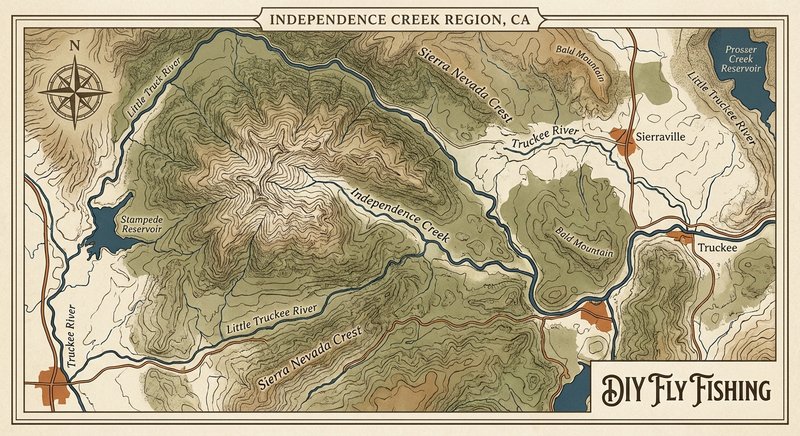
Independence Creek
Fly fishing in California · Intermediate · Best seasons: Summer, Fall
Target Species
Rainbow Trout, Brown Trout
About This Water
Eastern Sierra stream near Independence. Wild trout in remote canyon setting.
Fishing Recommendations
Independence Creek is one of the true gems of California’s Eastern Sierra. Tucked away just south of the town of Independence in Inyo County, this creek represents classic "pocket water" fishing at its finest. While many anglers rush past it on their way to the famous Owens River or Mammoth Lakes, those who stop find a wild, rugged, and rewarding fishery that offers a pure alpine experience.
Here is your comprehensive guide to fly fishing Independence Creek.
🎣 Location Overview
Independence Creek is a high-gradient freestone stream that tumbles down the steep eastern escarpment of the Sierra Nevada. It is characterized by its crystal-clear water, steep drops, and an abundance of granite boulders that create endless pools, plunges, and pocket water.
What makes this creek special is the contrast in environments. The upper sections near Onion Valley (over 9,000 ft) offer a true alpine setting with stunted pines and dramatic peaks, while the lower sections near the desert floor (approx. 4,000 ft) flow through dense riparian willow corridors and cottonwoods. It is a high-energy stream where fish have a short growing season and an aggressive appetite.
🐟 Target Species & Behavior
The creek is primarily home to Rainbow Trout and Brown Trout.
- Rainbow Trout: These are the dominant species in the upper reaches. They are opportunistic and quick to strike. In the faster water, they hold in the "cushion" right in front of large boulders or in the soft seams on the edges of whitewater.
- Brown Trout: More prevalent in the middle and lower sections where the gradient levels out slightly and the undercut banks become more pronounced. These fish are more "skittish" than the rainbows; they prefer the shadows and the deep, slow water under overhanging brush.
- Behavior: Because the water is nutrient-poor and the season is short, these fish are not typically "selective." If your presentation is drag-free, they will usually eat. They feed primarily on caddis larvae, small mayflies, and terrestrial insects that fall from the dense bankside vegetation.
📅 Best Times to Fish
Optimal Seasons
- Summer (Late June – August): This is the prime window. Once the heavy snowmelt (runoff) subsides, the creek becomes fishable. The water remains cold even in the heat of July, and the dry fly action is at its peak.
- Fall (September – October): This is "Guide’s Choice" time. The water levels drop, making the creek easy to wade. The Brown Trout begin moving and feeding aggressively before the winter spawn. The fall colors in the canyon are spectacular.
Best Times of Day
- Summer: Early morning (7 AM – 10 AM) and the "Magic Hour" before sunset. During the heat of the day, fish move into the deeper, aerated pocket water.
- Fall: Mid-day becomes better as the water needs a little sun to warm up and get the bugs moving. 11 AM to 4 PM is the sweet spot.
🪰 Recommended Flies & Techniques
Top Fly Patterns
- Dry Flies:
- Royal Wulff or Royal Coachman (Size 14-16): High visibility is key in the bubbly water.
- Elk Hair Caddis (Tan or Olive, Size 14-18): Matches the prolific local hatches.
- Parachute Adams (Size 16-20): For the slower glides.
- Hopper patterns (Size 10-12): Excellent in late summer near the lower meadows.
- Nymphs:
- Bead-head Pheasant Tail (Size 16-18): A universal producer.
- Hare’s Ear (Size 14-16): Great for mimicking the larger stoneflies found in the rocks.
- Zebra Midge (Black or Red, Size 18-22): For when the fish are being finicky in the pools.
Effective Techniques
- Dry-Dropper Rig: This is the most effective way to fish Independence Creek. Use a buoyant dry fly (like a Stimulator) and hang a small nymph 18–24 inches below it.
- High-Sticking: Due to the conflicting currents, keeping as much fly line off the water as possible is crucial. Use a short line and a long leader to prevent drag.
- Dapping: In the lower sections where willows are thick, you may not be able to cast. Simply poke your rod through the brush and drop the fly on the water.
💡 Pro Tips & Local Knowledge
- The "Shadow Rule": Because the water is so clear, these fish are incredibly spooky. Always fish upstream (approaching from behind the fish) and try to stay off the skyline. If your shadow hits a pool, the fishing there is done for the next 30 minutes.
- The Seven-Cast Rule: In pocket water, if you haven't had a strike in seven well-placed casts, move on. These fish are opportunistic; if they are there and hungry, they will hit quickly.
- Focus on the "Tail-outs": In the evening, fish move from the deep heads of the pools to the shallow tail-outs to intercept drifting insects.
- The Campground Secret: Some of the best-stocked (and surprisingly wild) fishing is found right around the Independence Creek Campground. Don't be afraid to fish the high-pressure areas; most people don't venture more than 100 yards from their campsite.
⚠️ Important Information
Access
- Take Onion Valley Road west out of the town of Independence. This road parallels the creek for several miles, providing numerous pull-outs.
- For a more rugged experience, hike into the John Muir Wilderness from the Onion Valley trailhead at the end of the road.
Regulations & Permits
- General Season: Typically opens the last Saturday in April and closes November 15th.
- Licensing: A valid California Fishing License is required for everyone 16 and older.
- Regulations: Always check the current CDFW Highlands District Regulations, as bait restrictions or barbless hook requirements can change seasonally.
Special Considerations
- Wildlife: This is Black Bear and Mountain Lion country. Store food properly if camping and stay alert.
- Wading: The rocks are incredibly slippery granite. Wading boots with felt or aluminum bars are highly recommended.
- Altitude: You are fishing at high elevations. Stay hydrated and be aware of the signs of altitude sickness.
Bug Hatches & Matching Flies
| Hatch | Type | Peak months | Time of day | Hook sizes | Matching flies |
|---|---|---|---|---|---|
| Blue Winged Olive Baetis spp. | mayfly | March, April, October, November | Midday | #18-22 | Parachute Adams #18-22, RS2 #20-22, Pheasant Tail Nymph #18-20 |
| Golden Stonefly Hesperoperla pacifica | stonefly | June, July | Morning/Evening | #8-12 | Rogue River Stone #8-10, 20 Incher Stone #8-12, Pat's Rubber Legs #8-12 |
| Pale Morning Dun Ephemerella excrucians | mayfly | June, July, August | Late Morning/Afternoon | #14-18 | PMD Sparkle Dun #16-18, Quill Gordon #14-16, Military Mayfly #16-18 |
| Little Yellow Stonefly (Yellow Sally) Isoperla spp. | stonefly | July, August | Afternoon/Evening | #14-16 | Yellow Sally Stimulator #14-16, Iron Lotus #16 |
| Spotted Sedge Hydropsyche spp. | caddis | June, July, August | Evening | #14-18 | Elk Hair Caddis (Tan) #14-18, LaFontaine's Deep Sparkle Pupa #14-16, Holy Grail #16 |
| Zebra Midge Chironomidae | midge | Year-round | All Day | #18-24 | Zebra Midge (Black/Silver) #18-22, Griffith's Gnat #20-22 |
| Grasshoppers Melanoplus spp. | terrestrial | August, September | Afternoon | #10-14 | Dave's Hopper #10-12, Parachute Hopper #12-14 |
| Carpenter Ants Camponotus spp. | terrestrial | May, June | All Day | #12-16 | Black Foam Ant #14-16, Cinnamon Ant #16 |