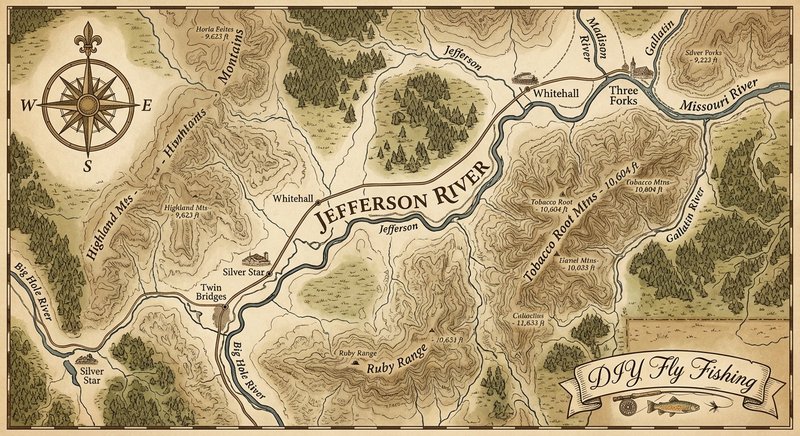
Jefferson River
Fly fishing in Montana · Intermediate · Best seasons: Summer, Fall
Target Species
Brown Trout, Rainbow Trout
About This Water
One of the three forks forming the Missouri. Brown trout fishing in scenic valley setting.
Fishing Recommendations
The Jefferson River, often called "The Jeff" by locals, is the "sleeper" of Montana’s famous trout streams. Formed by the confluence of the Big Hole, Beaverhead, and Ruby Rivers near Twin Bridges, it winds its way through a broad, cottonwood-lined valley until it joins the Madison and Gallatin at Three Forks to form the Missouri.
While it doesn't boast the fish-per-mile counts of the Madison, it is a trophy hunter's river. If you are looking for the fish of a lifetime and don't mind working for it, the Jefferson is your water.
🎣 Location Overview
The Jefferson is a classic meandering Western river characterized by slow-moving water, deep undercut banks, massive log jams, and extensive braided channels. Unlike the rocky, brawling nature of the nearby Gallatin, the Jefferson is a "soft" river with a silty bottom and a heavy reliance on woody debris for cover.
What makes it special is its low pressure. Most anglers bypass the Jeff for the more famous rivers nearby, meaning you can often spend a day on the water without seeing another drift boat. It is a temperamental river—highly sensitive to irrigation drawdowns and water temperatures—but when it’s "on," it produces some of the largest Brown Trout in the state.
🐟 Target Species & Behavior
- Brown Trout: The star of the show. These are predatory, wary, and often huge (20+ inches is common). They live in the dark shadows of "sweepers" (fallen trees) and deep undercuts. They are highly piscivorous, meaning they prefer eating other fish (and crayfish) over small insects.
- Rainbow Trout: Found less frequently than Browns, usually inhabiting the swifter riffles and the heads of islands where the oxygen levels are higher.
- Behavior: Fish here are opportunistic but lazy. They won't move five feet for a tiny mayfly, but they will explode out of a log jam for a large sculpin or a grasshopper.
📅 Best Times to Fish
Summer (Late June – July)
- The Window: Immediately after runoff (usually late June) is prime time. This coincides with the Salmonfly hatch, which can be legendary here.
- Conditions: As July progresses, water temperatures rise. Early morning and late evening are essential.
- Note: Many years, the Jefferson goes under "Hoot Owl" restrictions (no fishing after 2:00 PM) in late July/August due to high water temps.
Fall (September – October)
- The Window: This is arguably the best time to be on the Jeff. As air temperatures drop, the water cools, and the Brown Trout become aggressive ahead of their autumn spawn.
- Conditions: Blue-winged Olive (BWO) hatches occur on cloudy days, but the primary focus is streamer fishing.
🪰 Recommended Flies & Techniques
Streamer Fishing (The Primary Method)
The Jefferson is a streamer fisherman’s paradise. Because the water often has a slight "tea-colored" tint or silt, large profiles and vibrations are key.
- Patterns: Kelly Galloup’s Sex Dungeon (Olive or Black), Sculpzilla, Sparkle Minnow, and JJ Special.
- Technique: "Pounding the banks." Cast as tight to the wood and cut banks as possible. Give the fly aggressive strips to trigger a reaction strike.
Dry Flies
- Salmonflies (Late June/Early July): Large Pteronarcys patterns like the Cat Puke or Sofa Pillow.
- Terrestrials (August/September): Morrish Hoppers, Pink Pookies, and Fat Alberts. The Jefferson valley is hay country; when the wind blows, the hoppers hit the water, and the fishing is electric.
- Tricos/BWOs: In the fall, look for Trico spinners in the morning and BWOs on drizzly afternoons. Use a Parachute Adams or RS2.
Nymphing
- Patterns: Pat’s Rubber Legs (Olive/Brown), San Juan Worms (after a rain), and large Crayfish patterns.
- Technique: Use a strike indicator and fish the "seams" where fast and slow water meet.
💡 Pro Tips & Local Knowledge
- Respect the Wood: On the Jeff, if you aren't losing a few flies to the sunken logs, you aren't fishing where the big fish live. You have to cast into the "scary" spots.
- The Silt Factor: The Jefferson is a "dirty" river. It doesn't need to be crystal clear to fish well. In fact, a little turbidity (6–12 inches of visibility) can make the big Browns feel bold enough to feed in the middle of the day.
- Boat vs. Wade: This is primarily a float fishing river. Wading is difficult due to the muddy bottom and the fact that most of the land surrounding the river is private. A drift boat or raft allows you to cover the miles of "dead water" to find the "pockets of gold."
- The "Big Hole" Effect: If the Big Hole River is flooding or blowing out, the Jefferson will be too. Always check the USGS gauges for both rivers before heading out.
⚠️ Important Information
- Access: Montana has excellent stream access laws, but you must stay below the ordinary high-water mark. Use established Fishing Access Sites (FAS) like Kountz Bridge, Cardwell, or Drouillard.
- Regulations: The Jefferson is generally open year-round, but specific sections have different rules regarding bait and catch-and-release. Always check the current Montana FWP Fishing Regulations.
- Drought Management: The Jefferson is a focal point for conservation. During dry years, local groups may ask anglers to voluntarily stop fishing when flows drop below certain CFS levels to protect the trout. Be a steward of the water and check for local closures.
- Safety: The river is full of "sweepers" and "strainers" (fallen trees). If you are rowing, keep your eyes downstream. The current is deceptive and can push a boat into a log jam quickly.
Bug Hatches & Matching Flies
| Hatch | Type | Peak months | Time of day | Hook sizes | Matching flies |
|---|---|---|---|---|---|
| Midges Chironomidae | midge | February, March, April | Late Morning/Afternoon | #18-24 | Zebra Midge #18-22, Griffith's Gnat #18-22, Morgan's Midge #20-22 |
| Blue-Winged Olive Baetis spp. | mayfly | April, May, September, October | Late Morning/Afternoon | #16-20 | RS2 #18-20, Parachute Adams #16-20, Pheasant Tail #16-18 |
| Mother's Day Caddis Brachycentrus | caddis | May | All Day/Evening | #14-16 | Elk Hair Caddis (Dark) #14-16, Peacock Caddis #14-16, LaFontaine's Deep Sparkle Pupa #14-16 |
| Salmonfly Pteronarcys californica | stonefly | June | All Day | #4-8 | Pats Rubber Legs #4-8, Cat Puke #4-6, Rogue River Stone #6-8 |
| Golden Stonefly Hesperoperla pacifica | stonefly | June, July | Morning/Afternoon | #8-12 | Chubby Chernobyl (Gold) #8-12, Golden Stone Nymph #8-12, Fluttering Stone #10-12 |
| Pale Morning Dun Ephemerella excrucians | mayfly | June, July | Morning/Early Afternoon | #14-18 | PMD Sparkle Dun #16-18, Split Case PMD #16-18, Trigger Finger PMD #16-18 |
| Spotted Sedge Hydropsyche | caddis | July, August | Evening | #14-16 | Godard Caddis #14-16, X-Caddis (Tan) #14-16, Soft Hackle Hare's Ear #14-16 |
| Trico Tricorythodes spp. | mayfly | July, August, September | Early Morning | #20-24 | Trico Spinner #20-24, Sunken Trico Spinner #20-22, Trico Drowned Spinner #22-24 |
| Grasshoppers Orthoptera | terrestrial | July, August, September | Late Morning/Afternoon | #6-12 | Morrish Hopper #8-12, Parachute Hopper #10-12, Thunder Thighs Hopper #8-10 |
| Autumn Willowfly Claassenia sabulosa | stonefly | August, September | Evening | #8-12 | Stimulator (Orange/Yellow) #8-12, 20 Incher Stone #8-12 |