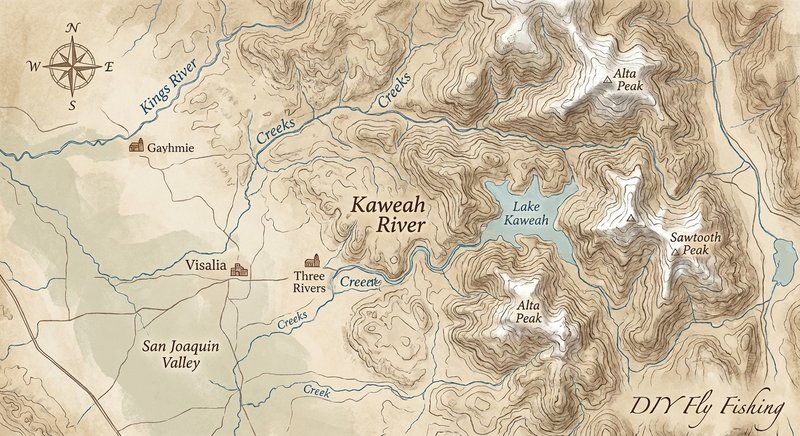
Kaweah River
Fly fishing in California · Beginner · Best seasons: Spring, Summer, Fall
Target Species
Rainbow Trout
About This Water
Below Lake Kaweah with wild rainbow trout. Gateway to Sequoia National Park fishing.
Fishing Recommendations
As an expert guide who has spent years navigating the granite-lined canyons of the Southern Sierra, I can tell you that the Kaweah River is one of California’s most rugged and rewarding gems. Flowing out of Sequoia National Park, this is a quintessential "freestone" river experience. It isn’t about trophy-sized monsters; it’s about wild, vibrant trout in one of the most beautiful settings on Earth.
Here is your comprehensive guide to fly fishing the Kaweah River.
🎣 Location Overview
The Kaweah River is defined by its steep gradient and massive granite boulders. Unlike the slow, meandering meadow streams of the Northern Sierra, the Kaweah is a high-energy river. It is divided into four main forks (North, Middle, East, and South), with the Middle Fork and East Fork being the primary targets for fly anglers.
What makes it special is the "Pocket Water." Because the river drops so quickly, the fish live in tiny pockets of calm water created by boulders. It is technical, physical fishing that requires short, accurate casts and nimble wading. The scenery—towering Giant Sequoias and jagged peaks—is world-class.
🐟 Target Species & Behavior
- Wild Rainbow Trout: The star of the show. These fish are brilliantly colored, often with deep red lateral lines and heavy spotting.
- Brown Trout: Found occasionally in the lower reaches and deeper pools of the Middle Fork.
- Behavior: Due to the cold, nutrient-poor snowmelt and high-velocity water, Kaweah trout are opportunistic feeders. They don’t have the luxury of inspecting a fly for ten minutes; if it looks like food and isn't moving at 20 mph, they will smash it.
- Where they hold: They rarely sit in the main "white water." Look for the "cushion" in front of boulders, the "seams" where fast and slow water meet, and the tail-outs of deep pools at dusk.
📅 Best Times to Fish
The Kaweah is highly dependent on snowpack runoff.
- Spring (Late May – June): This is "high water" season. Fishing can be dangerous and difficult until the peak runoff subsides. Focus on the edges and slower side channels.
- Summer (July – August): Prime Time. As the flows drop, the river becomes wadeable. This is the golden era for dry fly fishing. The water remains cool even when the Central Valley is scorching.
- Fall (September – October): Excellent fishing. The water is lower and crystal clear, requiring a stealthier approach. The fish are aggressive, bulking up for the winter.
- Time of Day: During mid-summer, the morning and evening "magic hours" are best. In the late fall, wait for the sun to hit the water to activate insect life.
🪰 Recommended Flies & Techniques
Top Fly Patterns
- Dry Flies:
- Stimulators (Orange or Yellow, #12-16): Great for imitating stoneflies or grasshoppers.
- Parachute Adams (#14-18): The ultimate "everything" fly for this river.
- Elk Hair Caddis (#14-16): High visibility in broken water.
- Nymphs:
- Prince Nymph (#14-16): The "attractor" fly that always seems to work here.
- Pheasant Tail (#16-18): Perfect for the calmer tail-outs.
- Golden Stonefly Nymphs: Essential for the deeper slots in the Middle Fork.
Effective Techniques
- The "Dry-Dropper": This is the most effective way to fish the Kaweah. Use a high-floating dry (like a Stimulator) and hang a small nymph (like a Bead-head Pheasant Tail) 18–24 inches below it.
- Short Line Nymphing: Because the water is so fast, traditional long-distance casting causes "drag" immediately. Keep your rod tip high and only have a few feet of fly line on the water.
- Stealth: The water is gin-clear. Approach pools from downstream and stay low to avoid casting a shadow over the fish.
💡 Pro Tips & Local Knowledge
- The "Hospital Rock" Stretch: Located on the Middle Fork inside Sequoia National Park. Park at Hospital Rock and hike upstream. The further you hike, the better the fishing gets as the crowds disappear.
- The East Fork (Mineral King Road): If the Middle Fork is too high or warm, head up Mineral King Road. The water is smaller, colder, and the fish are even more eager to take a dry fly.
- Watch the Granite: The granite boulders on the Kaweah are notoriously slippery when wet and can be unstable. Wear felt-soled boots (where legal) or boots with aluminum cleats.
- High-Vis is Key: Because you are fishing broken, bubbly water, use flies with white calf-tail or neon posts. If you can’t see your fly, you can’t set the hook.
⚠️ Important Information
- Access: Much of the best fishing is within Sequoia National Park. You will need to pay the park entrance fee.
- Regulations: Always check the current California Department of Fish and Wildlife (CDFW) regulations. In the National Park, barbless hooks are highly encouraged, and there are specific limits on take (though most dedicated fly anglers practice 100% catch and release here to preserve the wild stocks).
- Safety:
- Rattlesnakes: Common in the lower elevations (Three Rivers area) during summer. Watch your step when scrambling over rocks.
- Water Safety: The Kaweah is a "heavy" river. Never wade deeper than your knees in fast current.
- Permits: A valid California Fishing License is required for anyone 16 or older.
Guide’s Final Word: The Kaweah is a river of "thousand casts." You will work hard for your fish, but when you land a wild Sierra Rainbow in the shadow of a 2,000-year-old tree, you'll realize it's one of the most soulful fly fishing experiences in the West.
Bug Hatches & Matching Flies
| Hatch | Type | Peak months | Time of day | Hook sizes | Matching flies |
|---|---|---|---|---|---|
| Blue Winged Olive (BWO) Baetis spp. | mayfly | March, April, October, November | Late Morning/Afternoon | #16-22 | Parachute Adams #16-20, Pheasant Tail Nymph #18-22, RS2 #18-20 |
| Golden Stonefly Hesperoperla pacifica | stonefly | May, June, July | All Day/Evening | #6-12 | Pat's Rubber Legs #8-12, Chubby Chernobyl #8-12, Golden Rogue Stone #10-12 |
| Yellow Sally Isoperla spp. | stonefly | June, July, August | Late Afternoon/Evening | #14-16 | Yellow Stimulator #14-16, Iron Lotus #14-16, Little Yellow Sloan #16 |
| Mother's Day Caddis Brachycentrus occidentalis | caddis | April, May | Morning/Late Afternoon | #14-16 | Elk Hair Caddis #14-16, Peacock Caddis #16, Holy Grail #14-16 |
| Pale Morning Dun (PMD) Ephemerella excrucians | mayfly | June, July, August | Morning/Early Afternoon | #14-18 | PMD Parachute #16-18, Split Case PMD #16-18, CDC PMD Emerger #16-18 |
| March Brown Rhithrogena morrisoni | mayfly | March, April | Afternoon | #12-14 | March Brown Western Deceiver #12-14, Hare's Ear Nymph #12-14, Soft Hackle March Brown #14 |
| Spotted Sedge Hydropsyche spp. | caddis | July, August, September | Evening | #14-18 | LaFontaine's Deep Sparkle Pupa #14-16, E/C Caddis #16, Mercer's Missing Link #14-18 |
| Carpenter Ant Camponotus spp. | terrestrial | July, August, September | Mid-day/Afternoon | #10-16 | Carpenter Ant #12-14, Chernobyl Ant #10-14, Black Foam Ant #14-16 |