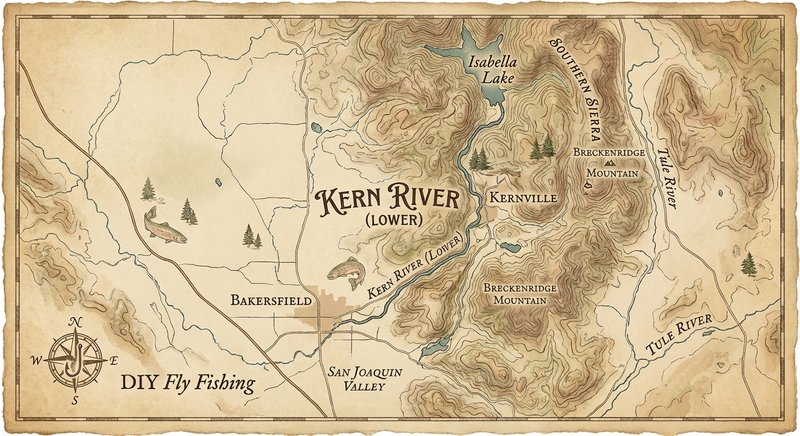
Kern River (Lower)
Fly fishing in California · Beginner · Best seasons: Spring, Summer, Fall, Winter
Target Species
Rainbow Trout
About This Water
Below Lake Isabella tailwater with rainbow trout. Accessible southern Sierra fishing.
Fishing Recommendations
The Lower Kern River, stretching from the outlet of Lake Isabella down through the steep, boulder-strewn Kern Canyon toward Bakersfield, is one of California’s most rugged and rewarding fly fishing destinations. While many anglers flock to the Upper Kern (above the lake), the Lower Kern offers a more "brawling" river experience with heavy pocket water, deep plunge pools, and hard-fighting rainbows.
🎣 Location Overview
The Lower Kern is a high-gradient river characterized by massive granite boulders and swift, powerful currents. Unlike the gentle meadows of the High Sierra, this is "big water" fishing.
What makes it special is the sheer volume of oxygenated pocket water. Because the water is released from the bottom of the Isabella Dam, it stays cooler than you’d expect for the high-desert environment, allowing trout to thrive even when the air temperature hits triple digits. It is a physical river—wading is challenging, but the reward is access to fish that rarely see flies compared to the more accessible roadside spots on the Upper Kern.
🐟 Target Species & Behavior
- Rainbow Trout: The primary target. These fish are exceptionally strong because they spend their lives battling heavy current. You will find both wild "Kern River" strain rainbows and some holdover planters.
- Behavior: In this fast water, trout don't have long to decide. They are opportunistic. They hold in the "soft" spots: behind boulders, in the foam lines, and in the seams where fast water meets slow water.
- Feeding: They keyed in on caddis, stoneflies, and midges. Because of the turbulent water, they rely heavily on their sense of vibration and silhouette.
📅 Best Times to Fish
The Lower Kern is a rare year-round fishery in California, but each season requires a different approach:
- Spring (March – May): Excellent fishing, but highly dependent on dam releases. If the snowmelt is heavy, the river can be dangerously high and unfishable. If flows are stable, the March Brown and Mother’s Day Caddis hatches are legendary.
- Summer (June – August): The canyon gets hot (frequently 100°F+). Fish early mornings and late evenings. The water remains cool near the dam, but further down-canyon, water temps can rise. This is the prime time for "Hopper-Copper-Dropper" rigs.
- Fall (September – November): The Golden Window. Flows stabilize, air temperatures drop, and the fish feed aggressively before winter. October Caddis hatches provide some of the best dry fly action of the year.
- Winter (December – February): A great "low and slow" fishery. While the Upper Kern might be frozen or inaccessible, the Lower Kern remains open. Focus on deep nymphing in the warmer parts of the day (11 AM – 3 PM).
🪰 Recommended Flies & Techniques
Top Fly Patterns
- Nymphs: Perdigons (size 14-18) in purple or olive, Pat’s Rubber Legs (black/tan), Prince Nymphs, and Bead-head Pheasant Tails.
- Dry Flies: Stimulators (orange/yellow), Elk Hair Caddis (size 14-16), Parachute Adams, and the October Caddis (size 8-10) in the fall.
- Streamers: Woolly Buggers (olive/black) and Sculpzilla.
Techniques
- Tight-Line/Euro Nymphing: This is arguably the most effective way to fish the Lower Kern. Because the currents are so complex, traditional indicator rigs often get dragged. A tight-line setup allows you to get heavy flies down into the pockets and maintain contact.
- Short-Line Indicator: If using a bobber, keep your leader short (5–7 feet) to navigate the shallow, rocky pockets without constant snagging.
- Pound the Banks: During summer, trout move to the very edges of the river to escape the heavy center current. Toss big terrestrials (hoppers) right against the granite walls.
💡 Pro Tips & Local Knowledge
- Wading Safety: I cannot stress this enough: The rocks in the Kern are "greased lightning." They are incredibly slippery. Felt soles with tungsten studs are mandatory. A wading staff is not a luxury; it is a necessity.
- The "Flow" Rule: Check the USGS gauges for "Kern River bl Isabella Dam." Ideal fishing flows for wading are between 300 and 700 CFS. Anything over 1,000 CFS becomes dangerous for wading and much harder to fish effectively.
- Look for the "Slack": In such a fast river, trout look for the path of least resistance. Even a 12-inch "bucket" of slower water behind a rock can hold a dozen fish. Don't overlook the tiny pockets.
- The Bridge Strategy: Many anglers fish right near the bridges (Sandy Flat, Democrat). If you hike just 15 minutes away from these access points, the fishing pressure drops to almost zero.
⚠️ Important Information
- Access: Highway 178 runs through the canyon. There are several turnouts and day-use areas (Richbar, Live Oak, Democrat). Some areas require a Forest Service "Adventure Pass" for parking.
- Regulations: The Lower Kern generally follows standard California district regulations, but always check the current CDFW handbook, as specific sections can have different bag limits or gear restrictions (especially near the powerhouse).
- Safety: This is a "Killer Kern" for a reason. The current is stronger than it looks. Never wade deeper than your knees in fast water.
- Cell Service: Virtually non-existent in the canyon. Let someone know where you are going and when you expect to be back.
Guide’s Final Word: The Lower Kern is a "blue-collar" trout stream. It’s tough, it’s hot, and it’s slippery—but the rainbows are among the hardest-fighting fish in the state. Bring your heavy 5-weight or 6-weight rod, stay hydrated, and watch your step!
Bug Hatches & Matching Flies
| Hatch | Type | Peak months | Time of day | Hook sizes | Matching flies |
|---|---|---|---|---|---|
| Blue Winged Olive Baetis | mayfly | February, March, October, November | Late Morning/Afternoon | #18-22 | RS2 #18-22, Parachute Adams #18-22, BWO CDC Emerger #20 |
| Spotted Sedge Hydropsyche | caddis | May, June, September | Evening | #14-18 | Elk Hair Caddis #14-18, Pupa-tator #16, LaFontaine's Deep Sparkle Pupa #14-16 |
| Golden Stonefly Hesperoperla pacifica | stonefly | May, June | Morning/Evening | #6-10 | Pats Rubber Legs #6-10, Rogue River Stone #8-10, Golden 20-Incher #8-12 |
| Trico Tricorythodes | mayfly | July, August, September | Early Morning | #20-24 | Trico Spinner #20-24, Sunken Trico #22 |
| Pale Morning Dun Ephemerella | mayfly | June, July | Late Morning | #16-18 | PMD Sparkle Dun #16-18, Pheasant Tail #16-18, Quigley Cripple #16 |
| Yellow Sally Isoperla | stonefly | June, July | Afternoon/Evening | #14-16 | Yellow Sally Foam #14-16, Iron Sally #14-16 |
| Midge Chironomidae | midge | January, February, December | All Day | #20-26 | Zebra Midge #18-22, Griffith's Gnat #20-24, Top Secret Midge #22-24 |
| Grasshopper Caelifera | terrestrial | August, September | Afternoon | #8-12 | Morrish Hopper #8-12, Dave's Hopper #10-12 |