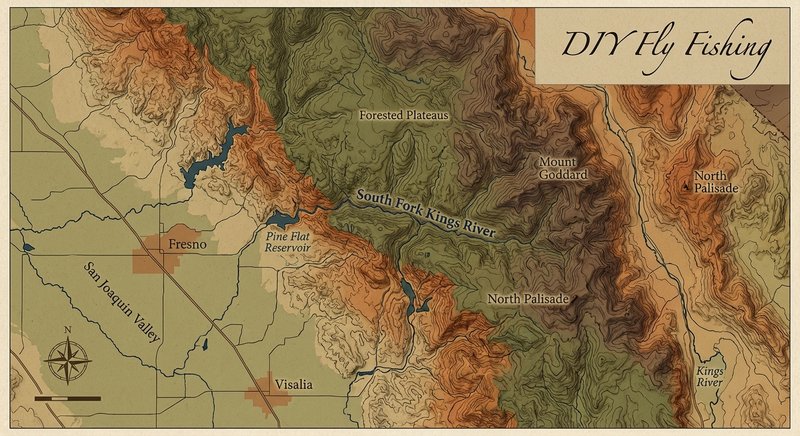
Kings River (South Fork)
Fly fishing in California · Intermediate · Best seasons: Summer, Fall
Target Species
Rainbow Trout, Brown Trout
About This Water
Sierra Nevada freestone with wild rainbow trout. Beautiful canyon fishing near Fresno.
Fishing Recommendations
As a guide who has spent years navigating the granite-carved canyons of the Sierra Nevada, I can tell you that the South Fork of the Kings River is one of the crown jewels of California fly fishing. Located primarily within Kings Canyon National Park and the Sequoia National Forest, it offers a quintessential "High Sierra" experience: crystal-clear water, aggressive wild trout, and scenery that rivals Yosemite but with half the crowds.
Here is your comprehensive guide to fishing the South Fork.
🎣 Location Overview
The South Fork of the Kings is a classic freestone river born from snowmelt high in the wilderness. What makes it special is the diversity of water. In the Cedar Grove area, the river meanders through lush meadows (like Zumwalt Meadow), offering flat, technical water. Above and below the valley floor, the river transforms into a high-gradient staircase of plunges, deep emerald pools, and pocket water choked with massive granite boulders.
Anglers love it because it is a "honest" river. The fish are wild, and while they aren't always giants, they are incredibly beautiful and hard-fighting. It is a place where you can spend all day casting dries to rising fish in the shadows of 3,000-foot cliffs.
🐟 Target Species & Behavior
- Rainbow Trout: These are the primary residents. They are opportunistic and tend to hold in the "fast glass"—the slick water just above a drop-off—or in the bubbly oxygenated water at the head of pools.
- Brown Trout: Found more frequently in the lower reaches and the slower, deeper meadow sections. They are notorious for hiding under "overhangs"—either undercut banks or large granite slabs. They become much more aggressive and territorial as the fall spawn approaches.
- Behavior: Because the growing season is short, these fish are hungry. They aren't usually "PhD" fish like those on the Fall River, but they are wary of poor presentations and heavy wading vibrations in the clear water.
📅 Best Times to Fish
The window for the South Fork is dictated entirely by snowmelt.
- Summer (July – August): This is the prime window. Once the spring runoff subsides (usually by late June or early July), the river becomes fishable. This is "Dry Fly Season."
- Fall (September – October): My personal favorite. The water levels drop and clear significantly, and the Brown Trout begin to move. The air is crisp, the deciduous trees turn gold, and the fish are putting on weight for winter.
- Time of Day: In the heat of summer, the "magic hour" is the last two hours of light when the canyon walls provide shade. In the fall, mid-day fishing is excellent as the water takes longer to warm up.
🪰 Recommended Flies & Techniques
Top Fly Patterns
- Dry Flies:
- Stimulators (Orange or Yellow, #8-12): Perfect for mimicking the Golden Stoneflies found here.
- Parachute Adams (#14-18): The ultimate generalist for any hatch.
- Elk Hair Caddis (#14-16): Tan or Olive; essential for the evening hatch.
- Hoppers/Ants: In August and September, a foam Carpenter Ant or a Dave’s Hopper can be lethal.
- Nymphs:
- Bead-head Pheasant Tail (#16-18): A staple for the slower meadow sections.
- Prince Nymph (#12-14): Great for the heavier, turbulent pocket water.
- Pat’s Rubber Legs: In dark stonefly colors for the deep pools.
Techniques
- Dry-Dropper: This is the most effective way to cover the Kings. Use a high-floating Stimulator as your indicator and hang a small Pheasant Tail or Copper John 18–24 inches below it.
- Pocket Water Picking: In the boulder-strewn sections, don't worry about long casts. Use a "High Sticking" technique, keeping as much line off the water as possible to avoid drag.
- Stealth: The water is exceptionally clear. Wear natural colors (tan/grey/green) and avoid "lining" the fish (casting your fly line directly over their heads).
💡 Pro Tips & Local Knowledge
- Focus on the "Gristle": Many anglers cast into the middle of big pools. I tell my clients to focus on the "gristle"—the turbulent, oxygenated water at the very head of the pool. The biggest rainbows sit right where the whitewater turns into green water.
- The "Shadow Line": Because the canyon is so deep, the sun disappears early. Fish the "shadow line" as it moves across the river; trout feel safer in the shade and will move out from under rocks to feed as soon as the direct sun leaves the water.
- The Cedar Grove "Fly-Only" Stretch: There is a specific stretch from the upstream bridge at Cedar Grove to the mouth of Lewis Creek that is often less pressured by bait anglers (check current CA DFW regs for specific boundaries).
⚠️ Important Information
- Access: Highway 180 (Kings Canyon Scenic Byway) is the only way in. It is a long, winding drive from Fresno. Note: This road usually closes in mid-November and doesn't reopen until late April or May.
- Regulations: You are fishing within a National Park and National Forest. A California fishing license is required. Most of the South Fork is Catch and Release only or has very specific lure/hook restrictions (Barbless hooks are highly recommended and often required). Always check the latest CA Department of Fish and Wildlife (CDFW) "District Regulations" before your trip.
- Safety:
- Bears: This is heavy Black Bear country. Use the lockers at trailheads and never leave food in your car.
- Wading: The granite rocks are slicker than they look. Studded wading boots and a wading staff are highly recommended.
- Rattlesnakes: Be mindful when walking through tall grass or over rock piles near the water.
The South Fork is a place for the soul. Take a moment to look up at the cliffs—the fishing is world-class, but the cathedral you're standing in is even better. Tight lines!
Bug Hatches & Matching Flies
| Hatch | Type | Peak months | Time of day | Hook sizes | Matching flies |
|---|---|---|---|---|---|
| Golden Stonefly Calineuria californica | stonefly | June, July | Morning/Evening | #8-12 | Golden Stimulator #8-12, Kaufmann's Stone #8-10, Pats Rubber Legs #8-12 |
| Pale Morning Dun Ephemerella excrucians | mayfly | July, August | Late Morning/Afternoon | #14-18 | Parachute PMD #16-18, Pheasant Tail Nymph #14-18, PMD Emerger #16-18 |
| Spotted Sedge Hydropsyche | caddis | July, August, September | Evening | #14-18 | Elk Hair Caddis #14-16, LaFontaine's Deep Sparkle Pupa #14-16, Peeping Caddis #14-16 |
| Blue Winged Olive Baetis | mayfly | April, May, October, November | Mid-day | #18-22 | RS2 #20-22, BWO Sparkle Dun #18-20, JujuBaetis #20-22 |
| Little Yellow Stonefly (Yellow Sally) Isoperla | stonefly | July, August | Afternoon/Evening | #14-16 | Yellow Sally Dry #14-16, Little Yellow Sloan #14-16 |
| Giant Salmonfly Pteronarcys californica | stonefly | June | All Day | #4-8 | Rogue Foam Stone #4-8, Bitch Creek Nymph #4-8 |
| Grasshoppers Acrididae | terrestrial | August, September | Late Morning/Afternoon | #8-12 | Dave's Hopper #10-12, Morrish Hopper #8-12 |
| Carpenter Ant Camponotus | terrestrial | July, August | Afternoon | #12-16 | Chernobyl Ant #12-14, Black Foam Ant #14-16 |
| Zebra Midge Chironomidae | midge | All Year | Morning | #18-24 | Zebra Midge #18-22, Griffith's Gnat #20-22 |