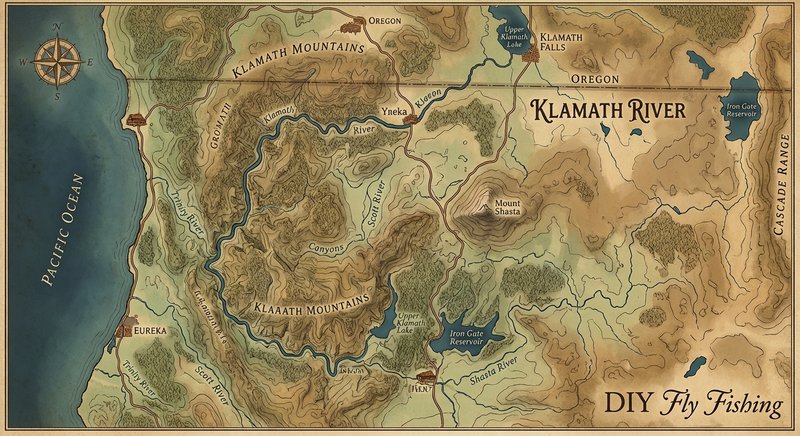
Klamath River
Fly fishing in California · Intermediate · Best seasons: Fall, Winter
Target Species
Steelhead, Chinook Salmon
About This Water
Famous for its steelhead runs. The lower river offers excellent fishing in scenic canyon country.
Fishing Recommendations
The Klamath River is the lifeblood of Northern California’s “Lost Coast” region. Flowing over 250 miles from Oregon to the Pacific Ocean, it is a rugged, powerful, and culturally significant river. For the fly angler, the Klamath is legendary for its prolific runs of "Half-pounder" steelhead and its hard-fighting adult winter steelhead. It is a river of high volume, dark basalt rocks, and deep canyons, offering a truly wild experience.
🎣 Location Overview
The Klamath is unique because of its sheer productivity. Unlike the clear, gin-bright waters of the nearby Smith or Smith-tributaries, the Klamath is often "fishy" looking—slightly turbid with a greenish tint, rich in nutrients.
What makes it special is the "Half-pounder" run. These are immature steelhead (12–16 inches) that return to the river after only a few months at sea. They are incredibly aggressive, travel in large schools, and provide some of the fastest fly-rod action in the West. This is contrasted by the majestic Adult Steelhead (6–12+ lbs) and the massive King (Chinook) Salmon that push through its lower and middle reaches. The scenery is breathtaking, characterized by dense Douglas fir forests, river otters, bald eagles, and the occasional black bear.
🐟 Target Species & Behavior
Steelhead (Summer/Fall & Winter Runs)
- Half-pounders: These fish are unique to the Klamath and Rogue systems. They are extremely aggressive and often hold in faster riffles and "tail-outs." They are not shy and will often chase a swung fly.
- Adults: These fish follow the half-pounders. They tend to hold in the "seams" between fast and slow water, behind large boulders, or in deep ledge holes.
Chinook Salmon (Kings)
- The Klamath hosts significant runs of Fall Chinook. While many fly anglers target steelhead, hooking a 20-30 lb King in the lower river is a heart-pounding reality. They hold in deep pools and the "guts" of runs, moving primarily during low light or rising water.
📅 Best Times to Fish
Fall (September – November)
- Prime Window: This is the "Golden Era" on the Klamath.
- Conditions: The water is warmer, and the half-pounders are everywhere. The weather is generally mild. This is the best time for traditional "swinging" with floating lines or light tips.
Winter (December – February)
- Prime Window: Late December through February.
- Conditions: This is the hunt for the big "Adults." The weather can be brutal (rain and cold), and the river is prone to blowing out. However, when the water is dropping and clearing (the "green drop"), the fishing for large, wild steelhead is world-class.
Best Time of Day
- Low Light: Early morning and late evening are best, especially for salmon and wary adult steelhead.
- Mid-day: On colder winter days, the "bite" often turns on between 11:00 AM and 2:00 PM as the water temperature rises a few degrees.
🪰 Recommended Flies & Techniques
The "Klamath Swing" (Traditional)
The most popular way to fish this river is the down-and-across swing.
- Flies: Silver Hilton, Blue Heron, Green Butt Skunk, and the Klamath Intruder.
- Tip: For half-pounders, use smaller flies (Size 6-10). For adults, go bigger and darker.
Nymphing (High Productivity)
If the swing is slow, indicator nymphing is deadly.
- Flies: Rubber Legs (size 4-8), Copper Johns, Prince Nymphs, and Glow Bugs (egg patterns) during the salmon spawn.
- Technique: Focus on the "seams" and the heads of the pools where oxygen is high.
Streamers & Tips
- In the winter, you must get the fly down. Use T-11 or T-14 sink tips and weighted streamers like Egg Leech patterns or Zonkers in black, blue, or purple.
💡 Pro Tips & Local Knowledge
- Follow the Salmon: In October and November, find the spawning Chinook. Steelhead will sit directly behind the salmon redds, gorging on loose eggs. A well-placed egg pattern (bead) here is almost a guaranteed hookup.
- The "Swing" Speed: The Klamath is a relatively fast river. If your fly is swinging too fast, it will skip over the fish. Use a "mend" immediately after the fly hits the water to sink it, then let it swing slowly through the zone.
- Cover Water: This is a "step-and-cast" river. Cast, swing, step down two feet. Repeat. Don't fall in love with one rock; the fish are often moving as much as you are.
- The "Iron Gate" Factor: The river flow is controlled by the Iron Gate Dam. Check the USGS gauges. If the dam is "pulsing" or releasing high flows, the fishing can be tough.
⚠️ Important Information
Access
- Upper River: High access near Hornbrook and I-5. Good for wading.
- Middle River: Area around Happy Camp and Orleans. Requires more effort but offers more solitude.
- Lower River: Near the town of Klamath. Primarily a boat game (jet boats) due to the size of the water and tribal land restrictions.
Regulations & Permits
- Steelhead Report Card: You must have a California Steelhead Report Card in addition to your fishing license.
- Barbless Hooks: Mandatory for all steelhead fishing in California.
- Wild vs. Hatchery: Many fish are wild; know how to identify a clipped adipose fin. Wild fish must be released immediately.
- Tribal Lands: Respect the Yurok and Karuk tribal lands. Some areas are closed to the public or require specific tribal permits.
Safety
- The Klamath is a powerful river with "heavy" water. Use a wading staff and always wear a wading belt. The rocks are notoriously slippery—studded boots or felt (where legal) are highly recommended.
Bug Hatches & Matching Flies
| Hatch | Type | Peak months | Time of day | Hook sizes | Matching flies |
|---|---|---|---|---|---|
| Salmonfly Pteronarcys californica | stonefly | May, June | Afternoon/Evening | #4-8 | Rogue Foam Stone #4-6, Kauffman's Stone #4-8, Chubby Chernobyl (Orange) #6-8 |
| Golden Stonefly Hesperoperla pacifica | stonefly | June, July | Morning/Evening | #8-12 | Golden Stimulator #8-10, Pat's Rubber Legs #8-12, Norm Wood Special #10 |
| Blue-Winged Olive (BWO) Baetis spp. | mayfly | March, April, October, November | Afternoon | #18-22 | Parachute Adams #18-20, Pheasant Tail Nymph #18-22, RS2 #20-22 |
| October Caddis Dicosmoecus gilvipes | caddis | September, October, November | Afternoon/Evening | #8-12 | Orange Stimulator #8-10, Peeping Caddis #10-12, Morrish October Caddis #8-10 |
| Pale Morning Dun (PMD) Ephemerella spp. | mayfly | June, July, August | Morning/Afternoon | #14-18 | PMD Sparkle Dun #16-18, Quigley Cripple #14-16, Military May #16-18 |
| Spotted Sedge Hydropsyche | caddis | May, June, July, August | Evening | #14-18 | Elk Hair Caddis #14-16, LaFontaine's Deep Sparkle Pupa #14-18, Prince Nymph #12-16 |
| Little Yellow Stonefly (Yellow Sally) Isoperla spp. | stonefly | June, July | Evening | #14-16 | Yellow Stimulator #14-16, Yellow Sally Nymph #14-16, Little Yellow Sloan #16 |
| Green Sedge Rhyacophila | caddis | April, May, June | All Day | #12-16 | Green Weenie #12-14, Caddistrophic Pupa #14-16, Iris Caddis #14-16 |
| Midges Chironomidae | midge | January, February, March, December | Morning/Afternoon | #18-24 | Zebra Midge #18-22, Griffith's Gnat #20-22, Morgan's Midge #20-24 |
| Grasshoppers Orthoptera | terrestrial | July, August, September | Late Morning/Afternoon | #8-12 | Dave's Hopper #8-12, Morrish Hopper #10-12, Parachute Hopper #12 |