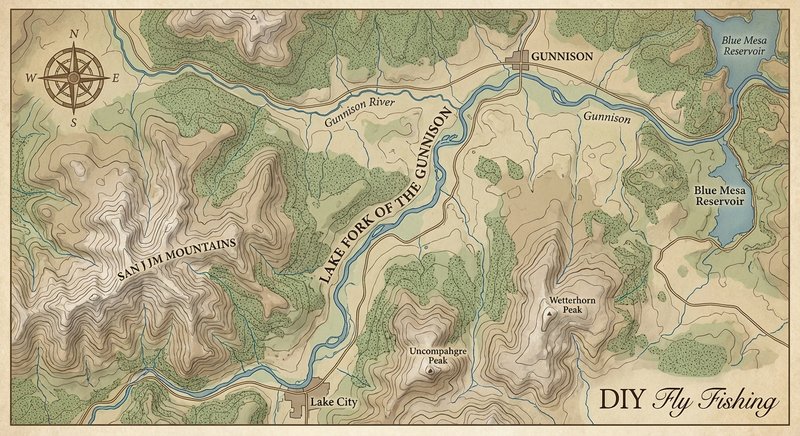
Lake Fork of the Gunnison
Fly fishing in Colorado · Intermediate · Best seasons: Summer, Fall
Target Species
Brown Trout, Rainbow Trout
About This Water
Scenic river near Lake City. Wild brown and rainbow trout with excellent dry fly opportunities.
Fishing Recommendations
The Lake Fork of the Gunnison is one of Colorado’s most underrated freestone gems. While the main stem of the Gunnison gets the international glory, the Lake Fork offers a more intimate, rugged, and diverse experience. Flowing from the high peaks of the San Juan Mountains near Lake City down to Blue Mesa Reservoir, it transitions from a high-alpine meadow stream to a tumbling canyon river.
Here is your guide to mastering the Lake Fork.
🎣 Location Overview
The Lake Fork is a classic "pocket water" river. It is characterized by its steep gradient, crystal-clear water, and a valley floor littered with volcanic boulders. What makes it special is the sheer variety of water: you’ll find slow-moving "S-curves" through willow-lined meadows above Lake San Cristobal, followed by turbulent, high-energy stretches in the "Gate" (a narrow canyon), and finally, broader riffles as it nears the reservoir.
Anglers love the Lake Fork because it feels wilder than the nearby Taylor or Upper Gunnison. It is a dry-fly paradise during the summer and a trophy-hunter’s destination in the fall.
🐟 Target Species & Behavior
- Brown Trout: The dominant species. They are notoriously opportunistic but can be wary in the slower meadow sections. They love "structured" water—look for them tucked tight against undercut banks, behind large mid-river boulders, or in the soft "seams" between fast and slow water.
- Rainbow Trout: Found primarily in the faster riffles and the well-oxygenated "heads" of pools. They are hard-fighting and often more willing to rise to a dry fly than the larger Browns.
- The "Runners": In late summer and fall, massive Brown Trout and Kokanee Salmon migrate up from Blue Mesa Reservoir. These are not your average mountain trout; they are heavy-bodied fish that require stout gear.
📅 Best Times to Fish
Summer (Late June – August)
- Conditions: Post-runoff (usually late June) is the prime window. The water clears, and the fish become hyper-aggressive to compensate for the lean winter months.
- Window: 9:00 AM to 7:00 PM. The Golden Stonefly hatch in early July is legendary.
Fall (September – October)
- Conditions: Low, clear water and golden aspens. This is arguably the most beautiful time to be on the water.
- Window: 10:00 AM to 4:00 PM. As the water cools, the fish concentrate in deeper pools. The Brown Trout become extremely aggressive as they prepare for the spawn.
🪰 Recommended Flies & Techniques
Top Fly Patterns
- Dries:
- Chubby Chernobyl (Size 8-12, Gold or Orange): The gold standard for the Golden Stone hatch.
- Elk Hair Caddis (Size 14-18, Tan): Effective nearly every evening.
- Amy’s Ant (Size 10-14): A great attractor/terrestrial pattern for mid-summer.
- Nymphs:
- Pat’s Rubber Legs (Size 8-12, Coffee/Black): The best "anchor" fly for a two-fly rig.
- Frenchie or Pheasant Tail (Size 14-18): Standard mayfly imitations that work year-round.
- Perdigons (Size 16-18, Flashy): Great for getting deep quickly in fast pocket water.
- Streamers:
- Sex Dungeon or Sculpzilla (Olive or Black): Essential for the big Browns in the fall.
Techniques
- Hopper-Dropper: This is the "bread and butter" of the Lake Fork. Use a buoyant dry fly (like a Chubby) with a weighted nymph 24–30 inches below it. In the pocket water, this allows you to cover two zones of the water column simultaneously.
- High-Sticking: Because the currents are complex, keep as much fly line off the water as possible. Short, accurate casts are more effective than long "hero" casts.
- Streamer Stripping: In the fall, swing streamers through deep holes or strip them aggressively through undercut banks to trigger a territorial strike from a pre-spawn Brown.
💡 Pro Tips & Local Knowledge
- The "Gate" Section: Located north of Lake City, this canyon section is steep and rugged. It requires some light rock scrambling, but the fishing pressure is significantly lower. The fish here are less picky and more numerous.
- Respect the "Private": The Lake Fork has a lot of "checkerboard" property ownership. Use an app like OnX Maps to ensure you are on BLM, National Forest, or public access easements. The locals and landowners are friendly, but they are protective of their water.
- Stealth is Key: By August, the water is low and "glassy." Wear dull-colored clothing (no bright white hats) and avoid splashing as you wade. If you see a fish in the meadows, you should assume it can see you too.
- The "Coke" Factor: If you see Kokanee Salmon (bright red fish) in September, look behind them. Large Brown Trout often sit just downstream of the salmon to feast on drifting eggs. Use a small orange egg pattern for a high success rate.
⚠️ Important Information
- Access: Much of the best water is accessed via Highway 149. There are several well-marked BLM access points between Lake City and Blue Mesa.
- Regulations: Regulations can change by section. Generally, much of the Lake Fork is catch and release only for certain species or has specific bag limits. Always check the current Colorado Parks and Wildlife (CPW) fishing brochure before heading out.
- Wading Safety: The rocks in the Lake Fork are notoriously "greasy" and round. Felt-soled boots or studs are highly recommended, as is a wading staff, especially during the higher flows of early summer.
- Elevation: You are fishing at 8,000 to 9,000 feet. Drink twice as much water as you think you need and wear high-SPF sunscreen, even on cloudy days.
Bug Hatches & Matching Flies
| Hatch | Type | Peak months | Time of day | Hook sizes | Matching flies |
|---|---|---|---|---|---|
| Blue Winged Olive Baetis spp. | mayfly | April, May, September, October | Mid-day | #18-22 | RS2 #20-22, Parachute Adams #18-22, WD-40 #20-22 |
| Salmonfly Pteronarcys californica | stonefly | June, July | All day | #4-8 | Pats Rubber Legs #6-8, Rogue River Stone #4-6, Chubby Chernobyl #6-8 |
| Pale Morning Dun Ephemerella invaria | mayfly | July, August | Late Morning/Afternoon | #16-18 | Pheasant Tail Nymph #16-18, PMD Sparkle Dun #16-18, Parachute PMD #16-18 |
| Golden Stonefly Hesperoperla pacifica | stonefly | July | Morning/Afternoon | #8-12 | 20 Incher Stone #8-12, Golden Chubby #10-12, Yarn Wing Golden Stone #8-10 |
| Green Sedge Hydropsyche spp. | caddis | June, July, August | Evening | #14-18 | Elk Hair Caddis #14-18, LaFontaine's Deep Sparkle Pupa #14-16, Puterbaugh Caddis #16-18 |
| Yellow Sally Isoperla spp. | stonefly | July, August | Afternoon/Evening | #14-16 | Yellow Sally Stimulator #14-16, Iron Sally #14-16 |
| Trico Tricorythodes spp. | mayfly | August, September | Early Morning | #20-24 | Trico Spinner #20-24, Sunken Trico Spinner #22-24 |
| Grasshopper Orthoptera | terrestrial | August, September | Afternoon | #8-14 | Dave's Hopper #10-12, Morrish Hopper #8-12, Amy's Ant #10-14 |
| Midge Chironomidae | midge | January, February, March, December | Late Morning/Early Afternoon | #20-26 | Zebra Midge #20-24, Griffith's Gnat #20-22, Top Secret Midge #22-24 |