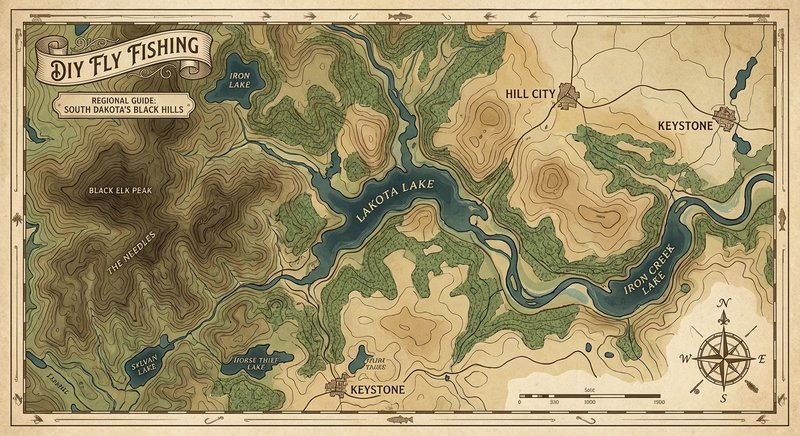
Lakota Lake
Fly fishing in South Dakota · beginner · Best seasons: spring, summer, fall
Target Species
Rainbow Trout
About This Water
Black Hills lake with stocked rainbow trout. Quiet mountain setting.
Fishing Recommendations
Welcome to the Black Hills of South Dakota. As a guide in these parts, I can tell you that Lakota Lake is one of the "hidden gems" of the region. While tourists flock to the nearby Sylvan Lake for the views, serious fly anglers often head to Lakota for a quieter experience and excellent trout fishing.
Here is your comprehensive guide to fly fishing Lakota Lake.
🎣 Location Overview
Lakota Lake is a scenic, 10-acre impoundment located in Custer County, just off the iconic Iron Mountain Road (Hwy 16A). It is nestled in a valley surrounded by towering granite spires and ponderosa pines.
What makes Lakota special is its intimacy and clarity. Unlike the larger reservoirs in the Hills, Lakota feels like a private sanctuary. It is fed by Iron Creek, which keeps the water relatively cool and oxygenated. The lake features a mix of shallow weedy flats, steep rocky drop-offs, and a distinct channel where the creek flows through the center. It is a "no-wake" lake, making it a paradise for float tubers and kayakers.
🐟 Target Species & Behavior
The primary draw here is the Rainbow Trout. The South Dakota Game, Fish & Parks (SDGFP) stocks Lakota regularly, but because of the inlet from Iron Creek, you will also find wild Brown Trout and the occasional Brook Trout that wash down from the high country.
- Cruising Patterns: Rainbows here tend to cruise the "ledge" where the shallow littoral zone drops off into deeper water.
- Feeding Habits: These fish are opportunistic. They key in on heavy midge hatches in the spring, scuds (freshwater shrimp) year-round, and terrestrial insects that fall from the overhanging pines during the summer.
📅 Best Times to Fish
Spring (Late April – June)
This is prime time. As the ice melts, trout move into the shallows to soak up the sun. The midge hatches can be prolific.
- Window: 10:00 AM – 4:00 PM (when the water warms slightly).
Summer (July – August)
The water warms up, and trout head for the deeper center channel or stay near the Iron Creek inlet.
- Window: Dawn and Dusk. Mid-day fishing is tough unless you go deep with a sinking line.
Fall (September – October)
My favorite time. The "leaf peepers" are out, and the trout get aggressive before the lean winter months.
- Window: All day. Overcast days are particularly productive for streamer fishing.
🪰 Recommended Flies & Techniques
Nymphing (The Consistency King)
The most effective way to fish Lakota is under a 1" slip indicator or a "dry-dropper" rig.
- Top Patterns:
- Scuds: Orange or Olive (Size 14-18). Black Hills lakes are crawling with scuds.
- Zebra Midges: Black/Silver or Red/Silver (Size 18-22).
- Pheasant Tail: Natural (Size 16-20).
- Technique: Fish these 4–7 feet under an indicator along the weed lines. Give the line a tiny twitch every 30 seconds to mimic natural movement.
Dry Fly (The Evening Thrill)
When the wind dies down in the evening, the surface will "boil" with rising fish.
- Top Patterns:
- Parachute Adams: (Size 16-20) for general hatches.
- Griffith’s Gnat: (Size 18-22) for midge clusters.
- Terrestrials: Foam Ants or Beetles (Size 14-16) dropped right against the granite walls.
Streamers (For the Big Browns)
- Top Patterns: Woolly Buggers in Olive, Thin Mints, or Pine Squirrel Leeches.
- Technique: Use a slow, rhythmic strip-strip-pause. Let the fly sink near the dam or the deeper rock faces.
💡 Pro Tips & Local Knowledge
- The "Inlet" Secret: The area where Iron Creek enters the lake (the north end) is consistently the best spot. The moving water brings in food and extra oxygen. If the lake is "slow," focus your efforts there.
- Bring a Vessel: While there is a nice trail around the lake, the best water is often just out of reach of a back-cast due to the trees. A float tube, kayak, or canoe is a massive advantage here.
- Stealth Matters: Because the water is so clear, these fish can be spooky. Avoid wearing bright colors, and use long, fine leaders (9ft 5X or 6X fluorocarbon is standard).
- The "Scud Slide": If you are fishing from the bank, cast parallel to the shoreline rather than straight out. Trout cruise the edges; don't wade through the fish you're trying to catch!
⚠️ Important Information
- Access: There is a well-maintained parking lot and a vault toilet at the trailhead. The walk to the water is short and easy.
- Regulations:
- A South Dakota Fishing License is required (available online or at local fly shops in Hill City or Rapid City).
- Standard Black Hills trout limits apply, but please consider Catch and Release to preserve the quality of this small fishery.
- Boating: Electric motors only. No internal combustion engines allowed.
- Wildlife: This is mountain lion and mountain goat country. Keep your eyes peeled, especially if fishing during the low-light "magic hours."
Lakota Lake offers that quintessential Black Hills experience—quiet water, granite peaks, and hungry trout. Tight lines!
Bug Hatches & Matching Flies
| Hatch | Type | Peak months | Time of day | Hook sizes | Matching flies |
|---|---|---|---|---|---|
| Speckled Dun Callibaetis spp. | mayfly | June, July, August | Late Morning/Afternoon | #12-16 | Parachute Adams #14-16, Callibaetis Nymph #12-14, RS2 #16 |
| Chironomids Chironomidae | midge | April, May, September | All Day | #18-24 | Zebra Midge #18-22, Ice Cream Cone #14-18, Griffith's Gnat #20-22 |
| Blue-Winged Olive Baetis spp. | mayfly | May, September, October | Mid-day/Overcast | #18-22 | BWO Sparkle Dun #18-20, Pheasant Tail Nymph #18-22 |
| Damselfly Enallagma spp. | terrestrial | June, July | Morning/Afternoon | #10-14 | Marabou Damsel Nymph #10-12, Adult Damsel #12 |
| Cinnamon Caddis Hydropsyche spp. | caddis | July, August | Evening | #14-16 | Elk Hair Caddis #14-16, LaFontaine's Deep Sparkle Pupa #14-16 |
| Scud Gammarus lacustris | terrestrial | March, April, October | All Day | #12-16 | Ray Charles #14-16, Orange Scud #12-16 |
| Trico Tricorythodes spp. | mayfly | August, September | Early Morning | #20-24 | Trico Spinner #22-24, Sunken Trico Spinner #22 |
| Grasshoppers Melanoplus spp. | terrestrial | August, September | Afternoon/Evening | #8-12 | Dave's Hopper #10-12, Parachute Hopper #10 |