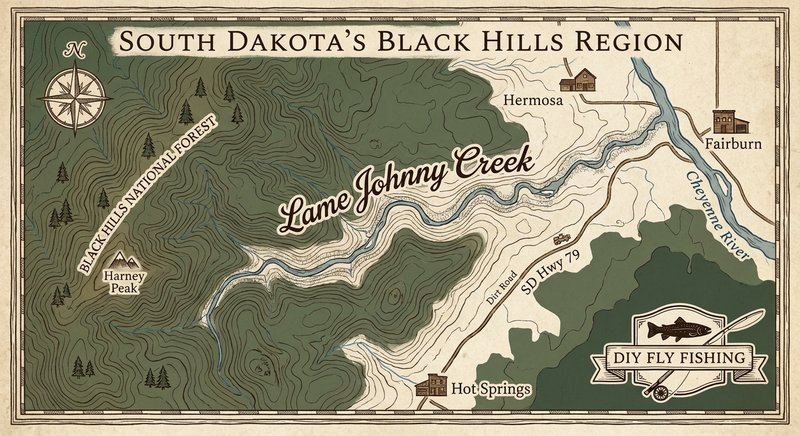
Lame Johnny Creek
Fly fishing in South Dakota · intermediate · Best seasons: spring, summer, fall
Target Species
Brown Trout
About This Water
Black Hills stream with historic name. Wild brown trout in remote valley.
Fishing Recommendations
Lame Johnny Creek is one of the Black Hills' best-kept secrets. Located primarily within the boundaries of Custer State Park, it offers a quintessential "blue-lining" experience for anglers who prefer solitude, wild fish, and intimate water over the crowded banks of more famous tailwaters.
Here is your comprehensive guide to fly fishing Lame Johnny Creek.
🎣 Location Overview
Lame Johnny Creek is a small, high-gradient stream that flows through the rugged ponderosa pine forests and granite outcroppings of the southern Black Hills. Unlike the larger, more manicured sections of Rapid Creek, Lame Johnny is wild, brushy, and often demanding.
What makes it special is its resilience and its "wildness." Following the Legion Lake Fire in 2017, the drainage saw significant changes, but the trout populations have bounced back with vigor. The water is characterized by deep plunge pools, tight undercut banks, and short, bubbly riffles. It is a technical stream where a 20-foot cast is considered "long distance," and stealth is more important than casting prowess.
🐟 Target Species & Behavior
The primary resident is the Wild Brown Trout. You may encounter an occasional Brook Trout in the higher elevations or a stray Rainbow, but the Browns own this water.
- Behavior: These fish are exceptionally "spooky." Because the water is clear and the stream is narrow, they are highly sensitive to shadows and bank vibrations.
- Where they hold: Look for "the darkest water." In Lame Johnny, Browns love to tuck under the thick overhanging grass and root balls. They also sit at the very head of plunge pools, waiting for the current to deliver food.
- Feeding: They are opportunistic. Because nutrient density isn't as high as a spring creek, they can't afford to be too picky, but they will reject a fly if the drift isn't natural.
📅 Best Times to Fish
- Spring (Late April – June): This is the prime window. As the hills green up and water levels rise from snowmelt, the fish become aggressive. This is when you’ll see the best aquatic insect activity.
- Summer (July – August): The water levels drop, and the "Terrestrial Game" begins. This is the most fun time to fish Lame Johnny, using grasshopper and ant patterns. However, watch water temperatures; if the water hits 68°F, give the fish a break.
- Fall (September – October): The Brown Trout begin to color up for the spawn. They become more territorial and aggressive. The cooling air temperatures make for comfortable hiking through the canyons.
- Best Time of Day: During the heat of summer, stick to the early morning (6 AM – 10 AM). In the shoulder seasons, the "banker's hours" (10 AM – 4 PM) are best as the sun warms the water and activates the bugs.
🪰 Recommended Flies & Techniques
Top Fly Patterns
- Dries:
- Elk Hair Caddis (Size 14-18): The gold standard here.
- Parachute Adams (Size 16-20): For picky fish in the flat tails of pools.
- Hi-Vis Ant or Foam Beetle (Size 14-16): Deadly in mid-summer.
- Joe’s Hopper or Morrish Hopper (Size 10-12): For the meadow stretches.
- Nymphs:
- Pheasant Tail (Size 16-18): Imitates almost everything in this creek.
- Gold-Ribbed Hare’s Ear (Size 14-16): Great for the deeper plunge pools.
- Zebra Midge (Red or Black, Size 18-22): For technical winter/early spring fishing.
- Streamers:
- Thin Mint or Black Wooly Bugger (Size 10-12): Jigged through the deeper holes to entice the larger resident Browns.
Techniques & Presentation
- The "Crouch and Crawl": Stay off the skyline. If you can see the fish, they have likely already seen you. Kneel on the bank and cast from a low profile.
- Dapped Presentations: In some areas, the brush is so thick you can't cast. Simply poke your rod tip through the willows and drop your fly on the water.
- Dry-Dropper: This is the most effective setup for Lame Johnny. Use a buoyant dry (like a Stimulator) with a small unweighted Pheasant Tail dropped 12–18 inches below it.
💡 Pro Tips & Local Knowledge
- Gear Up Light: Leave the 9-foot 5-weight at home. A 7’6” 3-weight or 4-weight rod is the perfect tool for these tight quarters. Fiberglass rods are especially fun here because they load quickly with very little line out.
- Focus on the State Park: The stretches within Custer State Park offer the best access. The water near the Lame Johnny trailhead and the sections downstream from the dam are excellent.
- Skip the Waders: In the summer, "wet wading" with quick-dry pants and sturdy wading boots (with studs/felt) is the way to go. You’ll be doing a lot of hiking through brush and over rocks.
- Look for "Pocket Water": Don't just fish the big pools. A Brown Trout can hide in a pocket of water no bigger than a dinner plate if there is enough bubbles/oxygen.
⚠️ Important Information
- Access: Much of Lame Johnny flows through Custer State Park. You will need a Park Entrance License (Daily or Annual).
- Permits: A valid South Dakota Fishing License is required for all anglers 16 and older.
- Bison & Wildlife: This is critical. Custer State Park is home to a massive free-roaming Bison herd. Bison always have the right of way. If a herd is near the creek, move to a different section. Rattlesnakes are also common in the lower, drier elevations of the creek during summer—watch where you step.
- Regulations: Check the current SD Game, Fish & Parks handbook. Lame Johnny is generally under standard Black Hills management, but always verify current creel limits or "catch and release only" designations for specific park zones.
Lame Johnny Creek isn't about trophy sizes—it's about the beauty of the South Dakota landscape and the challenge of fooling a wild fish in a spectacular, rugged setting. Tight lines!
Bug Hatches & Matching Flies
| Hatch | Type | Peak months | Time of day | Hook sizes | Matching flies |
|---|---|---|---|---|---|
| Blue Winged Olive Baetis tricaudatus | mayfly | March, April, October, November | Midday | #18-22 | RS2 #20-22, Parachute Adams #18-22, WD-40 #20-22 |
| Pale Morning Dun Ephemerella excrucians | mayfly | June, July | Late Morning/Afternoon | #16-18 | PMD Sparkle Dun #16-18, Pheasant Tail Nymph #16-18, Trigger Finger PMD #16 |
| Midges Chironomidae | midge | January, February, March, December | All Day | #18-24 | Zebra Midge #18-22, Griffith's Gnat #20-22, Morgan's Midge #20-24 |
| Tan Caddis Hydropsyche | caddis | June, July, August | Evening | #14-18 | Elk Hair Caddis #14-16, LaFontaine's Sparkle Pupa #16-18, Peacock Caddis #16 |
| Little Black Stonefly Capniidae | stonefly | February, March | Afternoon | #16-20 | Black Copper John #16-18, Little Black Sloan #18, Prince Nymph #14-18 |
| Tricos Tricorythodes | mayfly | July, August, September | Early Morning | #20-24 | Trico Spinner #22-24, Sunken Trico #22, Trico Dun #20-22 |
| Yellow Sally Isoperla | stonefly | June, July | Afternoon | #14-16 | Yellow Sally Dry #14-16, Iron Lotus #16, Little Yellow Stimulator #14-16 |
| Terrestrials Melanoplus (Grasshoppers) | terrestrial | July, August, September | Midday/Afternoon | #10-14 | Morrish Hopper #10-12, Black Foam Ant #16-18, Ice Beetle #14-16 |