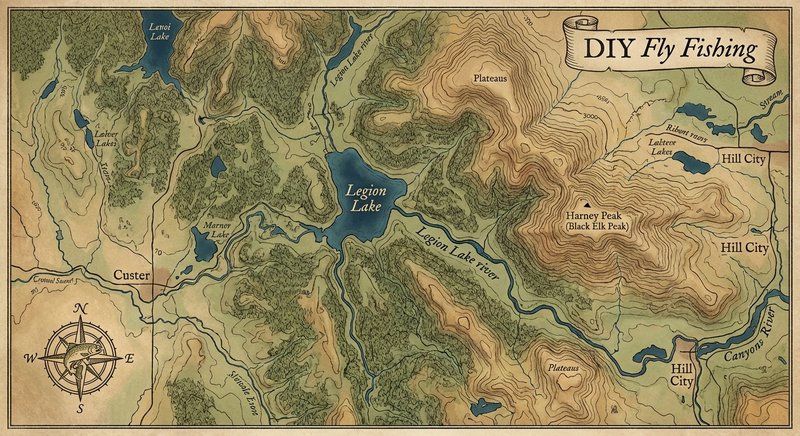
Legion Lake
Fly fishing in South Dakota · beginner · Best seasons: spring, summer, fall
Target Species
Rainbow Trout
About This Water
Custer State Park lake with trout stocking. Historic CCC-era lake.
Fishing Recommendations
Welcome to the Black Hills of South Dakota. As your guide for the day, I’m excited to talk about Legion Lake. Located within the stunning boundaries of Custer State Park, Legion Lake is a gem that offers some of the most accessible yet rewarding stillwater fly fishing in the region.
At roughly 9 acres, it’s a manageable size for any angler, but don't let its modest scale fool you—the granite outcrops and ponderosa pine backdrop provide a majestic setting for chasing high-mountain trout.
🎣 Location Overview
Legion Lake is one of the "crown jewel" lakes of Custer State Park. Formed by a dam built by the Civilian Conservation Corps in the 1930s, it sits at an elevation of about 5,000 feet. What makes it special is the combination of granite "needles" rising directly out of the water and its clarity.
The water is generally clear with moderate weed growth in the shallower bays during the summer. It’s a "diner" lake, meaning it has a high concentration of aquatic insects, making it a prime location for fly anglers who prefer technical matching-the-hatch scenarios over blind casting.
🐟 Target Species & Behavior
The primary target here is the Rainbow Trout.
- Behavior: The South Dakota Game, Fish & Parks (SDGFP) stocks this lake heavily, but because of the high angler pressure, the fish become "educated" quickly. You will find "stockies" that are aggressive, but there are also holdover rainbows that have grown wise and selective.
- Holding Zones: Look for trout cruising the edges of the weed lines or hovering near the shadows cast by the large granite rocks. In the heat of the day, they retreat to the deeper channel near the dam.
- Diet: Their diet consists mainly of midges (year-round), Scuds (Amphipods), Callibaetis mayflies, and Damselflies.
📅 Best Times to Fish
Optimal Seasons
- Spring (May - June): This is the prime window. As the ice melts and the water warms, the fish are incredibly active. The Callibaetis hatches start in late June.
- Summer (July - August): Early mornings and late evenings are mandatory. The water can warm up, so targeting the deeper water near the dam or the shaded rock walls is key.
- Fall (September - October): My personal favorite. The crowds thin out, and the trout feed aggressively to bulk up for winter. The colors of the Black Hills are spectacular during this time.
Best Times of Day
- Dawn & Dusk: The "Magic Hour" is real here. The wind usually dies down, the water turns to glass, and you’ll see rings from rising trout all across the lake.
- Mid-Day: Only effective if there is a breeze (creating a "chop" on the water) or if you are fishing deep with a sinking line.
🪰 Recommended Flies & Techniques
Top Fly Patterns
- Nymphs:
- Zebra Midge (Red or Black, sizes 18-22): A staple for Black Hills stillwater.
- Gold-Ribbed Hare’s Ear (Sizes 14-16): Mimics the various scuds and nymphs.
- Flashback Pheasant Tail (Sizes 16-18): Great for when the Callibaetis are active.
- Dry Flies:
- Parachute Adams (Sizes 16-20): The ultimate "searching" pattern.
- Griffith’s Gnat (Sizes 18-22): Perfect for midge clusters during calm evenings.
- Cinnamon Ant or Foam Beetle: Late summer terrestrials are deadly near the shoreline trees.
- Streamers/Leeches:
- Balanced Leech (Olive or Maroon): Fish this under an indicator.
- Woolly Bugger (Black or Thin Mint, sizes 10-12): Best for active fish near the dam.
Effective Techniques
- The "Indicator Drop": Suspend a Zebra Midge or a Scud 4–6 feet below a small slip-indicator. Cast it near the weed edges and let it sit. Every few minutes, give it a tiny twitch.
- Dry-Dropper: In the summer, use a Hopper or a large Parachute Adams as your "buoy" and hang a small unweighted Pheasant Tail 2 feet below it.
- Stripping Streamers: Using an intermediate sinking line, slow-strip a small leech pattern along the face of the dam.
💡 Pro Tips & Local Knowledge
- The Rock Wall Strategy: Most people fish from the accessible docks or the beach. The real pros focus on the south shoreline, where the granite walls drop steeply into the water. Trout patrol these walls looking for insects falling off the rocks.
- Stealth Matters: Because the water is clear, heavy leaders will spook fish. Drop down to 5X or 6X fluorocarbon tippet for better success.
- Float Tubes: If you have one, use it! Getting 30 yards off the shore allows you to cast back toward the structure that shore anglers can’t reach. It also keeps your backcast away from the trees.
- The "Legion Lake Lodge" Hatch: In the evenings, the lights from the nearby lodge can attract bugs. Fishing the water within sight of the lodge porch can be surprisingly productive at dusk.
⚠️ Important Information
- Access: Very easy. There is a trail that circles the entire lake. Parking is available at the Legion Lake Lodge area.
- Regulations:
- A Custer State Park Entrance License is required for your vehicle.
- A South Dakota Fishing License is required (available online or at many local shops).
- The limit is typically 4 trout per day, but many local fly anglers practice catch and release to maintain the quality of the fishery.
- Special Considerations: This is a multi-use area. Expect hikers, paddle-boaters, and families. If you want solitude, head to the far side of the lake away from the lodge and docks.
- Wildlife: Be "Bison Aware." Custer State Park is home to a massive buffalo herd. It is not uncommon for a bull to wander near the lake shore. Give them at least 100 yards of space.
Tight lines, and enjoy the beauty of the Black Hills!
Bug Hatches & Matching Flies
| Hatch | Type | Peak months | Time of day | Hook sizes | Matching flies |
|---|---|---|---|---|---|
| Chironomids Chironomidae | midge | April, May, June, September | All Day | #16-22 | Zebra Midge #18-20, Ice Cream Cone #16-18, Griffith's Gnat #18-22 |
| Callibaetis Callibaetis ferrugineus | mayfly | June, July, August | Late Morning/Afternoon | #14-16 | Parachute Adams #14-16, Callibaetis Nymph #14-16, RS2 #16 |
| Damselfly Enallagma | terrestrial | June, July | Midday | #10-14 | Marabou Damsel #10-12, Adult Damsel #12-14 |
| Cinnamon Caddis Ceraclea | caddis | July, August | Evening | #14-18 | Elk Hair Caddis #14-16, LaFontaine's Deep Sparkle Pupa #14-16 |
| Black Ants Formicidae | terrestrial | July, August, September | Afternoon | #14-20 | Cinnamon or Black Ant #16-18, Chernobyl Ant #12-14 |
| Water Boatmen Corixidae | terrestrial | September, October | Afternoon | #14-16 | Water Boatman #14-16, Prince Nymph #14-16 |
| Grasshoppers Acrididae | terrestrial | August, September | Late Morning/Afternoon | #8-12 | Dave's Hopper #10-12, Parachute Hopper #10-14 |
| Scuds Gammarus | terrestrial | May, June, October | All Day | #14-18 | Ray Charles #16-18, Gold Ribbed Hare's Ear #14-16 |