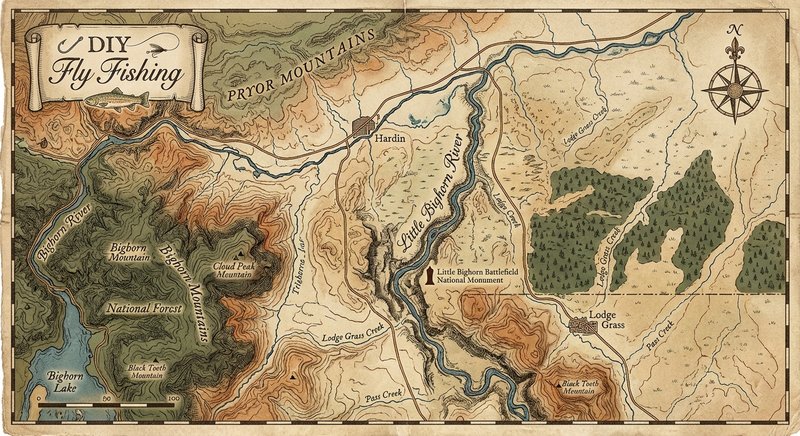
Little Bighorn River
Fly fishing in Montana · Beginner · Best seasons: Summer, Fall
Target Species
Brown Trout, Smallmouth Bass
About This Water
Historic river near Crow Agency with brown trout and smallmouth. Unique fishing destination.
Fishing Recommendations
The Little Bighorn River is one of Montana’s best-kept secrets, often overshadowed by its famous cousin, the Bighorn River at Fort Smith. Flowing out of the Bighorn Mountains of Wyoming and through the Crow Reservation in Montana, it offers a distinct "off-the-beaten-path" experience. Unlike the tailwater conditions of the main Bighorn, the Little Bighorn is a freestone stream that offers high-quality dry fly fishing and a unique transition from cold-water trout habitat to warm-water bass territory.
🎣 Location Overview
The Little Bighorn is a classic, mid-sized meadow stream characterized by tight bends, undercut banks, and gravel runs. It is an intimate river that requires stealth and precision rather than long-distance casting.
What makes it special is the striking transition of ecosystems. In its upper reaches within the Crow Reservation and near the Wyoming border, it is a cold, willow-lined trout stream. As it moves toward the valley floor near Lodge Grass and Crow Agency, the water warms slightly, and the structure changes to deeper holes and rocky ledges—perfect habitat for aggressive Smallmouth Bass. This "double-threat" capability makes it a favorite for anglers who want to catch two very different species in a single day.
🐟 Target Species & Behavior
Brown Trout
- Behavior: The Brownies here are wild and wary. They are notorious for hugging the deep undercut banks and hiding under overhanging willow sweepers.
- Holding Water: Look for "the seam" where fast water meets slow water near the banks. They rarely sit in the middle of the channel during the day unless there is a major hatch.
- Feeding: They are highly opportunistic. In summer, they look for terrestrials (hoppers/ants); in fall, they become aggressive as they prepare for the spawn.
Smallmouth Bass
- Behavior: The Smallmouths in the Little Bighorn are "river bronzebacks"—lean, muscular, and incredibly hard-fighting.
- Holding Water: They prefer the lower reaches where the current slows. Focus on deep pools, large woody debris (sunken logs), and the base of rocky cliffs.
- Feeding: They are predatory. They feed heavily on crayfish and smaller minnows (sculpins or shiners).
📅 Best Times to Fish
Summer (July – August)
- Conditions: This is the prime window for Terrestrial fishing. As the surrounding hayfields are cut, grasshoppers hit the water, leading to explosive surface strikes.
- Best Time of Day: Early morning for trout; mid-afternoon (when the sun is high and water is warmest) for Smallmouth Bass.
Fall (September – October)
- Conditions: The water cools and the Brown Trout begin their pre-spawn aggression. This is the best time for streamer fishing.
- Best Time of Day: 10:00 AM to 4:00 PM. The Blue Winged Olive (BWO) hatches on overcast days in October can be legendary.
🪰 Recommended Flies & Techniques
For Brown Trout
- Dry Flies:
- Terrestrials: Morrish Hopper (Size 8-12), Chernobyl Ant, or Dave’s Hopper.
- Mayflies: Parachute Adams (16-20) or Sparkle Duns for BWO hatches.
- Nymphs:
- Pheasant Tail (16-18), Gold-Ribbed Hare's Ear, or a Pat’s Rubber Legs in coffee/black.
- Technique: "Dapping" or Tight-Lining. Because of the thick brush, you often can't make a traditional backcast. Sneak up to the bank and drop your fly right against the grass.
For Smallmouth Bass
- Streamers:
- Sculpzilla (Olive/Black), Clouser Minnows (Chartreuse/White), and Woolly Buggers.
- Crayfish Patterns:
- Near-Nuff Crayfish or any weighted craw pattern hopped along the bottom.
- Technique: The Swing and Strip. Cast your streamer quartering downstream toward a log-jam, let it sink, and use erratic, short strips to mimic a fleeing baitfish.
💡 Pro Tips & Local Knowledge
- The "Hopper-Dropper" Rig: This is the most effective way to cover the Little Bighorn in August. Run a large foam hopper on top and a small bead-head nymph (like a Copper John) 18-24 inches below it.
- Stealth is Mandatory: The water is often clear. If you can see the fish, they have likely already seen you. Wear earthy tones and avoid "lining" the fish with your fly line.
- Focus on the Bends: The river meanders significantly. The "outside" of every bend usually creates a deep scour hole—this is where the biggest fish of both species live.
- The Smallmouth Transition: If you start catching more Smallmouth than Trout, you are likely in the lower stretches near Wyola or Lodge Grass. If you want more Trout, head further upstream toward the canyon.
⚠️ Important Information
Access & Permits (Crucial)
The Little Bighorn River flows largely through the Crow Indian Reservation.
- Tribal Permit Required: You cannot fish the reservation stretches with just a Montana State Fishing License. You must purchase a Crow Tribal Fishing Permit (available in Hardin or at local fly shops).
- Private Land: Much of the riverbank is private or tribal allotment land. In Montana, you can stay within the "high water mark," but access points are limited. Most anglers access via bridge crossings or public fishing access sites (FAS).
Regulations
- Always check the current Montana FWP regulations and Tribal laws before heading out, as seasons and limits can change annually.
- Catch and Release: While not always mandated by law, it is highly encouraged on this river to preserve the wild genetics of the Brown Trout.
Special Considerations
- Wildlife: This is rattlesnake and bear country. Wear sturdy boots and carry bear spray if you are hiking into the more remote canyon sections.
- Wading: The river bottom can be "greasy" with moss and slick rocks. Wading boots with studs or felt (where legal) and a wading staff are highly recommended.
Bug Hatches & Matching Flies
| Hatch | Type | Peak months | Time of day | Hook sizes | Matching flies |
|---|---|---|---|---|---|
| Blue Winged Olive Baetis spp. | mayfly | April, May, September, October | Midday/Afternoon | #18-22 | RS2 #18-22, BWO Sparkle Dun #18-22, Pheasant Tail #18-20 |
| Pale Morning Dun Ephemerella excrucians | mayfly | June, July | Late Morning/Early Afternoon | #14-18 | PMD Sparkle Dun #16-18, Split Case PMD #16-18, Last Chance Cripple #16-18 |
| Trico Tricorythodes | mayfly | July, August, September | Early Morning | #20-24 | Trico Spinner #20-24, Sunray Trico #22-24 |
| Mother's Day Caddis Brachycentrus occidentalis | caddis | May | All Day | #14-16 | Peacock Caddis #14-16, Soft Hackle Hare's Ear #14-16 |
| Yellow Sally Isoperla spp. | stonefly | June, July | Afternoon/Evening | #12-16 | Little Yellow Sloan #14-16, Yellow Sally Nymph #14-16 |
| Spotted Sedge Hydropsyche | caddis | July, August | Evening | #14-18 | Elk Hair Caddis #14-18, LaFontaine's Deep Sparkle Pupa #14-16 |
| Chironomids / Midges Chironomidae | midge | January, February, March, April | Midday | #18-24 | Zebra Midge #18-22, Griffith's Gnat #20-24 |
| Grasshoppers Acrididae | terrestrial | August, September | Midday/Afternoon | #8-12 | Morrish Hopper #10-12, Rainy's Grand Hopper #8-12 |
| Pale Evening Dun Heptagenia spp. | mayfly | July, August | Evening | #12-16 | Light Cahill #14-16, Hare's Ear Nymph #14-16 |