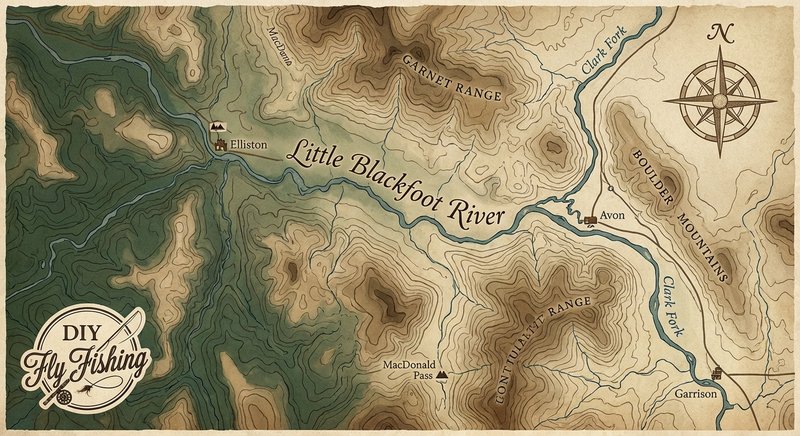
Little Blackfoot River
Fly fishing in Montana · Beginner · Best seasons: Summer, Fall
Target Species
Brown Trout, Rainbow Trout
About This Water
Tributary of the Clark Fork with wild brown and rainbow trout. Less crowded alternative.
Fishing Recommendations
The Little Blackfoot River is one of Montana’s best-kept secrets. While most anglers rush past it on their way to the "Big" Blackfoot or the Missouri, those in the know pull off Highway 12 to find an intimate, high-density trout fishery. It is a classic small-to-medium mountain stream that punches well above its weight class.
🎣 Location Overview
Flowing from the Continental Divide near Boulder and emptying into the Clark Fork at Garrison, the Little Blackfoot offers roughly 40 miles of diverse water. It transitions from a tight, timber-choked mountain creek in its upper reaches to a meandering, willow-lined meadow stream in its lower stretches.
What makes it special is its physicality and intimacy. This isn't a river for drift boats; it’s a wade-fisherman’s paradise. It is characterized by deep undercut banks, dense willow carrs, and technical pocket water. It feels "fishy" at every turn, offering a sense of solitude that is increasingly hard to find in Western Montana.
🐟 Target Species & Behavior
The Little Blackfoot is home to a robust population of Wild Brown Trout and Rainbow Trout, with some Brookies in the higher elevations.
- Brown Trout: These are the kings of the lower and middle river. They are notorious for hugging the undercut banks and hiding under "sweepers" (downed trees). They are opportunistic but wary; they prefer structure and shade.
- Rainbow Trout: Found primarily in the swifter riffles and at the heads of pools. They are aggressive feeders, especially during the Golden Stonefly hatch in early summer.
- Feeding Behavior: Because the river is relatively small, the fish are very "structure-oriented." They don't often sit in the middle of a wide-open flat; they want to be near a bank, a rock, or a log.
📅 Best Times to Fish
While you can fish the Little Blackfoot from spring through fall, the windows you requested are truly the "Golden Hours" of this river.
- Summer (July – August): This is prime time. As the spring runoff recedes (usually by late June), the river becomes a dry-fly factory.
- July: Peak of the Golden Stoneflies and Yellow Sallies.
- August: The "Terrestrial Window." This is when the river truly shines.
- Fall (September – October): As the water cools, the Brown Trout become aggressive and territorial ahead of their spawn.
- Conditions: Crisp mornings and warm afternoons. Low, clear water requires stealth.
- Best Time of Day: In mid-summer, fish the "Trico" hatch at dawn or the "Caddis" blizzard at dusk. In the fall, the 11:00 AM to 4:00 PM window is the most productive as the sun warms the water.
🪰 Recommended Flies & Techniques
Top Fly Patterns
- Dries:
- Chubby Chernobyl (Gold or Olive, Size 10-14) – The ultimate hopper/stonefly imitation.
- Purple Haze (Size 14-18) – A Montana staple that works when nothing else does.
- Elk Hair Caddis (Tan, Size 14-16) – Essential for evening rises.
- Morrish Hopper (Pink or Tan, Size 10-12) – Deadly in August.
- Nymphs:
- Perdigons (Olive or Black, Size 16) – Get deep fast in the pocket water.
- Pat’s Rubber Legs (Tan/Brown) – For the deep holes.
- Streamers:
- Sculpzilla (Olive) or Junior Galloup’s Dungeon. Keep them small to medium.
Techniques
- The Hopper-Dropper: This is the most effective way to fish the Little Blackfoot. Use a high-visibility foam dry (like a Chubby) and hang a small nymph (like a Pheasant Tail or Perdigon) 18–24 inches below it.
- Tight-Line Nymphing: In the canyon sections where the water is swift, Euro-nymphing or short-leash nymphing through the pockets is incredibly productive.
- Bank Bashing: In the meadow sections, cast your hopper within inches of the grassy bank. If you aren't hitting the grass occasionally, you aren't close enough.
💡 Pro Tips & Local Knowledge
- Focus on the "Small" Spots: On the Little Blackfoot, a "pool" might only be the size of a bathtub. Don't walk past them. Some of the biggest Browns live in tiny pockets of slack water behind a single boulder.
- The "Elliston to Garrison" Stretch: This middle-to-lower section has the best public access and the highest concentration of larger Brown trout.
- Stealth is Mandatory: The water is often crystal clear. Wear earthy tones (no bright white shirts) and avoid splashing as you wade. Use the willows as cover to stay out of the fish's line of sight.
- Wade Deeply, Fish Shallow: Don't just stand in the middle and cast. Often, the fish are right against the bank you are standing on. Fish the water near you before stepping into it.
⚠️ Important Information
Access
- Hwy 12: Much of the river parallels Highway 12. Look for FWP (Montana Fish, Wildlife & Parks) fishing access signs.
- Bridge Access: In Montana, you can access the river from any public bridge right-of-way, provided you stay within the high-water marks.
- Private Land: Be respectful. Much of the meadow water flows through private ranches. Stay in the stream bed and do not trespass on the banks above the high-water mark.
Regulations
- License: A valid Montana fishing license, Conservation License, and AIS (Aquatic Invasive Species) Prevention Pass are required.
- Catch & Release: While the Little Blackfoot has standard Central District regulations, I highly recommend catch and release for all wild trout here to maintain the high population density.
Special Considerations
- Moose & Bears: This is Montana. Moose love the willow bottoms of the Little Blackfoot, and Black Bears (as well as the occasional Grizzly) frequent the corridor. Carry bear spray and make noise if you are walking through thick brush.
- Water Temps: In late August, keep an eye on water temperatures. If the water hits 70°F, stop fishing to protect the trout from heat stress (Hoot Owl restrictions may apply).
Bug Hatches & Matching Flies
| Hatch | Type | Peak months | Time of day | Hook sizes | Matching flies |
|---|---|---|---|---|---|
| Blue Winged Olive Baetis spp. | mayfly | April, May, September, October | Late Morning/Afternoon | #16-20 | Parachute Adams #16-20, RS2 #18-20, Pheasant Tail #16-20 |
| Salmonfly Pteronarcys californica | stonefly | June | All Day | #4-8 | Rogue River Stone #4-8, Pats Rubber Legs #4-8, Cat Puke #6 |
| Golden Stonefly Hesperoperla pacifica | stonefly | June, July | Morning/Afternoon | #8-12 | Chubby Chernobyl (Gold) #8-12, Golden Twenty Incher #10-12 |
| Pale Morning Dun Ephemerella excrucians | mayfly | June, July, August | Late Morning | #14-18 | Sparkle Dun #16-18, Split Case PMD #14-16, Quigley Cripple #16 |
| Grannom Caddis Brachycentrus occidentalis | caddis | May | All Day/Evening | #14-16 | Elk Hair Caddis #14-16, LaFontaine's Deep Sparkle Pupa #14-16 |
| Yellow Sally Isoperla spp. | stonefly | July, August | Afternoon/Evening | #14-16 | Little Yellow Sloan #14-16, Yellow Sally Nymph #14-16 |
| Trico Tricorythodes spp. | mayfly | August, September | Early Morning | #20-24 | Trico Spinner #20-24, Sunken Trico Spinner #22 |
| Grasshoppers Orthoptera | terrestrial | August, September | Mid-day/Afternoon | #8-12 | Morrish Hopper #8-12, Parachute Hopper #10-12 |