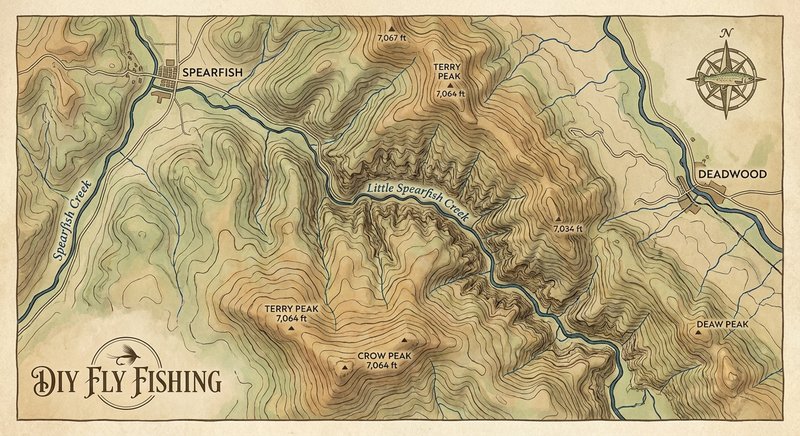
Little Spearfish Creek
Fly fishing in South Dakota · advanced · Best seasons: spring, summer, fall
Target Species
Brook Trout
About This Water
Tributary with wild brook trout. Small stream in Spearfish Canyon.
Fishing Recommendations
As an expert guide in the Black Hills, I can tell you that Little Spearfish Creek is one of the most enchanting small-stream experiences in South Dakota. While many anglers flock to the main stem of Spearfish Creek, "Little Spearfish" offers a more intimate, technical, and visually stunning experience for those who love chasing wild Brook Trout in a canyon setting.
🎣 Location Overview
Little Spearfish Creek is a tributary to the main Spearfish Creek, located near the town of Savoy in the northern Black Hills. It flows through a dramatic limestone canyon characterized by towering cliffs, ponderosa pines, and lush undergrowth.
The water is remarkably clear and remains cold year-round due to spring influences. It is a classic "pocket water" stream, filled with small plunge pools, riffles, and fallen timber. What makes it special is the scenery—passing landmarks like Roughlock Falls—and the fact that it feels much more "wild" than the roadside stretches of the main creek. It is the quintessential "blue line" for anglers who prefer 3-weight rods and stealth over long-distance casting.
🐟 Target Species & Behavior
The primary resident is the Brook Trout. While there are occasional Brown Trout that migrate up from the main creek, this is a Brookie stronghold.
- Behavior: These fish are wild and highly opportunistic, but because the water is gin-clear, they are incredibly "spooky." If they see your shadow or the flash of your rod, the hole is done.
- Holding Patterns: Look for them in the "cushion" in front of boulders, in the deep undercut banks, and right at the tail-outs of the small plunge pools. In the heat of summer, they will sit right in the fastest, oxygenated water.
- Diet: Their diet consists mainly of small aquatic insects (caddis and midges), but they are famous for their love of terrestrials during the summer months.
📅 Best Times to Fish
- Spring (May - June): This is when the canyon wakes up. Water levels are higher but rarely "blown out" because of the forest canopy and limestone geology. This is prime time for nymphing and the start of the early caddis hatches.
- Summer (July - August): The "Golden Age" on Little Spearfish. While other area streams might get too warm, the spring-fed nature of this creek keeps it cool. This is peak dry-fly and terrestrial season.
- Fall (September - October): My personal favorite. The Brook Trout take on their brilliant spawning colors (vibrant oranges and reds). They become more aggressive as they prepare for the spawn. Note: Please watch your step and avoid walking on "redds" (spawning beds) in late October.
- Time of Day: In the heat of summer, early morning and late evening are best. In the shoulder seasons (Spring/Fall), the mid-day sun warms the water enough to trigger insect activity.
🪰 Recommended Flies & Techniques
Top Fly Patterns
- Dries:
- Elk Hair Caddis (Size 14-18) – The gold standard here.
- Parachute Adams (Size 16-22) – For technical drifts in slower pools.
- Hi-Vis Ant or Beetle (Size 14-16) – Essential for summer.
- Royal Wulff (Size 14-16) – Great for the "choppy" plunge pools.
- Nymphs:
- Bead-head Pheasant Tail (Size 16-20) – Works year-round.
- Zebra Midge (Size 18-22) – Black or Red; lethal in the winter and early spring.
- Gold Ribbed Hare’s Ear (Size 16).
- Streamers:
- Micro Wooly Bugger (Size 10-12) in Olive or Black. Swing these through the deeper holes near the falls.
Techniques & Presentation
- The Dry-Dropper: This is the most effective way to fish Little Spearfish. Use a buoyant dry (like a Stimulator or Hopper) and hang a small Pheasant Tail about 18 inches below it.
- Dapping: Because the brush is thick, you often won't "cast" in the traditional sense. You’ll be poking your rod tip through the willows and dropping the fly vertically into the pockets.
- Short Leaders: Use a 7.5-foot leader. A standard 9-foot leader is often too long for these tight quarters.
💡 Pro Tips & Local Knowledge
- Stealth is Everything: I cannot stress this enough. Wear earthy colors (tans and greens) and move upstream. If you fish downstream, you will send silt and "warnings" to every fish in the creek. Kneel before you reach the bank.
- The "Roughlock" Hike: Park at the Roughlock Falls trailhead and hike above the falls. The fishing pressure drops significantly the further you walk from the parking lot.
- Downsized Gear: Leave your 5-weight at home. A 2-weight or 3-weight rod (6 to 7.5 feet long) is the perfect tool for this water. It makes a 10-inch Brookie feel like a monster.
- Watch the Wood: Little Spearfish has a lot of "deadfall" (fallen trees). These are the prime lies. Cast as close to the timber as you dare; the biggest fish are tucked deep under the logs.
⚠️ Important Information
- Access: Most of the creek is within the Black Hills National Forest, meaning public access is excellent. However, there are small pockets of private land near Savoy—look for "No Trespassing" signs and respect them.
- Regulations: A valid South Dakota fishing license is required. Most of this area allows for bait, but as a guide, I strongly recommend Catch and Release with barbless hooks to protect these wild Brookie populations.
- Safety: The limestone rocks in and around the creek are incredibly slick. Felt soles or studs are highly recommended. Also, be aware that this is mountain lion and northern forest habitat—carry a whistle and stay aware of your surroundings.
- Parking: Use the designated lots at Savoy or the Roughlock Falls area. Do not park on the grass or block forest service roads.
Bug Hatches & Matching Flies
| Hatch | Type | Peak months | Time of day | Hook sizes | Matching flies |
|---|---|---|---|---|---|
| Blue-Winged Olive Baetis spp. | mayfly | April, May, September, October | Midday | #18-22 | Parachute Adams #18-22, RS2 #20-22, Pheasant Tail Nymph #18-20 |
| Pale Morning Dun Ephemerella excrucians | mayfly | June, July | Late Morning/Afternoon | #16-18 | PMD Sparkle Dun #16-18, PMD Emerger #16-18, Frenchie #14-16 |
| Little Brown Stonefly Zapada spp. | stonefly | March, April | Midday | #14-16 | Prince Nymph #14-16, Pats Rubber Legs #12-14, Early Brown Stone #14-16 |
| Tan Caddis Hydropsyche spp. | caddis | June, July, August | Evening | #14-18 | Elk Hair Caddis #14-18, LaFontaine's Deep Sparkle Pupa #14-16, X-Caddis #16-18 |
| Trico Tricorythodes spp. | mayfly | August, September | Morning | #20-24 | Trico Spinner #20-24, Zebra Midge #20-22 |
| Midges Chironomidae | midge | January, February, March, December | All Day | #18-24 | Griffith's Gnat #18-22, Zebra Midge #18-24, Morgan's Midge #20-22 |
| Terrestrials Formicidae / Orthoptera | terrestrial | July, August, September | Afternoon | #10-16 | Foam Beetle #14-16, Cinnamon Ant #16-18, Parachute Hopper #10-12 |
| Grannom Caddis Brachycentrus spp. | caddis | May | Afternoon | #12-16 | Peeping Caddis #12-14, Grannom Adult #14-16 |