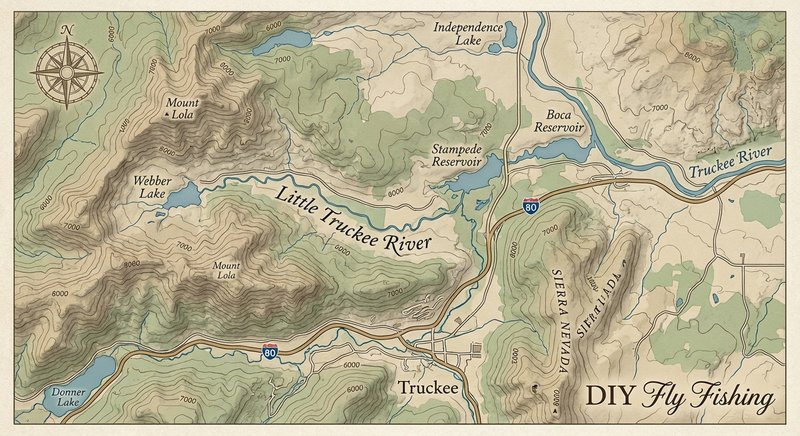
Little Truckee River
Fly fishing in California · Intermediate · Best seasons: Summer, Fall
Target Species
Brown Trout, Rainbow Trout
About This Water
Tributary of the Truckee with wild brown trout. Technical fishing in scenic Sierra meadows.
Fishing Recommendations
Tighten your wading boots and check your tippet—you’re heading to "The Little T." As an expert guide in the Sierras, I consider the Little Truckee River to be the crown jewel of Northern California technical fly fishing. It is a tailwater stretch located between Stampede Reservoir and Boca Reservoir, and while it can be humbling, the rewards are some of the most beautiful wild trout in the state.
🎣 Location Overview
The Little Truckee is a classic meadow stream characterized by slow, glassy glides, deep undercut banks, and winding "S" turns. Because it is a tailwater (the flow is controlled by the Stampede Dam), it offers relatively stable temperatures and high nutrient levels, leading to incredible insect biomass.
What makes it special is the technical challenge. This is "PhD-level" trout water. The fish are wild, highly educated, and have seen every fly in the catalog. Anglers love it because it rewards perfect presentations and stealth. It’s a place where you don't just "go fishing"—you hunt specific fish.
🐟 Target Species & Behavior
- Brown Trout: The stars of the show. These are wild, buttery-gold fish that often hold in the deep undercut banks or under overhanging willows. They are notoriously predatory but also highly selective during hatches.
- Rainbow Trout: Known for their vibrant colors and acrobatic fights. They tend to hold in the quicker "riffle-to-run" transitions and at the heads of deep pools.
- Behavior: During the day, fish hold in the deeper slots to avoid the high Sierra sun. During a hatch, they move into the shallow "tail-outs" of pools. They are extremely spooky; a heavy footstep or a thick fly line landing overhead will send them scurrying.
📅 Best Times to Fish
While open year-round, your target seasons are prime:
- Summer (Late June – August): This is the time for classic dry fly fishing. Pale Morning Duns (PMDs) and Caddis are the main events.
- Time of Day: Early morning for spinners and late evening for the caddis "blizzard."
- Fall (September – November): This is arguably the best time for trophy Browns. As temperatures drop, the Blue Winged Olives (BWOs) return.
- The Kokanee Factor: In late September/October, Kokanee salmon run up from Boca Reservoir to spawn. Large Brown trout follow them to gorge on eggs.
- Prime Window: Overcast, drizzly days in October are legendary for BWO hatches and aggressive streamer eats.
🪰 Recommended Flies & Techniques
Techniques
- Technical Nymphing: 90% of the fish are caught on the bottom. Use a "Truckee Rig"—an indicator with very long, thin leaders (6X is standard here).
- Dry Fly: Use a "Reach Cast" to avoid drag. If your fly twitches even a millimeter against the current, the fish will refuse it.
- The "Egg and Midge": In the fall, a two-fly rig with an egg pattern and a tiny midge dropper is lethal.
Top Fly Patterns
- Dries:
- PMD: Sparkle Dun or Quigley Hackle Stacker (Size 16-18)
- BWO: Thorax BWO or RS2 (Size 18-22)
- Caddis: Elk Hair Caddis or X-Caddis (Size 14-16)
- Nymphs:
- Zebra Midge: Red or Black (Size 18-22)
- Jigged Frenchie: (Size 16-18)
- Micro-Mayfly: (Size 18)
- Fall Specials:
- Eggs: McFlyFoam in peach or orange.
- Streamers: Dirty Hippy or Sculpzilla (Olive/White) for aggressive Browns.
💡 Pro Tips & Local Knowledge
- Sight Fish First: Before you even pull line off your reel, stand back 10 feet from the bank and watch the water for 5 minutes. Spotting a feeding fish before you cast increases your success rate by 50%.
- Downsize Everything: If you aren't getting bites, go smaller. A size 20 midge instead of a size 18 can make all the difference. Use 6X or even 7X fluorocarbon tippet.
- The "Meadow Stealth": The banks act like a drum. If you stomp along the edge, the vibrations alert the fish. Walk softly and stay low.
- Flow Rates: Check the USGS flow gauges for "Little Truckee NR Hobart Mills."
- Ideal: 150 – 300 CFS.
- Difficult: Below 100 CFS (fish are very spooky) or above 500 CFS (hard to wade).
⚠️ Important Information
- Access: The primary access is via Stampede Meadows Road. There are several well-marked parking pull-outs between the two reservoirs. Most anglers park at the bridge or the "Handicap Access" pull-out and hike in.
- Regulations:
- Barbless hooks only.
- Catch and Release only.
- A valid California Fishing License is required.
- Wading Safety: The bottom is "greasy" with round, slippery stones. Felt soles (where legal) or studded boots and a wading staff are highly recommended.
- Ethical Note: During the fall, do not walk on the "redds" (spawning beds). These are bright, clean patches of gravel. Stepping on them kills the next generation of trout.
Final Guide Advice: Bring your patience. You might only get five good shots at a fish in a day, but on the Little Truckee, those five shots are usually at the fish of a lifetime. Tight lines!
Bug Hatches & Matching Flies
| Hatch | Type | Peak months | Time of day | Hook sizes | Matching flies |
|---|---|---|---|---|---|
| Midges Chironomidae | midge | January, February, March, December | All Day | #18-24 | Zebra Midge #18-22, Palomino Midge #20-24, Griffith's Gnat #20-22 |
| Blue Winged Olive Baetis | mayfly | March, April, October, November | Mid-day | #16-22 | JujuBaetis #18-22, RS2 #20-22, BWO Sparkle Dun #18-20 |
| Pale Morning Dun Ephemerella excrucians | mayfly | June, July, August | Late Morning/Afternoon | #16-18 | Split Case PMD #16-18, Mercer's Pappy's PMD #16-18, Parachute PMD #16-18 |
| Green Drake Drunella doddsi | mayfly | June, July | Afternoon/Evening | #8-12 | Quigley's Green Drake Cripple #10-12, Green Drake Hairwing #10-12, Green Drake Nymph #10-12 |
| Little Yellow Stonefly Isoperla | stonefly | June, July | Afternoon/Evening | #14-16 | Yellow Sally Stimulator #14-16, Iron Sally #14-16 |
| Caddis Hydropsyche / Brachycentrus | caddis | May, June, July, August | Evening | #14-18 | Elk Hair Caddis #14-18, LaFontaine's Sparkle Pupa #16-18, Pulsating Caddis #14-16 |
| Tricos Tricorythodes | mayfly | August, September, October | Early Morning | #20-24 | Trico Spinner #20-24, Sunken Trico Spinner #22-24 |
| Terrestrials Formicidae / Gryllidae | terrestrial | July, August, September | Afternoon | #12-18 | Parachute Ant #16-18, Carpenter Ant #12-14, Morrish Hopper #10-14 |