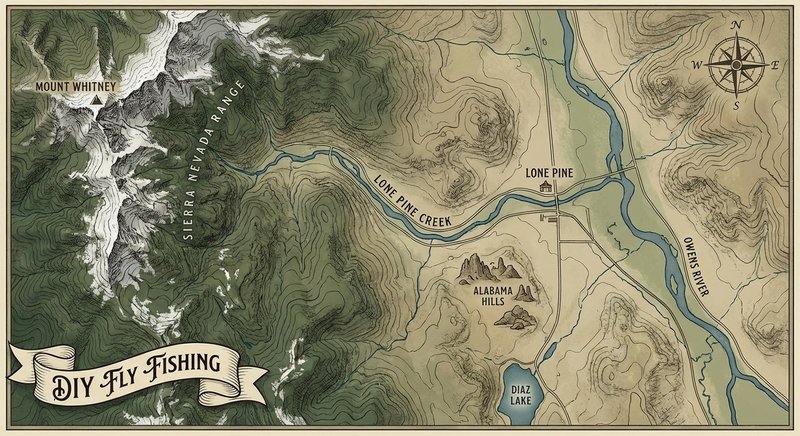
Lone Pine Creek
Fly fishing in California · Intermediate · Best seasons: Summer, Fall
Target Species
Rainbow Trout
About This Water
Below Mt. Whitney with wild rainbow trout. Gateway to the highest peak in lower 48.
Fishing Recommendations
Lone Pine Creek is one of the gems of the Eastern Sierra, offering a quintessential small-stream fly fishing experience against the backdrop of the tallest peak in the lower 48, Mount Whitney. This is high-gradient, fast-moving water that rewards stealth and precise presentations.
Here is your comprehensive guide to fly fishing Lone Pine Creek, California.
🎣 Location Overview
Lone Pine Creek originates from the high alpine lakes below Mount Whitney and tumbles down through the steep canyons of the Sierra Nevada before reaching the Owens Valley. The creek transitions from a rugged, high-altitude torrent at Whitney Portal (approx. 8,000 ft) to a softer, cottonwood-lined stream near the town of Lone Pine (approx. 3,700 ft).
What makes this water special is the dramatic scenery and the accessibility. You can fish pocket water surrounded by towering granite spires in the morning and be in the desert-like Alabama Hills by afternoon. The water is crystal clear, cold, and highly oxygenated—perfect habitat for active trout.
🐟 Target Species & Behavior
The primary target in Lone Pine Creek is the Rainbow Trout.
- Stocked vs. Wild: The lower sections near the campgrounds (Lone Pine Campground and Whitney Portal Campground) are stocked regularly by the CDFW. However, as you move away from the road and into the steeper pockets, you will find smaller, brilliantly colored wild Rainbows and the occasional Brown Trout.
- Behavior: Because the water moves fast, these fish are "opportunistic feeders." They don't have the luxury of inspecting a fly for five minutes; they have to make a split-second decision before the current sweeps the meal away.
- Holding Zones: Look for "soft water." In a high-gradient creek like this, fish hold behind boulders, in the foam lines (the "seams"), and in the small plunge pools at the base of waterfalls.
📅 Best Times to Fish
Optimal Seasons:
- Summer (July – August): This is the prime window. Once the spring runoff (snowmelt) subsides, the water becomes fishable. The higher elevations at Whitney Portal stay cool even when the valley is hot.
- Fall (September – October): My personal favorite. The crowds thin out, the water levels drop and clear up even further, and the fish are aggressively feeding to bulk up for winter. The fall colors (Aspens and Cottonwoods) are world-class.
Best Times of Day:
- Late Morning to Mid-Afternoon: Unlike lower-elevation rivers where you want to fish the crack of dawn, the high-altitude canyon of Lone Pine Creek stays shaded and cold. Fishing is often best once the sun hits the water and triggers insect activity.
🪰 Recommended Flies & Techniques
Because this is small, fast water, you don't need a massive fly box. Think attractor patterns and buoyancy.
Top Fly Patterns:
- Dry Flies:
- Royal Wulff (Size 14-16): The white wings make it easy to track in bubbly water.
- Elk Hair Caddis (Size 14-18): Great for skating across the surface.
- Parachute Adams (Size 16-20): The gold standard for clear water.
- Humpy (Yellow or Red): High buoyancy for rough pockets.
- Nymphs:
- Bead-head Prince Nymph (Size 16-18): The "flash" attracts fish in aerated water.
- Pheasant Tail Nymph (Size 18): Mimics the natural mayflies.
- Terrestrials:
- Ants and Beetles (Size 16): Deadly in late summer under overhanging brush.
Techniques:
- The "Dry-Dropper": This is the most effective way to fish this creek. Tie a buoyant dry fly (like a Size 14 Humpy) and hang a small nymph (like a Pheasant Tail) about 18–24 inches below it on 5X or 6X tippet.
- Short Line High-Sticking: You rarely need to cast more than 15 feet. Keep as much fly line off the water as possible to avoid "drag" caused by the complex currents.
💡 Pro Tips & Local Knowledge
- Stealth is Mandatory: Even though the water is fast, these fish are wary. Approach a pool from downstream, stay low, and try not to shadow the water. If they see you, the fishing is over in that hole.
- Focus on the "Pocket Water": Many anglers skip the tiny pockets between large boulders, thinking they are too small. These are often where the best wild fish hide. Every "bucket" of water the size of a trash can could hold a fish.
- The Whitney Portal Section: For the most "alpine" experience, fish the stretch just below the Whitney Portal pond. It is steep and requires some scrambling, but the fish are less pressured than those right next to the road.
- Equipment: Use a 3-weight or 4-weight rod (7'6" to 8'6"). Anything heavier is overkill for these fish and makes it harder to present flies delicately.
⚠️ Important Information
- Access: Much of the creek follows Whitney Portal Road. There are numerous pull-outs. The lower sections are easier walking, while the upper sections require moderate hiking/scrambling.
- Regulations: Generally, the creek falls under standard California District Regulations, but always check the current CDFW handbook for specific closures or barbless hook requirements, as regulations can change annually.
- Permits: You need a valid California Fishing License. No special wilderness permits are required just to fish the creek, but if you plan to hike deep into the Whitney Zone, check for day-hike restrictions.
- Safety: The rocks are incredibly slippery and the current is stronger than it looks. Be cautious when wading. Also, this is Bear Country—if you are keeping fish or carrying a lunch, use bear-safe practices.
Guide’s Summary: Lone Pine Creek isn't where you go to catch a 20-inch trophy; it’s where you go for high-action, beautiful scenery, and the pure joy of small-stream dry fly fishing. Keep your shadow off the water, fish the foam, and enjoy the view!
Bug Hatches & Matching Flies
| Hatch | Type | Peak months | Time of day | Hook sizes | Matching flies |
|---|---|---|---|---|---|
| Blue Winged Olive Baetis tricaudatus | mayfly | March, April, October, November | Late Morning/Afternoon | #18-22 | Parachute Adams #18-22, RS2 #20-22, Pheasant Tail #18-20 |
| Pale Morning Dun Ephemerella excrucians | mayfly | June, July, August | Morning/Early Afternoon | #16-18 | PMD Sparkle Dun #16-18, Military Mayfly #16-18, Quill Gordon #16 |
| Spotted Sedge Hydropsyche | caddis | May, June, July | Evening | #14-16 | Elk Hair Caddis (Tan) #14-16, LaFontaine's Deep Sparkle Pupa #14-16, Z-Wing Caddis #16 |
| Golden Stonefly Hesperoperla pacifica | stonefly | June, July | Morning/Evening | #8-12 | Pats Rubber Legs #8-12, Rogue River Stone #10-12, Golden Stone Nymph #10 |
| Yellow Sally Isoperla | stonefly | June, July, August | Afternoon/Evening | #14-16 | Yellow Stimulator #14-16, Little Yellow Sloan #16, Sally Nut #14 |
| Midges Chironomidae | midge | January, February, March, December | Mid-day | #20-24 | Zebra Midge #20-22, Griffith's Gnat #20-24, Black Beauty #22 |
| Grasshoppers Acrididae | terrestrial | August, September | Late Morning/Afternoon | #8-12 | Hopper Juan #10-12, Dave's Hopper #10, Parachute Hopper #12 |
| Carpenter Ants Camponotus | terrestrial | July, August | All Day | #12-16 | Chernobyl Ant #12-14, Black Foam Ant #14-16, Translucent Ant #16 |