Lower Sacramento River
Fly fishing in California · Intermediate · Best seasons: Spring, Summer, Fall, Winter
Target Species
Rainbow Trout, Steelhead
About This Water
World-class tailwater fishery below Shasta Dam. Large rainbow trout and seasonal steelhead.
Fishing Recommendations
Hello. It’s a pleasure to get you geared up for one of the most productive tailwaters in the lower 48. As a guide, when I think of the "Lower Sac," I think of a "trout factory." This isn't your typical intimate mountain stream; it’s a massive, powerful river that demands respect and specific tactics.
Here is your guide to the Lower Sacramento River.
🎣 Location Overview
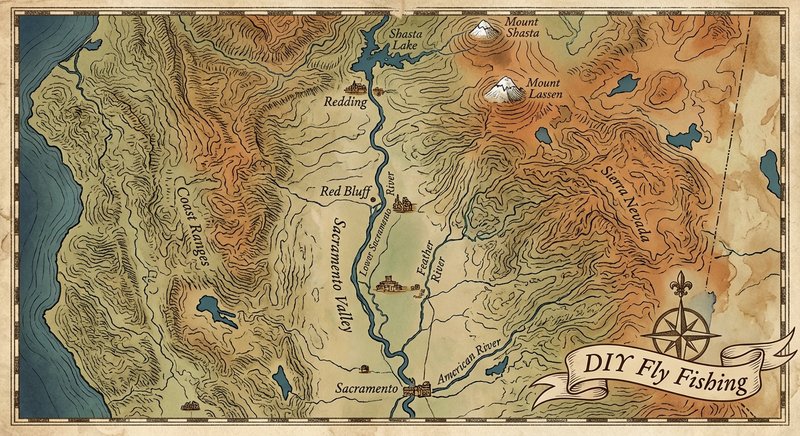
The Lower Sacramento River, specifically the stretch from Keswick Dam in Redding down to Red Bluff, is a legendary tailwater fishery. Because the water is released from the bottom of Shasta Lake, it remains a consistent 52–56 degrees year-round. This creates a "biological engine" that produces staggering amounts of aquatic insects and, consequently, some of the fattest, strongest wild Rainbow trout in the country.
What makes it special is the sheer volume of fish. It is common to hook fish in the 16–20 inch range that fight like steelhead. The river is wide (often over 100 yards), deep, and best fished from a drift boat or jet boat, though wading is possible in specific spots during low water.
🐟 Target Species & Behavior
- Wild Rainbow Trout: These are the stars of the show. Locally known as "bows," they are incredibly girthy due to the constant food supply. They hold in "seams," "riffles," and "buckets" (deeper depressions in the riverbed).
- Steelhead: While the line between a large resident Rainbow and a Steelhead can be blurry here, the river receives runs of Fall-run and Winter-run Steelhead. They are chrome, powerful, and often found in the faster water at the heads of runs.
- Behavior: These fish are "conveyor belt" feeders. They sit in heavy current and wait for the massive biomass of nymphs and eggs to come to them. They are not shy, but they are incredibly strong; if you don't have a good "downstream set," you'll lose them.
📅 Best Times to Fish
The Lower Sac is a 365-day fishery, but the experience changes by season:
- Spring (March – May): Prime Time. This is the "Mother's Day Caddis" season. The river comes alive with bugs. The weather is beautiful, and the fish are aggressive.
- Summer (June – August): Excellent fishing, but it is hot (often 100°F+). The water is kept high for agricultural needs downstream, making it strictly a boat game. Focus on the Hydropsyche caddis hatches.
- Fall (September – November): The "Egg Feed." When the Chinook Salmon begin to spawn, the Rainbows line up behind them to eat displaced eggs. This is arguably the best time for sheer numbers and size.
- Winter (December – February): Great for solitude and big fish. This is the time for Blue Winged Olives (BWO) and the beginning of the Stonefly activity.
🪰 Recommended Flies & Techniques
Techniques
- Indicated Nymphing: This is 90% of the game. Because the water is deep and fast, you need long leaders (9–12ft) and plenty of weight (split shot) to get the flies to the "zone" near the bottom.
- Dry Fly: Occurs during the Spring Caddis hatches or Winter BWO hatches, usually in the flats or slower side channels.
Top Fly Patterns
- Nymphs:
- Rubber Legs (Size 4-8): Brown or Black. The "standard" stonefly imitation.
- S&M Nymph (Size 14-18): Olive or Brown. A local staple for Mayflies.
- Pulsating Caddis (Size 14-16): Effective nearly year-round.
- Mercer’s Missing Link: Great for when they are looking at the surface.
- Eggs:
- Micro May/Glo-Bugs: Peach, Tangerine, and "Dead Egg" colors are vital from September through December.
- Streamers:
- Humungus or Buggers: In black or olive, swung on a sink tip during low light or higher water.
💡 Pro Tips & Local Knowledge
- The "Sacramento Set": Do not set the hook upward like you’re fishing a small creek. Because of the heavy current and long lines, you must set the hook downstream (low and toward the bank). If you pull up, you’ll pull the fly right out of the fish's mouth.
- Watch the "Redds": In the fall, look for bright, clean gravel. These are salmon spawning beds (redds). Fish the deep water behind them, but never walk on them. Walking on redds kills the next generation of salmon.
- The "Posse Grounds" to "Bonnyview" Stretch: If you are new to the river, this upper stretch through the city of Redding is the most consistent and has the highest fish counts per mile.
- Water Flows: Check the CDEC (California Data Exchange Center) for "Keswick" (KWK). Ideal fishing flows are between 3,000 and 6,000 cfs, but guides fish it up to 12,000 cfs.
⚠️ Important Information
- Access: Most access points are boat ramps (Posse Grounds, Turtle Bay, Bonnyview, Anderson River Park). For wading, try the area around the Sundial Bridge or near the Anderson River Park, but be extremely careful of the "heavy" water.
- Regulations: The Lower Sac has complex regulations regarding barbless hooks and seasonal closures to protect spawning salmon. Always check the current CDFW (California Department of Fish and Wildlife) regulations for "District 2" before heading out.
- Safety: The river is cold and powerful. If you are wading, use a wading staff and a belt. If you are rowing, be wary of bridge pilings and occasional "sweepers" (downed trees).
Guide’s Final Word: The Lower Sac is a world-class tailwater. Don't be intimidated by the size of the river. Focus on the seams, keep your flies on the bottom, and hold on tight—these fish have shoulders!
Bug Hatches & Matching Flies
| Hatch | Type | Peak months | Time of day | Hook sizes | Matching flies |
|---|---|---|---|---|---|
| Midges Chironomidae | midge | January, February, March, December | All Day | #18-24 | Zebra Midge #18-22, Mercer's Gidget #18-20, Griffith's Gnat #20-22 |
| Blue Winged Olive Baetis | mayfly | February, March, October, November | Late Morning/Afternoon | #16-20 | Hogan's S&M Nymph #16-18, Mercer's Pupa #18-20, RS2 #18-20 |
| Hydropsyche Caddis Hydropsyche | caddis | April, May, June, September | Late Afternoon/Evening | #12-16 | Bird's Nest #12-16, Peeping Caddis #14-16, Elk Hair Caddis #14-16 |
| Pale Morning Dun Ephemerella excrucians | mayfly | May, June, July | Morning/Early Afternoon | #14-18 | Trigger Finger PMD #16-18, Military May #16-18, Mercer's Poxyback PMD #14-16 |
| Yellow Sally Isoperla | stonefly | May, June, July | Afternoon/Evening | #14-16 | Mercer's Poxyback Sally #14-16, Yellow Stimulator #14-16, Little Yellow Sloan #14-16 |
| October Caddis Dicosmoecus gilvipes | caddis | September, October, November | All Day | #8-12 | Peeping Caddis (Orange) #8-10, Morrish's October October #8-10, Heavy Rubber Leg Stone #8-10 |
| Trico Tricorythodes | mayfly | July, August, September | Early Morning | #20-24 | Trico Spinner #22-24, CDC Trico Emerger #20-22 |
| Salmonfly Pteronarcys californica | stonefly | April, May | All Day | #4-8 | Pats Rubber Legs #6-8, Chubby Chernobyl #6-8, Rogue River Stone #4-8 |