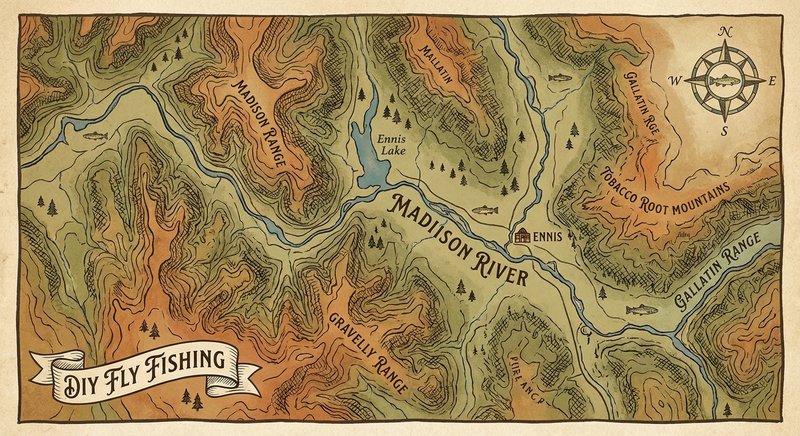
Madison River
Fly fishing in Montana · Intermediate · Best seasons: Spring, Summer, Fall
Target Species
Rainbow Trout, Brown Trout
About This Water
One of the most famous trout streams in America, the Madison River offers exceptional dry fly fishing for brown and rainbow trout. Known for its prolific hatches and stunning mountain scenery.
Fishing Recommendations
Welcome to the "50-Mile Riffle." As a guide who has spent countless days rowing the Madison, I can tell you there is no river in the lower 48 quite like it. It is a high-gradient, high-energy powerhouse that tests your mending skills and rewards your persistence with some of the hardest-fighting wild trout in Montana.
Here is your comprehensive guide to fly fishing the Madison River.
🎣 Location Overview
The Madison River is the quintessential Montana freestone (though technically tailwater-influenced). Born at the confluence of the Firehole and Gibbon rivers in Yellowstone National Park, it flows north through Hebgen and Quake Lakes before embarking on its most famous stretch: the Upper Madison.
What makes it special is its character. From Quake Lake down to Ennis, the river is often described as one continuous riffle. It lacks the classic "pool-and-drop" structure of most rivers. Instead, it is a boulder-strewn carpet of pocket water and runs. The water stays oxygenated and cool even in the heat of summer, making it a trout factory. The scenery is equally legendary, flanked by the towering Madison Range to the east and the Gravelly Range to the west.
🐟 Target Species & Behavior
The Madison is primarily a Rainbow and Brown Trout fishery.
- Rainbow Trout: These are the acrobats of the river. They hold in the fast, oxygen-rich water. Look for them in the "heavy" water—the guts of the riffles and the slicks behind mid-river boulders. They are opportunistic and will hammer a well-presented nymph or a skated dry fly.
- Brown Trout: The Madison holds some true "monsters" (20"+). Unlike the rainbows, the bigger Browns are structure-oriented. They lurk along the undercut banks, under overhanging willows, and in the deep "buckets" behind large rocks. In the fall, they become aggressive and territorial as they prepare to spawn.
- Behavior Note: Because the current is fast, Madison fish don't have long to decide. They are generally less "techy" than fish on the Missouri or Yellowstone, but your presentation must be drag-free to fool them.
📅 Best Times to Fish
Spring (April – Early June)
- The Draw: The Mother’s Day Caddis Hatch (early May) can be legendary if the water stays clear.
- Conditions: High water during runoff (late May/June) can make the river difficult to fish, though the edges remain productive for nymphing.
Summer (Late June – August)
- The Draw: The Salmonfly Hatch (late June/early July). This is the busiest time on the river. Giant orange stoneflies bring every big fish to the surface.
- Conditions: Following the Salmonflies, July brings Golden Stones, PMDs, and Yellow Sallies. August is "Hopper Season"—terrestrial fishing at its finest.
Fall (September – October)
- The Draw: My personal favorite time. The crowds thin out, and the big Browns get "toothy."
- Conditions: Blue Winged Olives (BWOs) pop on cloudy days. Streamer fishing becomes the primary tactic for trophy hunters.
🪰 Recommended Flies & Techniques
Top Fly Patterns
- Nymphs: Pat’s Rubber Legs (Black/Tan #4-10) is the "Madison River Jig." Also: Zebra Midges (#18-20), Lightning Bugs, and San Juan Worms (especially in high water).
- Dry Flies: Chubby Chernobyl (standard for Salmonflies/Hoppers), Sparkle Dun (PMDs), Elk Hair Caddis, and the Missing Link Caddis.
- Streamers: Sculpzilla, Barely Legal, and the Dungeon (White, Olive, or Yellow). The Madison is full of sculpins, so bottom-hugging streamers are key.
Effective Techniques
- The Hopper-Dropper: This is the Madison's bread and butter. Fish a buoyant dry fly (like a Chubby) with 2–3 feet of fluorocarbon tippet to a weighted nymph. It allows you to cover two water columns in the pocket water.
- High-Stick Nymphing: Because of the conflicting currents, keeping as much fly line off the water as possible is crucial to prevent drag.
- The "Madison Twitch": When fishing caddis or stoneflies, don't be afraid to give your dry fly a tiny twitch to mimic a fluttering insect.
💡 Pro Tips & Local Knowledge
- The "Bucket" Theory: On the Madison, you aren't looking for pools. You are looking for "buckets"—depressions in the riverbed the size of a hula-hoop where the water slows down slightly. If you find a boulder, fish the "pillow" in front of it and the "slick" behind it.
- Wading Caution: The Madison is notoriously difficult to wade. The rocks are round, bowling-ball sized, and covered in slick algae. Felt soles and studs are highly recommended. A wading staff is a lifesaver here.
- Wind is a Factor: The Madison Valley is a wind tunnel. If the wind is blowing upstream, use it to your advantage to slow your drift. If it's blowing downstream, downsize your dry fly profile to avoid "skating" unnaturally.
- The "Between the Lakes" Stretch: The section between Hebgen and Quake Lake is short but holds massive fish moving between the lakes. It’s technical, sight-fishing water.
⚠️ Important Information
Access
Montana has excellent stream access laws. You can fish anywhere below the high-water mark. Popular Access Sites (FAS) include:
- Raynolds Pass & Lyons Bridge: Great for wade anglers and the starting point for most floats.
- Varney Bridge to Ennis: The "Braids"—classic dry fly water but tricky to navigate by boat.
Regulations
- Permits: A Montana Fishing License and Conservation License are required.
- Check the Regs: Certain sections (like the "Between the Lakes" area) have specific catch-and-release rules or gear restrictions (artificial lures only). Always check the current Montana FWP booklet.
- Bear Safety: You are in Grizzly Country, especially above Lyon's Bridge. Carry bear spray and know how to use it, even if you are just a few hundred yards from the road.
Guide’s Final Word: The Madison is a river that rewards work. Don't stand in one place. Keep moving, keep casting into the pockets, and keep your tip up. Tight lines!
Bug Hatches & Matching Flies
| Hatch | Type | Peak months | Time of day | Hook sizes | Matching flies |
|---|---|---|---|---|---|
| Salmonfly Pteronarcys californica | stonefly | June, July | All Day | #2-8 | Pats Rubber Legs #4-8, Chubby Chernobyl (Orange) #4-8, Cat's Paws #4-6 |
| Pale Morning Dun (PMD) Ephemerella excrucians | mayfly | June, July, August | Late Morning/Afternoon | #14-18 | Sparkle Dun #16-18, Pheasant Tail #16-18, RS2 (Yellow) #16-18 |
| Mother's Day Caddis Brachycentrus occidentalis | caddis | May | Afternoon/Evening | #14-16 | Elk Hair Caddis #14-16, LaFontaine's Deep Sparkle Pupa #14-16, Iris Caddis #14-16 |
| Blue Winged Olive (BWO) Baetis | mayfly | April, May, September, October | Mid-day | #18-22 | Parachute Adams #18-22, BWO CDC Emerger #18-22, JujuBaetis #18-22 |
| Golden Stonefly Hesperoperla pacifica | stonefly | July | All Day | #8-12 | Water Walker (Golden) #8-12, Iron Lotus #10-12, Fluttering Stone #8-10 |
| Yellow Sally Isoperla | stonefly | July, August | Afternoon/Evening | #14-16 | Yellow Sally Foam Run #14-16, Jim's Yellow Sally #14-16, Mega Prince #14-16 |
| Spotted Sedge Hydropsyche | caddis | July, August | Evening | #12-16 | Goddard Caddis #14-16, Z-Lon Caddis #14-16, Peacock Caddis #14-16 |
| Grasshoppers Orthoptera | terrestrial | August, September | Late Morning/Afternoon | #6-12 | Morrish Hopper #8-12, Pink Pookie #8-10, Thunder Thighs #10-12 |
| Midges Chironomidae | midge | March, April, October, November | Late Morning | #18-24 | Zebra Midge #18-22, Griffith's Gnat #18-22, Morgan's Midge #20-22 |