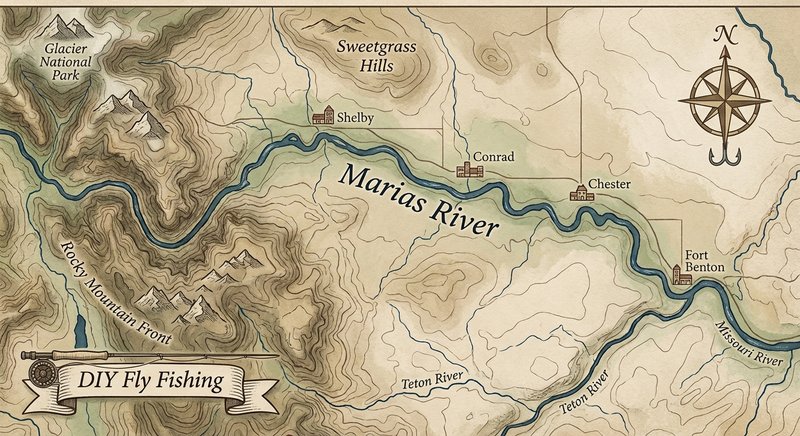
Marias River
Fly fishing in Montana · Beginner · Best seasons: Summer, Fall
Target Species
Rainbow Trout, Brown Trout
About This Water
Below Tiber Dam with rainbow and brown trout. Less crowded northeastern Montana option.
Fishing Recommendations
The Marias River in North-Central Montana is one of the state's best-kept secrets. While the crowds flock to the Missouri or the Madison, the Marias offers a rugged, "old Montana" experience. Flowing out of Tiber Dam (Lake Elwell), this tailwater winds through dramatic sandstone cliffs, cottonwood bottoms, and high-plains prairies.
It is a river of solitude, big sky, and surprisingly large trout for those willing to navigate its remote reaches.
🎣 Location Overview
The Marias River is a classic prairie tailwater. The primary trout water is the stretch directly below Tiber Dam, extending roughly 15 to 20 miles downstream. Beyond that, the water warms significantly and transitions into a fishery for walleye, pike, and catfish.
What makes the Marias special is the scenery and the silence. You are more likely to see a golden eagle or a mule deer than another angler. The river is characterized by slow, meandering bends, deep undercut banks, and occasional riffles. The water can have a "milky" or silty tint compared to mountain streams, but the nutrient-rich tailwater environment supports a robust biomass of insects and crustaceans.
🐟 Target Species & Behavior
The Marias is primarily a Brown Trout and Rainbow Trout fishery in its upper reaches.
- Brown Trout: These are the stars of the show. They haunt the deep undercut banks and submerged woody debris. They are opportunistic and can grow to "trophy" proportions by feeding on sculpin and smaller fish.
- Rainbow Trout: Found more frequently in the faster water and riffles just below the dam. They are hard-fighting and lean, often feeding heavily on midge larvae and scuds.
- Behavior: Because of the lower fishing pressure, these fish aren't as "leader shy" as Missouri River fish, but they are wary of overhead movement. In the heat of summer, they tuck deep under the banks, coming out into the ripples during low-light hours or heavy hatches.
📅 Best Times to Fish
While you can fish the Marias year-round, Summer and Fall are the undisputed prime windows.
- Summer (July – August): This is Terrestrial Season. The surrounding grasslands are home to millions of grasshoppers, crickets, and ants. When the wind blows (which is always), these insects are knocked into the river, triggering explosive surface takes.
- Fall (September – October): This is the best time for Trophy Browns. As the water cools, the Browns become aggressive and territorial ahead of their spawn. This is also when you’ll see reliable Blue-Winged Olive (BWO) hatches on overcast days.
- Best Time of Day: During summer, the "Hopper" window usually opens around 10:00 AM once the dew dries. In the fall, midday (11:00 AM – 3:00 PM) is the sweet spot for hatches and streamer activity.
🪰 Recommended Flies & Techniques
Dry Flies (The Main Event)
- Terrestrials: Morrish Hopper (Tan/Pink, size 8-12), Chubby Chernobyl (Gold or Purple, size 10), and Amy's Ant.
- Mayflies: Parachute Adams (size 16-20), Sparkle Dun (PMD or BWO, size 16-18).
- Caddis: Elk Hair Caddis (Tan, size 14-16) for evening rises.
Nymphing
The Marias is a tailwater, so "small and buggy" is the rule.
- Patterns: Ray Charles (Grey or Pink, size 16-18), Zebra Midge (Black or Red, size 18-20), and Pheasant Tails.
- Technique: Use a "Hopper-Dropper" rig in the summer—a large buoyant hopper with a weighted nymph 2-3 feet below it.
Streamers (For the Giants)
- Patterns: Sparkle Minnow (Gold/Olive), Wedgehead Sculpin, or a classic Black Wooly Bugger.
- Technique: Focus on the "inside" of deep bends and strip your fly tight against the undercut banks.
💡 Pro Tips & Local Knowledge
- The Wind is Your Friend: Don't be discouraged by the wind. On the Marias, a stiff breeze blows the grasshoppers into the water. If it’s windy, grab a 6-weight rod and a big foam hopper and fish the windward bank.
- The "Sanford" Stretch: The area around Sanford Park near the dam is the most reliable access point. If you have a raft or drift boat, a float from the dam to the first bridge is a classic day trip.
- Watch the Flows: Tailwater flows are controlled by the Bureau of Reclamation. Check the USGS gauges for "Marias River near Shelby." Extreme high or low flows can make fishing difficult.
- Pound the Banks: Unlike the Missouri where fish might be in the middle of the river, Marias trout love the structure. If your fly isn't within 6 inches of the bank, you’re missing fish.
⚠️ Important Information
- Access: Much of the land surrounding the Marias is private ranch land. Respect "No Trespassing" signs and stay below the ordinary high-water mark if wading.
- Regulations: Always check the Montana FWP (Fish, Wildlife & Parks) central district regulations before heading out. Generally, standard trout limits apply, but rules can change regarding seasonal closures near the dam.
- Safety: This is remote country. Cell service is spotty at best. Carry a spare tire, plenty of water, and bear spray (while less common than in the mountains, grizzlies do occasionally follow river corridors onto the plains).
- Rattlesnakes: Be extremely careful when walking through tall grass or along rock ledges; Prairie Rattlesnakes are common in this drainage during the summer.
Guide’s Final Word: The Marias isn't a river for people who want 40-fish days and easy access. It’s for the angler who wants a 20-inch Brown Trout on a hopper in a place where the only sound is the wind through the sagebrush.
Bug Hatches & Matching Flies
| Hatch | Type | Peak months | Time of day | Hook sizes | Matching flies |
|---|---|---|---|---|---|
| Midges Chironomidae | midge | March, April, October | All day | #18-24 | Zebra Midge #18-22, Griffith's Gnat #18-22, Palomino Midge #20-22 |
| Blue Winged Olive Baetis | mayfly | April, May, September, October | Late Morning/Afternoon | #16-20 | RS2 #18-20, Parachute Adams #16-20, Pheasant Tail #16-20 |
| Pale Morning Dun Ephemerella | mayfly | June, July | Morning/Early Afternoon | #14-18 | PMD Sparkle Dun #16-18, Split Case PMD #16-18, Chocolate Drop #16 |
| Spotted Sedge Hydropsyche | caddis | June, July, August | Evening | #14-18 | Elk Hair Caddis #14-16, LaFontaine's Deep Sparkle Pupa #14-16, X-Caddis #16-18 |
| Trico Tricorythodes | mayfly | July, August, September | Early Morning | #20-24 | Trico Spinner #20-24, Sunken Trico Spinner #20-22, Drowned Trico #22 |
| Yellow Sally Isoperla | stonefly | June, July | Afternoon/Evening | #14-16 | Little Yellow Sloan #14-16, Iron Sally #14-16, Yellow Stimulator #16 |
| Grasshoppers Orthoptera | terrestrial | August, September | Midday/Afternoon | #8-12 | Morrish Hopper #10-12, Pink Pookie #8-10, Parachute Hopper #12 |
| Crayfish Faxonius virilis | terrestrial | May, June, July, August | All day | #4-8 | Clouser Crayfish #6-8, Near Nuff Crayfish #6-10, Rubber Legged Wooly Bugger #4-8 |