Mattole River
Fly fishing in California · Advanced · Best seasons: Winter, Spring
Target Species
Steelhead
About This Water
Lost Coast steelhead fishery. Remote winter fishing in pristine coastal environment.
Fishing Recommendations
The Mattole River is one of California's last truly "wild" coastal rivers. Tucked away in the rugged "Lost Coast" region of Humboldt County, it is a place of haunting beauty, ancient redwoods, and some of the most challenging yet rewarding steelhead fishing in the lower 48.
🎣 Location Overview
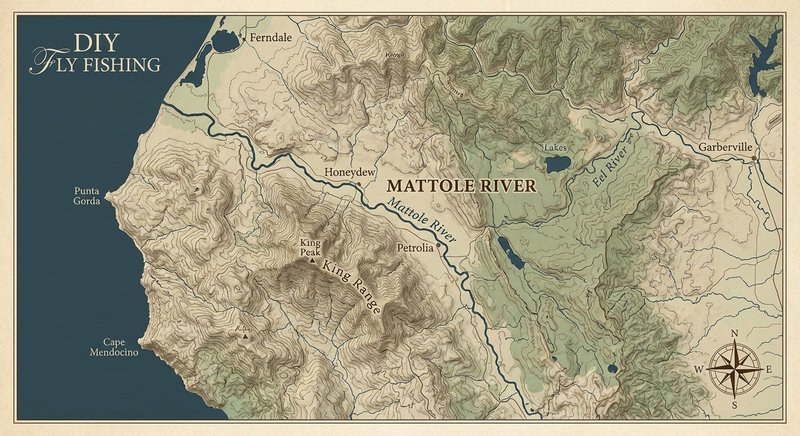
The Mattole is unique because it is one of the few rivers in California that remains entirely undammed. It flows through a remote valley before emptying into the Pacific Ocean near Petrolia.
What makes it special is its solitude and volatility. Because there are no dams to regulate flow, the river is "flashy"—it rises quickly with rain and can turn into a chocolate mess, but it also clears relatively fast. Anglers love the Mattole because it offers a "step back in time" experience. You aren’t fighting crowds; you are fighting the elements and a legendary strain of wild, oversized winter steelhead. The water character ranges from deep, slow-moving coastal pools to classic boulder-strewn riffles and tailouts.
🐟 Target Species & Behavior
The primary draw here is the Wild Winter Steelhead. Unlike many rivers that rely on hatchery supplementation, the Mattole is managed for wild fish.
- Behavior: These fish are fresh off the salt and incredibly powerful. They aren't looking to "feed" in the traditional sense, but they are aggressive and territorial.
- Holding Water: In the lower river, look for them in the "guts" of pools as they rest after entering the mouth. In the middle and upper river, they hold in classic "walking speed" water, near large boulders, or in the tailouts of pools before they push over the next riffle.
- Diet: While they don't eat much in freshwater, they retain their predatory instincts. They will strike at silhouettes, movement, and "hot" colors that trigger an ancestral feeding or aggression response.
📅 Best Times to Fish
- Optimal Months: Late December through March.
- January & February: These are the peak months for fresh, bright "chrome" fish.
- March: Excellent for "drop-backs" (fish heading back to sea) and the tail end of the fresh run.
- Best Conditions: The "Green Room." You are looking for the river to be on the drop after a storm. When the water has 3–4 feet of visibility and a distinct turquoise-green tint, the fishing is world-class.
- Time of Day: Light is everything. Low light (dawn and dusk) is prime, but on the Mattole, overcast days are better than sunny ones. Steelhead feel exposed in clear water under a bright sun and will tuck deep into cover.
🪰 Recommended Flies & Techniques
Techniques
- Spey Casting (The Swing): This is the soul of the Mattole. Using a 7- or 8-weight Spey rod to swing flies across deep runs.
- Indicator Nymphing: Highly effective in the pocket water of the upper river using heavy beads or glo-bugs.
Top Fly Patterns
- Intruders: Pink/Purple, Black/Blue, or Chartreuse. These large, articulated flies provide the movement needed in high flows.
- Prom Dress / Hobo Spay: Sparse, flashy flies that work wonders when the water is clearing.
- Glo-Bugs & Beads: 10mm to 12mm beads in "Mottled Roe" or "Oregon Cheese" are staples, especially when fishing behind spawning salmon early in the season.
- Rubber Legs / Stoneflies: A large black or golden stonefly nymph trailed by a bead is a deadly combo in the riffles.
💡 Pro Tips & Local Knowledge
- Watch the Hydrograph: Before you drive to the Lost Coast, check the USGS Gauge at Petrolia. If the river is spiking above 5,000 cfs, stay home. If it’s dropping from 3,000 down toward 1,000 cfs, get in the truck immediately.
- The "Humboldt Twitch": When swinging a fly, don't just let it hang. A subtle pulse of the rod tip can often trigger a strike from a follower.
- Stealth Matters: The Mattole can get very clear. Avoid wading deep into the run you are about to fish. Steelhead often hold closer to the bank than you think.
- The Mouth (The Lagoon): Fishing near the mouth can be incredible, but be wary of the tides. When the tide pushes in, it can "stall" the river, causing fish to school up and wait for the next push.
⚠️ Important Information
- Access: Much of the Mattole is bordered by private land. Public access is primarily found at bridge crossings (like the Honeydew Bridge and the A.W. Way County Park) and Bureau of Land Management (BLM) land near the mouth. Respect "No Trespassing" signs—local landowners are protective of their privacy.
- Regulations: Check the CA Department of Fish & Wildlife (CDFW) Special Regulations. The Mattole is usually under "Low Flow Closure" rules. If the water is too low, it's illegal to fish.
- Gear Requirements: This is a Barbless Hook river.
- Catch and Release: This is a wild fishery. Every fish is precious. Handle them with care, keep them in the water, and use a heavy enough tippet (12lb–15lb) to land them quickly so they don't reach exhaustion.
- The Drive: The roads to the Mattole (especially Mattole Road/Wildcat) are winding, steep, and often plagued by potholes or mudslides. Ensure your vehicle is in good shape and carry a spare tire.
Guide’s Final Word: The Mattole is not a river for the numbers-hungry angler. It is a river for the poet and the grinder. You might go three days without a pull, but the fish you eventually land will be a wild, silver ghost you'll remember for the rest of your life.
Bug Hatches & Matching Flies
| Hatch | Type | Peak months | Time of day | Hook sizes | Matching flies |
|---|---|---|---|---|---|
| Blue Winged Olive (BWO) Baetis spp. | mayfly | March, April, October, November | Mid-day | #16-22 | Parachute Adams #18-20, RS2 #18-22, Pheasant Tail #16-20 |
| Golden Stonefly Hesperoperla pacifica | stonefly | May, June | Morning/Evening | #6-10 | Rogue Stone #8-10, Pat's Rubber Leg #6-10, Golden Demon #8-10 |
| October Caddis Dicosmoecus gilvipes | caddis | September, October, November | Afternoon/Evening | #8-12 | Orange Stimulator #8-10, October Caddis Pupa #10-12, Peery's October Caddis #8-10 |
| March Brown Rhithrogena morrisoni | mayfly | March, April | Afternoon | #12-14 | March Brown Western #12-14, Hare's Ear Nymph #12-14, March Brown Wet #14 |
| Salmonfly Pteronarcys californica | stonefly | May | All Day | #4-8 | Chubby Chernobyl #6-8, Kaufmann's Stone #4-8 |
| Little Yellow Stonefly (Yellow Sally) Isoperla spp. | stonefly | June, July | Evening | #14-16 | Yellow Sally Dry #14-16, Iron Lotus #16 |
| Green Sedge Rhyacophila spp. | caddis | April, May, June | Evening | #12-16 | Elk Hair Caddis (Green) #14-16, Green Weenie #12-14, LaFontaine's Deep Sparkle Pupa #14-16 |
| Midges Chironomidae | midge | December, January, February | Mid-day | #18-24 | Griffith's Gnat #20-22, Zebra Midge #18-22, Top Secret Midge #20-24 |