McGee Creek
Fly fishing in California · Intermediate · Best seasons: Summer, Fall
Target Species
Rainbow Trout, Brook Trout
About This Water
Eastern Sierra tributary to Crowley Lake. Wild trout in scenic high country.
Fishing Recommendations
Welcome to the Eastern Sierra. As your guide, I’m excited to walk you through one of the most scenic and rewarding small-stream fisheries in California: McGee Creek.
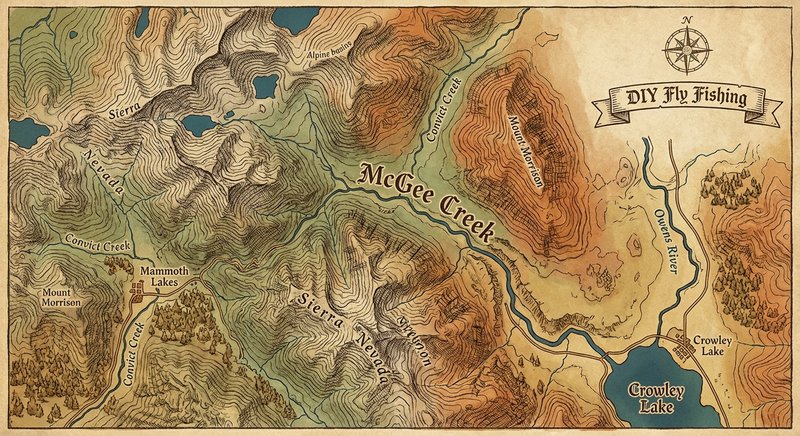
Located just south of Mammoth Lakes, McGee Creek is a classic high-elevation freestone stream that flows from the crest of the Sierra Nevada down into Crowley Lake. It offers a "tale of two creeks"—the rugged, high-alpine canyon reaches and the meandering, meadow-style lower sections.
🎣 Location Overview
McGee Creek is a gem of the Eastern Sierra because of its accessibility and its diversity. The creek starts in a dramatic, multi-colored canyon (rich in iron and slate, giving the rocks a reddish hue) and winds its way through sagebrush flats before entering the North Arm of Crowley Lake.
What makes it special: Unlike the larger Owens River nearby, McGee is intimate. It is the quintessential "blue line" experience. The water is crystal clear, cold, and fast-moving in the canyon, becoming slow and "spring-creek-like" as it hits the valley floor. Anglers love it for the solitude, the stunning backdrop of Mt. Baldwin and Mt. McGee, and the chance to catch wild, brightly colored trout on light gear.
🐟 Target Species & Behavior
- Rainbow Trout: These are the primary residents. In the upper sections, they are wild, opportunistic, and average 6–10 inches. However, in the lower sections near Crowley Lake, you can encounter much larger "lake-run" fish during spawning migrations or when they seek thermal refuge.
- Brook Trout: Found predominantly in the higher elevations and the headwater beaver ponds. They are aggressive, stunningly beautiful, and will often beat the Rainbows to a well-placed dry fly.
- Behavior: Because the water is nutrient-poor compared to lower-elevation rivers, these fish are "lookers." They have a high metabolism in the short summer window and are rarely extremely selective, but they are very "spooky." If they see your shadow or feel the vibration of your footsteps on the bank, the pool is done.
📅 Best Times to Fish
Optimal Seasons
- Summer (Late June – August): This is the prime window. Once the snowmelt (runoff) subsides, the water clears and the dry fly fishing becomes world-class.
- Fall (September – October): My personal favorite. The aspen trees turn brilliant gold, the mosquitoes disappear, and the Brook trout enter their spawning colors. You also get the chance for larger Brown and Rainbow trout moving up from Crowley Lake.
Best Times of Day
- Mid-Morning to Late Afternoon: In the high Sierra, you don't need to be on the water at dawn. The "bug life" doesn't wake up until the sun hits the water. 10:00 AM to 4:00 PM is the sweet spot.
🪰 Recommended Flies & Techniques
Top Fly Patterns
- Dry Flies:
- Parachute Adams (#14-18): The gold standard for the Sierra.
- Elk Hair Caddis (#14-16): Great for the faster pocket water in the canyon.
- Royal Wulff (#14-16): High visibility and high buoyancy.
- Hopper patterns (#10-12): Essential for the lower meadow sections in August and September.
- Nymphs:
- Bead-head Pheasant Tail (#16-20): Mimics the small mayflies common here.
- Zebra Midge (#18-22): Black or Red; effective in the slower meadow pools.
Effective Techniques
- Dry-Dropper: This is the most effective way to fish McGee. Use a buoyant dry fly (like a Stimulator or Hopper) and hang a small Pheasant Tail or Copper John about 18–24 inches below it.
- The "High Stick": In the upper canyon, use a short line and keep as much fly line off the water as possible to avoid drag in the complex currents.
💡 Pro Tips & Local Knowledge
- Stalk the Meadows: In the lower sections (near the trailhead), the water moves slowly. Don't just walk up to the bank. Stay 10 feet back, crouch low, and observe. These fish are sensitive to movement against the skyline.
- Follow the "Color": If the water in the main stem is slightly off-color due to a summer thunderstorm, move higher up the trail. The higher you go, the faster the water clears.
- The "Crowley Move": In the fall, focus on the very lowest section of the creek where it enters the lake. Large migratory fish will hold in the deep bends of the creek. Swing a small woolly bugger or a perch imitation here for a chance at a 20-inch trophy.
- Gear: Use a 2-weight or 3-weight rod. Anything heavier is overkill for the resident fish and will make delicate presentations in the meadows difficult. Use a 7.5ft to 9ft leader tapering to 5X or 6X tippet.
⚠️ Important Information
Access
- Take McGee Creek Road off Hwy 395 (between Bishop and Mammoth).
- Follow the road to the end (the McGee Creek Trailhead).
- The Canyon: Hike up the main trail. You’ll parallel the creek for miles. The further you hike, the fewer anglers you’ll see.
- The Meadows: Access is available near the pack station and the lower campgrounds.
Regulations & Permits
- Season: Generally opens the last Saturday in April and closes November 15th.
- Barbless Hooks: While not always mandated by law on every stretch of McGee, I highly recommend them for easy release of the wild trout.
- Check Current Regs: California CDFW regulations can change; always check the "Sierra District" special regulations before heading out, especially regarding the section closest to Crowley Lake.
Special Considerations
- Bears & Wildlife: This is active Black Bear country. If you’re packing a lunch, use bear-resistant containers or keep it on your person.
- Altitude: You are starting at roughly 7,000 feet and climbing. Stay hydrated and be prepared for sudden weather changes.
Guide’s Final Word: McGee Creek isn't about counting fish; it's about the quality of the environment. Slow down, watch the water, and enjoy the most beautiful "backyard" in California. Tight lines!
Bug Hatches & Matching Flies
| Hatch | Type | Peak months | Time of day | Hook sizes | Matching flies |
|---|---|---|---|---|---|
| Midges Chironomidae | midge | March, April, May, September, October | All day | #18-24 | Zebra Midge #18-22, Griffith's Gnat #20-22, Brooks Sprout Midge #20-24 |
| Blue Winged Olive Baetis spp. | mayfly | March, April, September, October | Late Morning/Afternoon | #18-22 | RS2 #18-22, BWO Parachute #18-20, Pheasant Tail #18-20 |
| Pale Morning Dun Ephemerella excrucians | mayfly | June, July, August | Late Morning | #16-18 | PMD Sparkle Dun #16-18, Mercer's Trigger Case PMD #16-18, Quigley's PMD Hackle Stacker #16-18 |
| Spotted Sedge Hydropsyche | caddis | June, July, August | Evening | #14-18 | Elk Hair Caddis #14-18, LaFontaine's Deep Sparkle Pupa #14-16, Peeking Caddis #14-16 |
| Little Yellow Stonefly Isoperla spp. | stonefly | June, July | Morning/Evening | #14-16 | Yellow Sally Stimulator #14-16, Iron Lotus #16, Slovenian Sedge (Yellow) #14-16 |
| Trico Tricorythodes spp. | mayfly | August, September | Early Morning | #20-24 | Trico Spinner #22-24, Trico Parachute #20-22 |
| Grasshoppers Acrididae | terrestrial | August, September | Late Afternoon | #10-14 | Hopper Juan #12-14, Dave's Hopper #10-12, Parachute Hopper #12-14 |
| Golden Stonefly Hesperoperla pacifica | stonefly | June, July | Afternoon | #8-12 | Golden Stone #8-10, Pat's Rubber Legs #8-12, Kaufmann's Stone #8-10 |