Merced River
Fly fishing in California · Intermediate · Best seasons: Spring, Summer, Fall
Target Species
Rainbow Trout, Brown Trout
About This Water
Flowing from Yosemite with wild rainbow trout. Scenic Sierra fishing near the park.
Fishing Recommendations
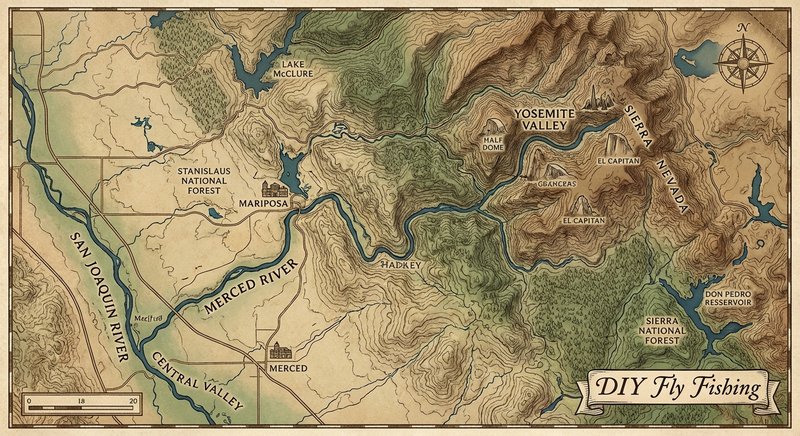
The Merced River is one of California’s most iconic waterways, carving its way through the granite heart of Yosemite National Park before tumbling down into the rugged canyons of the Sierra foothills. For the fly angler, it offers a dramatic split personality: the placid, meadow-lined waters of Yosemite Valley and the turbulent, high-gradient "Wild Trout" section downstream.
Here is your comprehensive guide to fly fishing the Merced.
🎣 Location Overview
The Merced is a classic freestone river, meaning its flows are dictated entirely by snowmelt and rain rather than dam releases.
- The Upper River (Yosemite Valley): This section flows through the famous valley floor. It is characterized by slow glides, deep pools, and breathtaking views of El Capitan and Half Dome. The fish here are plentiful but often smaller and can be "educated" due to high tourist visibility.
- The Lower River (El Portal to Bagby): This is the rugged canyon section. Below the park boundary, the river drops steeply, creating classic "pocket water," heavy runs, and massive boulders. This is where the larger, wilder fish live. The section from the Yosemite park boundary downstream to McClure is designated as a Wild Trout Water, managed for self-sustaining populations.
🐟 Target Species & Behavior
- Rainbow Trout: The primary resident. In the canyon sections, these fish are incredibly strong, utilizing the heavy current to their advantage. They hold in the "cushion" in front of boulders or in the bubbly seams of riffles.
- Brown Trout: Found throughout the system, but they reach impressive sizes in the deeper pools of the lower canyon and the undercut banks of the Valley. They are predatory and light-sensitive, often becoming active during "low light" transitions.
- Behavior: These are 100% wild fish. They are wary of overhead shadows and heavy wading. In the fast water of the canyon, they have a split second to decide to eat, leading to aggressive strikes. In the Valley, they are more selective and require delicate presentations.
📅 Best Times to Fish
- Spring (Late March – April): Before the snowmelt hits full tilt. This is the window for the March Brown and Grannom Caddis hatches. If the winter was dry, this is prime time.
- Summer (July – August): Once the runoff subsides (usually by late June), the river becomes fishable again. Morning and evening windows are crucial as midday temperatures in the canyon can soar. This is the season of the Golden Stonefly.
- Fall (September – November): Arguably the best time. Flows are low and stable, the water is clear, and the Brown trout become aggressive as they prepare to spawn. The Blue Winged Olive (BWO) hatches on overcast days are legendary.
🪰 Recommended Flies & Techniques
Techniques
- High-Stick Nymphing: In the canyon, the currents are complex. Using a longer rod (10ft 4wt or 5wt) to keep your line off the water is essential to prevent drag.
- Dry-Dropper: Perfect for the pocket water. A high-visibility foam hopper or stonefly with a weighted nymph 2-3 feet below.
- Streamer Stripping: Effective in the deep pools of the El Portal section for large Browns, especially during low light or slightly turbid water.
Top Fly Patterns
- Dries:
- Golden Stonefly: Size 8-12 (Chubby Chernobyl or Rogue Foam Stone).
- Parachute Adams: Size 14-20 (The universal Merced fly).
- Elk Hair Caddis: Size 14-18 (Tan or Olive).
- Nymphs:
- Pat’s Rubber Legs: Size 8-12 (Black/Brown or Coffee).
- Prince Nymph: Size 12-16 (A Merced staple).
- Pheasant Tail / Perdigons: Size 16-20 (For the picky fish in the glides).
- Streamers:
- Woolly Bugger: Black or Olive.
- Sculpzilla: Size 4-8.
💡 Pro Tips & Local Knowledge
- The "Pocket Water" Secret: Many anglers bypass the chaotic, fast water. In the Merced canyon, 12-inch rainbows will sit in a pocket of calm water the size of a dinner plate. If there is a break in the current, there is a fish in it.
- Stealth in the Valley: If fishing inside Yosemite National Park, use long leaders (12ft+) and 6x tippet. The water is gin-clear, and the fish see thousands of people; a splashy cast will end your chances.
- Watch the Gauge: For the lower river, look for flows between 300 cfs and 800 cfs for ideal wading. Anything over 1,500 cfs becomes dangerous to wade in the canyon.
- The Golden Stone Crawl: In July, look for the husks of Stoneflies on the rocks. If you see them, fish a large, heavy nymph tight to the bottom near the banks.
⚠️ Important Information
- Access: Highway 140 follows the river for many miles, providing excellent pull-off access. Inside the Park, use the various turnout and picnic area parking.
- Regulations:
- Inside Yosemite NP: Check park-specific regs; generally, barbless hooks are encouraged, and bait is prohibited in many areas.
- Wild Trout Section (Foresta Rd to Bagby): Strict Catch and Release only with barbless lures/flies. Always check the current CA Department of Fish and Wildlife (CDFW) Year-Round Inland Mountain Trout regulations.
- Safety: The Merced is a powerful river. The granite rocks are notoriously slippery (felt soles or studs are highly recommended). Watch for rattlesnakes in the lower canyon during the summer months.
- Permits: A valid California Fishing License is required for anyone 16 or older.
Guide’s Final Word: The Merced is not a "numbers" river where you'll catch 50 fish a day. It is a river for the thinking angler who appreciates wild fish in one of the most beautiful settings on Earth. Respect the water, watch your footing, and keep your flies in the seams!
Bug Hatches & Matching Flies
| Hatch | Type | Peak months | Time of day | Hook sizes | Matching flies |
|---|---|---|---|---|---|
| Golden Stonefly Calineuria californica | stonefly | May, June | Morning/Evening | #6-10 | Rogue River Stone #8-10, Pats Rubber Legs #6-10, Golden Stimulator #8-12 |
| Blue Winged Olive (BWO) Baetis | mayfly | March, April, October, November | Afternoon | #18-22 | Parachute Adams #18-22, RS2 #20-22, Pheasant Tail Nymph #18-20 |
| Grannom Caddis (Mother's Day Caddis) Brachycentrus | caddis | April, May | Afternoon/Evening | #14-16 | Elk Hair Caddis #14-16, Peacock Caddis #14-16, Deep Sparkle Pupa #14-16 |
| Pale Morning Dun (PMD) Ephemerella | mayfly | June, July | Morning/Early Afternoon | #16-18 | PMD Sparkle Dun #16-18, Pale Morning Dun Parachute #16-18, Mercer's Poxyback PMD #16-18 |
| Yellow Sally Isoperla | stonefly | June, July, August | Evening | #14-16 | Yellow Sally Stimulator #14-16, Little Yellow Sloan #14-16, Yellow Humpy #14-16 |
| October Caddis Dicosmoecus | caddis | September, October | All Day | #8-12 | Orange Stimulator #8-10, October Caddis Pupa #10-12, Morrish October Caddis #8-10 |
| Midges Chironomidae | midge | January, February, December | Morning/Afternoon | #18-24 | Zebra Midge #18-22, Griffith's Gnat #20-22, Top Secret Midge #20-24 |
| Grasshoppers Acrididae | terrestrial | July, August, September | Afternoon | #8-12 | Dave's Hopper #8-12, Parachute Hopper #10-12, Morrish Hopper #8-12 |