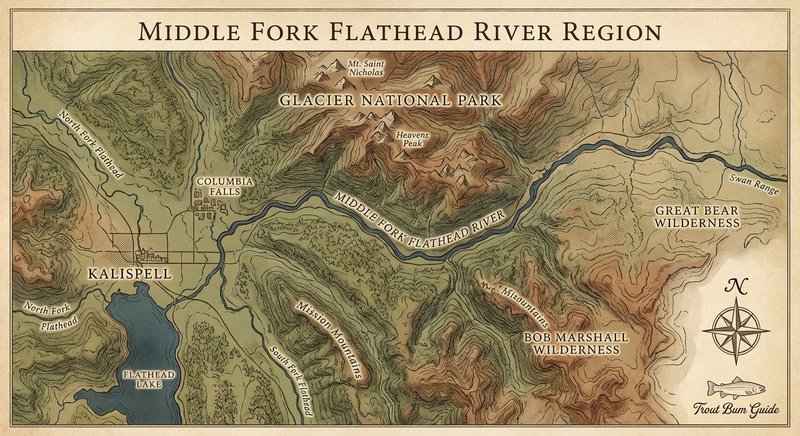
Middle Fork Flathead River
Fly fishing in Montana · Advanced · Best seasons: Summer, Fall
Target Species
Cutthroat Trout, Bull Trout
About This Water
Wild and Scenic River along Glacier's southern boundary. Remote wilderness fishing for native trout.
Fishing Recommendations
Welcome to one of the most pristine fly fishing experiences in the Lower 48. The Middle Fork of the Flathead River is the boundary between the Great Bear Wilderness and Glacier National Park. This is "Wild and Scenic" water in every sense of the word—gin-clear, cold, and home to native fish that have never seen a concrete hatchery tank.
Here is your guide to mastering the Middle Fork.
🎣 Location Overview
The Middle Fork of the Flathead is a quintessential freestone mountain river. It is famous for its striking turquoise-tinted water, a result of "glacial flour" (fine mineral particles) suspended in the flow.
What makes it special is its wildness. The upper reaches are accessible only by hiking or packing in via horse, while the lower sections run along Highway 2. Because it is a freestone river (un-dammed), its character changes with the snowmelt. It features classic pool-drop sequences, massive boulder gardens, and deep, emerald-green holes. Anglers love it because the fish are exceptionally "honest"—if you put a decent dry fly in front of a Westslope Cutthroat here, they are likely to rise for it.
🐟 Target Species & Behavior
Westslope Cutthroat Trout
These are the stars of the show. They are native, beautiful, and highly opportunistic.
- Behavior: They are "surface-oriented." Because the nutrient levels in cold mountain water are low, they can’t afford to let a meal pass by.
- Where they hold: Look for "the soft water next to the fast water." They love foam lines, the soft eddies behind large boulders, and the tail-outs of deep pools.
Bull Trout
The "grizzly bear" of the river. These are federally protected, migratory apex predators that can reach over 30 inches.
- Behavior: They are piscivores (fish-eaters). They often follow the Cutthroat schools or hold in the deepest, darkest slots of the river.
- Note: You must check current Montana FWP regulations; targeting Bull Trout is often restricted to specific seasons or catch-and-release only with no "intentional" targeting in certain sections.
📅 Best Times to Fish
Summer (July – August)
This is the prime window. Runoff usually subsides by early July.
- Conditions: Clear water and stable flows.
- Prime Window: Late July is the peak for terrestrial and stonefly action.
- Time of Day: In the heat of August, the "inner-tube hatch" (recreational floaters) starts at noon. Get on the water at 7:00 AM to have the river to yourself.
Fall (September – October)
My personal favorite time. The crowds vanish, and the larch trees turn gold.
- Conditions: Lower, more technical water.
- Prime Window: Mid-day. As the water temperature drops, the fish wait for the afternoon sun to activate the bugs.
- Hatch: Look for Blue Winged Olives (BWO) on overcast days.
🪰 Recommended Flies & Techniques
Dry Flies (The Bread & Butter)
The Middle Fork is a world-class dry fly fishery.
- Chubby Chernobyl (Size 8-12): Gold, Purple, or Royal. This is the "standard" high-buoyancy fly.
- Purple Haze (Size 12-16): For some reason, Flathead Cutthroats have a genetic obsession with purple.
- Stimulators (Size 10-14): Orange or Yellow to mimic the Golden Stoneflies.
- Turck’s Tarantula: Great for skittering across the surface to trigger aggressive strikes.
Nymphing
Use a "Hopper-Dropper" rig to cover two water columns.
- Pat’s Rubber Legs (Olive/Brown): To mimic stonefly nymphs.
- Prince Nymphs or Pheasant Tails (Size 14-16): Classic droppers 2 feet below your dry fly.
Streamers (For the Big Guys)
- White or Olive Sculpzilla: Mimics the small sculpins Bull Trout and large Cutthroats feed on.
- Black Woolly Bugger: A universal constant in the canyon sections.
💡 Pro Tips & Local Knowledge
- The "Twitch": When fishing a large dry fly like a Chubby, don't just dead-drift it. Give it a tiny, subtle twitch as it enters a soft pocket. It often triggers a "reaction strike" from a Cutthroat that was on the fence.
- The Canyon Stretch: The section from Bear Creek down to West Glacier offers incredible scenery but requires a raft or drift boat. If wading, focus on the area around Essex or the various pull-offs along Highway 2 where the river bends away from the road.
- Slippery Rocks: The Middle Fork rocks are notoriously slick ("river snot"). Felt soles or studs are highly recommended for wading safety.
- The "Park" Bank: If you are standing in the river, the North/East bank is Glacier National Park. If you step foot on that bank to fish, you are technically under Park jurisdiction/regulations.
⚠️ Important Information
- Bear Safety: This is high-density Grizzly Bear country. Always carry bear spray on your person (not in your pack), and know how to use it. Make noise when walking through heavy brush to the river.
- Regulations:
- A Montana Fishing License is required.
- Most of the Middle Fork is Catch and Release for trout.
- Bull Trout must be released immediately without being removed from the water.
- Access: Much of the river parallels Hwy 2, providing easy access points. However, some land is private; look for FWP fishing access site (FAS) signs.
- The "Middle Fork Float": If you are rafting, be aware of "The Spruce Park" section and the "John Stevens Canyon." These contain Class III-IV rapids that can be deadly for inexperienced rowers. Use a local shuttle service and check CFS (cubic feet per second) levels before launching.
Tight lines, and enjoy the views—they are just as good as the fishing!
Bug Hatches & Matching Flies
| Hatch | Type | Peak months | Time of day | Hook sizes | Matching flies |
|---|---|---|---|---|---|
| Salmonfly Pteronarcys californica | stonefly | June, July | All day | #4-8 | Chubby Chernobyl (Orange) #6-10, Pat's Rubber Leg (Black/Orange) #4-8, Cat Puke #6-8 |
| Golden Stonefly Hesperoperla pacifica | stonefly | July, August | Morning/Evening | #8-12 | Goldie Joe #8-10, Yug's Golden Stone #10-12, Iron Lotus #12-14 |
| Pale Morning Dun (PMD) Ephemerella inermis/infrequens | mayfly | July, August | Late Morning/Afternoon | #14-18 | Sparkle Dun #16-18, Split Case PMD #16-18, Quigley Cripple #14-16 |
| Blue Winged Olive (BWO) Baetis spp. | mayfly | April, May, September, October | Mid-day/Afternoon | #18-22 | Parachute Adams #18-22, RS2 #20-22, Pheasant Tail #18-20 |
| Skwala Stonefly Skwala americana | stonefly | April, May | Afternoon | #10-14 | Skwala Stone Dry #10-12, Twenty Incher #10-14 |
| Green Drake Drunella doddsii | mayfly | July | Afternoon | #10-12 | H & L Variant #10-12, Green Drake Hairwing #10-12, Doddsii Nymph #12 |
| Tan Caddis Hydropsyche spp. | caddis | July, August, September | Evening | #14-18 | Elk Hair Caddis #14-18, LaFontaine's Deep Sparkle Pupa #14-16, Goddard Caddis #14-16 |
| October Caddis Dicosmoecus gilvipes | caddis | September, October | Afternoon/Evening | #8-12 | Orange Stimulator #8-10, October Pupa #10-12 |
| Western March Brown Rhithrogena morrisoni | mayfly | May, June | Mid-day | #12-14 | March Brown Western #12-14, Hare's Ear Nymph #12-14 |
| Grasshoppers Orthoptera | terrestrial | August, September | Late Morning/Afternoon | #8-12 | Morrish Hopper #8-12, Pink Pookie #10-12, Charlie Boy Hopper #10-12 |