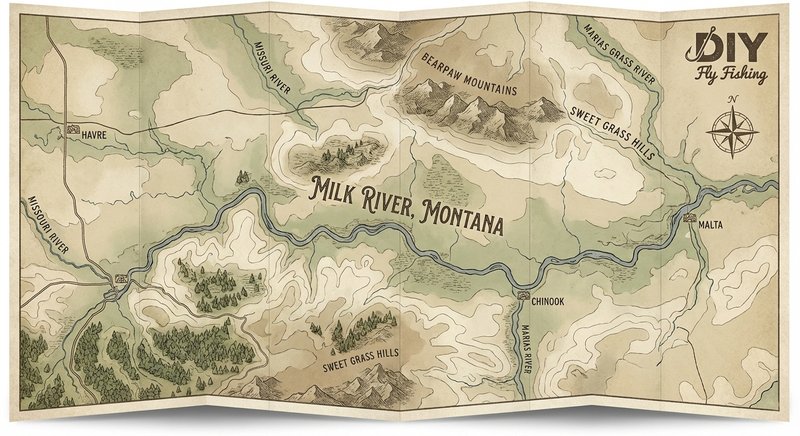
Milk River
Fly fishing in Montana · Beginner · Best seasons: Summer, Fall
Target Species
Walleye, Northern Pike, Sauger
About This Water
Northern Montana prairie river with walleye, pike, and sauger. Unique plains fishing.
Fishing Recommendations
The Milk River in North-Central Montana is a hidden gem for the adventurous angler. Unlike the crystal-clear, fast-moving trout streams of Western Montana, the Milk is a meandering, "prairie-style" river characterized by its silt-laden, tea-colored water and slow-moving deep pools. It offers a rugged, remote experience where you are more likely to see a mule deer or a coyote than another angler.
For those willing to trade the "Blue Ribbon" trout crowds for the toothy predators of the plains, the Milk River provides some of the best warm-water fly fishing in the Big Sky State.
🎣 Location Overview
The Milk River originates in the foothills of the Rockies and winds its way through the vast Montana prairie before joining the Missouri River. Its name comes from its distinct "milky" appearance, caused by fine silt and clay suspension.
This is a low-gradient river with high cutbanks, muddy bottoms, and an abundance of sunken timber. It is a highly productive ecosystem, though it is extremely sensitive to rainfall; a heavy storm can turn the river into "chocolate milk" overnight. Anglers love it for the solitude and the opportunity to catch trophy-sized Walleye and Northern Pike on a fly rod—a feat many Montana anglers never attempt.
🐟 Target Species & Behavior
Walleye & Sauger
In the Milk River, these two cousins behave similarly. They are light-sensitive bottom-dwellers. They use the river’s turbidity to their advantage, hunting small forage fish like fathead minnows and shiners.
- Where they hold: Look for the "seams" where faster water meets slow deep pools, and the downstream side of sandbars.
- Behavior: They are most active during "the magic hour"—dawn and dusk—when they move into shallower water to feed.
Northern Pike
The apex predator of the Milk. These "water wolves" are ambush specialists.
- Where they hold: Anywhere there is structure. Sunken logs, root balls, and the mouths of small coulees/tributaries are prime territory.
- Behavior: They are highly aggressive. In the summer, they will strike out of territorial dominance; in the fall, they are feeding heavily to bulk up for winter.
📅 Best Times to Fish
Summer (July – August)
- Conditions: The water level drops and stabilizes after the spring runoff.
- Time of Day: Early morning (5:00 AM – 9:00 AM) and late evening. During the heat of the day, fish go deep and become lethargic.
- Note: Watch the water temperature; if it gets too high, the fish (especially Pike) can become stressed.
Fall (September – November) PRIME TIME
- Conditions: This is the golden window. The water clears significantly, and temperatures drop.
- Time of Day: You can fish all day. The Walleye feeding window stays open longer, and Pike become incredibly aggressive.
- The "Fall Run": As the water cools, fish move toward deeper holes near the confluence with the Missouri or below dams (like Fresno or Vandalia).
🪰 Recommended Flies & Techniques
Top Fly Patterns
Visibility is key in the Milk River. Think Contrast, Flash, and Vibration.
- Clouser Minnows: (Size 2 to 2/0) Chartreuse/White or Black/Silver. The jigging motion is irresistible to Walleye.
- Game Changers: (4"–6") White or Perch patterns. The vibration these create in murky water helps Pike find them.
- Bunny Leeches: (Size 2) All black or purple. The movement of rabbit strips works wonders in slow current.
- Dirty Hippy: A great articulated streamer that moves a lot of water.
Techniques
- Dredging the Bottom: For Walleye and Sauger, you must be near the bottom. Use a Type 3 or Type 6 sinking tip.
- The "Milk River Twitch": Use a slow, erratic strip with long pauses. Walleye often hit the fly on the "drop" after a strip.
- Pike Stripping: For Pike, use a faster, more aggressive strip-strip-pause cadence. Use a wire tippet (15-20lb) or heavy fluorocarbon (40lb+) to prevent bite-offs.
💡 Pro Tips & Local Knowledge
- Focus on the Tailwaters: The area below Fresno Dam (near Havre) and Vandalia Diversion (near Glasgow) are hotspots. The dams oxygenate the water and concentrate baitfish.
- The "Gumbo" Factor: Montana's prairie soil (gumbo) is notorious. If it rains even a little, the access roads become impassable, and the river turns to mud. Always check the 48-hour weather forecast before heading out.
- Black is King: In turbid water, a black fly creates the strongest silhouette against the surface. If white/chartreuse isn't working, switch to a solid black Wooly Bugger or Leech.
- Noise Matters: Use flies with rattles or large heads (like a Muddler Minnow style) to create a "push" of water that fish can feel with their lateral lines.
⚠️ Important Information
Access
- The Milk River flows largely through private land. Use the Montana Fishing Access Sites (FAS) or bridge crossings.
- BLM Land: There are significant stretches of BLM land near Malta and Glasgow that offer great walk-in access. Use an app like OnX Maps to stay legal.
Regulations & Permits
- A Montana Fishing License and AIS (Aquatic Invasive Species) Prevention Pass are required.
- The Milk River is in Region 6. Note that Sauger and Walleye have different daily limits, and you must keep the tail on any Sauger for identification (Sauger have spots on the dorsal fin and a different tail marking).
Safety
- Rattlesnakes: The Missouri Breaks and Milk River country are prime rattlesnake habitat in the summer. Wear brush pants or gaiters.
- Hydration: It gets incredibly hot and dry in the summer. Carry more water than you think you need.
Bug Hatches & Matching Flies
| Hatch | Type | Peak months | Time of day | Hook sizes | Matching flies |
|---|---|---|---|---|---|
| Blue-Winged Olives Baetis spp. | mayfly | April, May, September, October | Midday | #18-22 | Parachute Adams #18-22, RS2 #20-22, Pheasant Tail #18-20 |
| Tricos Tricorythodes spp. | mayfly | July, August, September | Early Morning | #20-24 | Trico Spinner #20-24, Drowned Trico #22, Griffith's Gnat #20-22 |
| Spotted Sedge Hydropsyche spp. | caddis | June, July, August | Evening | #14-18 | Elk Hair Caddis #14-18, LaFontaine's Deep Sparkle Pupa #16, Soft Hackle Hare's Ear #14-16 |
| Grasshoppers Melanoplus spp. | terrestrial | July, August, September | Midday to Afternoon | #8-12 | Morrish Hopper #10-12, Parachute Hopper #8-12, Joe's Hopper #10 |
| Pale Morning Duns Ephemerella inermis/infrequens | mayfly | June, July | Late Morning to Afternoon | #16-18 | PMD Sparkle Dun #16-18, Split Case PMD #16-18, CDC Floating Nymph #16 |
| Midges Chironomidae | midge | March, April, October, November | All Day | #18-24 | Zebra Midge #18-22, Morgan's Midge #20-24, Palomino Midge #20-22 |
| Yellow Sallies Isoperla spp. | stonefly | June, July | Evening | #14-16 | Yellow Stimulator #14-16, Iron Sally #14-16, Sally Side-Down #16 |
| Damselflies Enallagma spp. | other | July, August | Midday | #10-14 | Marabou Damsel #10-12, Adult Damsel #12-14 |