Mill Creek
Fly fishing in California · Intermediate · Best seasons: Summer, Fall
Target Species
Rainbow Trout, Brook Trout
About This Water
Wild and Scenic River near Lassen with native trout. Remote backcountry fishing experience.
Fishing Recommendations
🎣 Location Overview
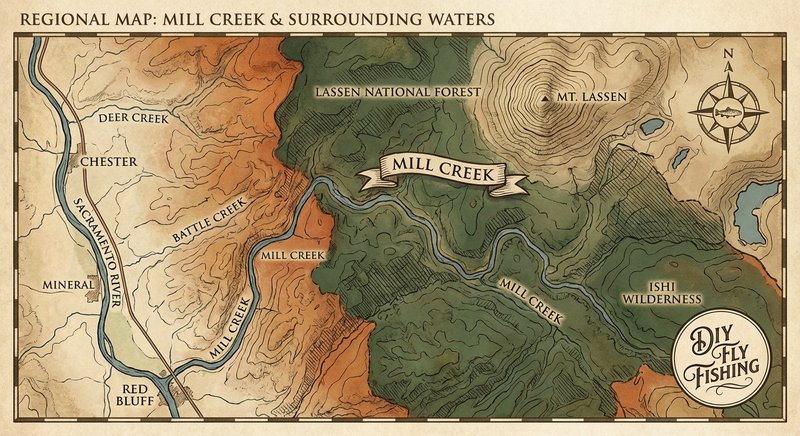
Mill Creek is a stunning, high-gradient freestone stream located in Northern California, primarily flowing through the Lassen National Forest and the southern reaches of Lassen Volcanic National Park. This isn’t your typical lazy meadow stream; it is a rugged, boulder-strewn drainage that carves through deep volcanic canyons.
What makes Mill Creek truly special is its wild, primitive character. Because much of it is roadless and requires hiking to access, the fishing pressure is remarkably low. The water is crystal clear, cold, and highly oxygenated, creating a playground for wild trout. Anglers love it for the "pocket water" fishing—short, quick casts into tiny eddies and behind large volcanic boulders where hungry trout lie in wait.
🐟 Target Species & Behavior
The creek is a stronghold for wild, native fish that are known for their tenacity rather than their sheer size.
- Rainbow Trout: These are the primary residents. They are incredibly hardy, sporting vivid pink lateral lines and heavy spotting. In the fast water of Mill Creek, these fish are "opportunistic predators"—they don't have time to inspect a fly closely because the current moves so fast. They hit hard and fast.
- Brook Trout: Found more frequently in the higher elevations and smaller tributaries of the Mill Creek drainage. They are opportunistic and often congregate in the slower, deeper pools or the "tail-outs" of the larger runs.
- Behavior: These fish are spooky due to the clarity of the water. However, because the nutrient levels in high-elevation freestones are lower than in spring creeks, they are rarely "picky." If you can get a fly to them without showing them your shadow, they will likely strike.
📅 Best Times to Fish
- Optimal Seasons: Late June through October.
- Spring is often unfishable due to heavy snowmelt (runoff) which turns the creek into a dangerous torrent.
- Summer (July-August) is prime time for dry fly action as the water levels stabilize.
- Fall (September-October) offers the best wading conditions and beautiful scenery, with fish feeding aggressively to bulk up for winter.
- Best Time of Day:
- Mid-morning to Late Afternoon: Unlike lower-elevation rivers, Mill Creek stays cold. You don't need to be there at dawn. The best insect activity occurs when the sun hits the water and warms the surface slightly.
- Prime Windows: The "Golden Hour" on Mill Creek is often from 2:00 PM to 5:00 PM when caddis and stoneflies are most active.
🪰 Recommended Flies & Techniques
Top Fly Patterns
- Dry Flies:
- Royal Wulff or Royal Coachman (Size 12-14): The classic attractor. High visibility is key in the white water.
- Elk Hair Caddis (Tan or Olive, Size 14-16): Mimics the abundant caddis populations.
- Parachute Adams (Size 14-18): For the flatter glides and slower pools.
- Stimulators (Orange or Yellow, Size 10-12): Great for mimicking large stoneflies or grasshoppers in late summer.
- Nymphs:
- Pheasant Tail (Size 16-18): A universal producer.
- Prince Nymph (Size 12-14): The "flash" works well in deep, dark holes.
- Golden Stonefly Nymphs: Essential for the deeper runs.
Effective Techniques
- High-Sticking / Tight-Line Nymphing: Because the currents are complex, traditional indicator nymphing often leads to "drag." Use a heavy nymph and keep as much fly line off the water as possible.
- Dry-Dropper: This is the "bread and butter" of Mill Creek. Tie a buoyant dry fly (like a Stimulator) and hang a small Bead-head Pheasant Tail 18 inches below it.
- The "Pocket Water" Approach: Don't spend 30 minutes in one hole. Cast 3–5 times into a pocket, and if nothing hits, move to the next one.
💡 Pro Tips & Local Knowledge
- Stealth is Vital: The water is gin-clear. If you stand on top of a boulder looking into a pool, the fish have already seen you. Crouch low, wear earthy colors, and fish "upstream" so you are approaching the fish from behind their field of vision.
- Look for the "Seams": The best fish stay where the fast "white" water meets the slow "green" water. That bubble line is a conveyor belt of food.
- The Hole in the Wall: If you are fishing near the Ishi Wilderness sections, look for deep undercut banks under volcanic ledges. These spots often hold the largest Rainbows that are hiding from the midday sun.
- Rod Choice: A 7.5ft to 8.5ft 3-weight or 4-weight rod is perfect. You don't need long casts; you need accuracy and the ability to maneuver under overhanging branches.
⚠️ Important Information
- Access: Access points include the Black Rock Campground area and various trailheads within Lassen Volcanic National Park. Be prepared for steep hikes; the "Mill Creek Trail" offers some of the best access but requires good physical conditioning.
- Regulations: Always check the current California Department of Fish and Wildlife (CDFW) regulations. Sections of Mill Creek may have specific gear restrictions (barbless hooks) or seasonal closures to protect spawning salmon or steelhead in the lower reaches.
- Safety: This is rugged country. Cell service is non-existent. Bear spray is recommended as both Black Bears and the occasional Mountain Lion frequent the canyon.
- Wading: The volcanic rocks are extremely slippery. Felt-soled boots or boots with metal studs/cleats are highly recommended to avoid a fall in the fast current.
Bug Hatches & Matching Flies
| Hatch | Type | Peak months | Time of day | Hook sizes | Matching flies |
|---|---|---|---|---|---|
| Salmonfly Pteronarcys californica | stonefly | May, June | All day | #4-8 | Rogue River Salmonfly #4-6, Pats Rubber Legs #4-8 |
| Golden Stonefly Hesperoperla pacifica | stonefly | June, July | Morning/Evening | #8-12 | Norm Wood Special #8-10, 20 Incher Stone #8-12 |
| Pale Morning Dun Ephemerella excrucians | mayfly | June, July, August | Late Morning/Afternoon | #14-18 | Sparkle Dun #16-18, Pheasant Tail #14-18 |
| Blue Winged Olive Baetis | mayfly | March, April, October, November | Midday | #18-22 | Parachute Adams #18-22, RS2 #20-22 |
| Spotted Sedge Hydropsyche | caddis | June, July, August, September | Evening | #14-18 | Elk Hair Caddis #14-16, LaFontaine's Deep Sparkle Pupa #14-16 |
| Little Yellow Stone Isoperla | stonefly | June, July | Afternoon/Evening | #14-16 | Yellow Sally #14-16, Iron Lotus #16 |
| October Caddis Dicosmoecus atripes | caddis | September, October | All day | #8-12 | Stimulator (Orange) #8-10, Pecka's October Caddis Pupa #10-12 |
| Little Olive Stonefly Zapada cinctipes | stonefly | February, March, April | Midday | #14-18 | Little Olive Stone #16, Prince Nymph #14-18 |
| Terrestrials Formicidae / Gryllidae | terrestrial | July, August, September | Late Afternoon | #10-16 | Carpenter Ant #14-16, Morrish Hopper #10-12 |