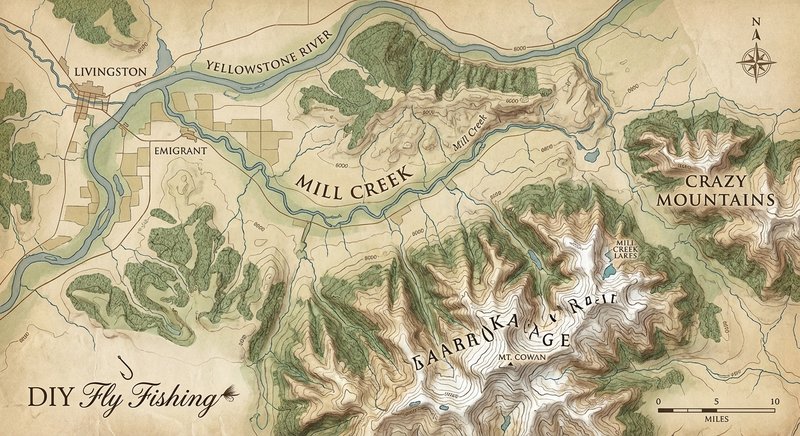
Mill Creek
Fly fishing in Montana · Intermediate · Best seasons: Summer, Fall
Target Species
Cutthroat Trout, Rainbow Trout
About This Water
Paradise Valley tributary with wild cutthroat and rainbow trout. Scenic backcountry fishing.
Fishing Recommendations
Welcome to one of the hidden gems of the Paradise Valley. While most anglers flock to the Yellowstone River or the famous spring creeks nearby, Mill Creek offers a quintessential small-stream mountain experience. As your guide, I’m excited to walk you through this rugged, high-gradient fishery.
🎣 Location Overview
Mill Creek is a major tributary of the Yellowstone River, flowing out of the Absaroka-Beartooth Wilderness east of Pray, Montana. It is a high-energy, freestone stream characterized by plunging pools, tight pocket water, and crystal-clear mountain runoff.
What makes Mill Creek special is its wildness. Unlike the wider, slower sections of the Yellowstone, Mill Creek requires physical agility and precise casting. It is a "busy" creek—lots of boulders, downed timber, and varying currents. Anglers love it because it offers a break from the boat-heavy traffic of the main river, providing a "blue-line" experience where the fish are opportunistic and the scenery is unmatched.
🐟 Target Species & Behavior
- Yellowstone Cutthroat Trout: The crown jewel of the creek. These fish are known for their stunning orange slashes and aggressive takes. They are generally not "leader shy" but are very sensitive to overhead movement and shadows.
- Rainbow Trout: Found primarily in the lower reaches near the confluence with the Yellowstone. They are harder fighters and tend to hold in the faster, highly oxygenated "riffle" water.
- Behavior: Because the growing season is short and the water is nutrient-poor compared to the valley floor, these fish are opportunistic. They don't have the luxury of being picky; if it looks like food and isn't dragging, they will usually smash it. They hold in "soft" pockets—behind boulders, in the tail-outs of pools, and underneath overhanging brush.
📅 Best Times to Fish
- Summer (Late June – August): This is the prime window. Runoff is the biggest factor here. Mill Creek can be a torrent until late June. Once the water clears and drops, the dry fly fishing is world-class.
- Fall (September – October): This is the local favorite. The water is low, the crowds are gone, and the fish are putting on weight for winter. The fall colors in the canyon are spectacular.
- Best Time of Day: In the heat of summer, 9:00 AM to 4:00 PM is perfect as the sun hits the water and triggers insect activity. In the fall, wait for the water to warm up slightly; 11:00 AM to 5:00 PM is the sweet spot.
- Conditions: Overcast days can trigger incredible Blue Winged Olive hatches, but generally, bright sun is fine here because the water is so well-oxygenated.
🪰 Recommended Flies & Techniques
Top Fly Patterns
- Dry Flies:
- Chubby Chernobyl (Tan/Orange, size 10-14): The ultimate attractor and floatation device for a dropper.
- Royal Wulff or Royal Trude (size 12-16): High visibility in broken water.
- Parachute Adams (size 14-18): For when they get a bit more selective during a hatch.
- Ants and Beetles (size 14-16): Crucial for late summer/fall.
- Nymphs:
- Pheasant Tail (size 14-18): A classic that never fails.
- Copper John (Red or Copper, size 14-16): Sinks fast in heavy pockets.
- Perdigons: Great for slicing through the fast current to reach the bottom quickly.
Techniques & Presentation
- Dry-Dropper: This is the "bread and butter" on Mill Creek. Use a buoyant dry fly (like a Chubby) and hang a weighted nymph 18-24 inches below it.
- Short Line Casting: You rarely need to cast more than 20-30 feet. Focus on "high-sticking" to keep your line off the complex, multi-directional currents.
- Stealth: The water is clear. Approach pools from downstream and stay low. If you can see the fish, they’ve likely already seen you.
💡 Pro Tips & Local Knowledge
- The "Pocket Water" Secret: Many anglers bypass the small pockets (the size of a dinner plate) between large boulders. Don't. A 14-inch Cutthroat will often sit in a tiny soft spot right in the middle of heavy whitewater.
- Upper vs. Lower: The lower section (near the Forest Service boundary) has more rainbows and easier access. As you head further up the canyon toward the trailhead (Passage Creek area), the fish get smaller but the percentage of pure Yellowstone Cutthroats increases.
- The Terrestrial Factor: In August, the canyon walls are crawling with grasshoppers and ants. If the "standard" Mayfly patterns aren't working, throw a size 14 Cinnamon Ant right against the bank.
⚠️ Important Information
- Access: Much of the lower creek flows through private ranch land. Use the established Fishing Access Sites (FAS) or stay within the high-water mark if you enter via public bridges. Once you enter the Gallatin National Forest (heading east up Mill Creek Road), you have miles of public access.
- Regulations: Always check the current Montana FWP regulations. Mill Creek is generally open from the third Saturday in May through November 30th. Pay attention to specific limits on Cutthroat trout (often catch and release only).
- Wildlife & Safety: This is Grizzly Bear country. Always carry bear spray, make noise while walking through thick brush, and fish with a partner if possible.
- Wading: The rocks are incredibly slick and "rolly." Felt soles or studded boots are highly recommended, along with a wading staff.
Guide’s Final Word: Mill Creek isn't about catching the biggest fish in Montana; it's about catching the prettiest fish in one of the most beautiful canyons in the West. Bring a 4-weight rod, a box of bushy dries, and your camera. Tight lines!
Bug Hatches & Matching Flies
| Hatch | Type | Peak months | Time of day | Hook sizes | Matching flies |
|---|---|---|---|---|---|
| Salmonfly Pteronarcys californica | stonefly | June, July | All Day | #4-8 | Rogue River Stone #4-6, Pat's Rubber Leg #6-8, Cat Puke #6 |
| Golden Stonefly Hesperoperla pacifica | stonefly | July | Morning/Afternoon | #8-12 | Chubby Chernobyl (Gold) #8-12, Golden Stone Nymph #10-12, Water Walker #10 |
| Pale Morning Dun (PMD) Ephemerella excrucians | mayfly | July, August | Late Morning/Afternoon | #14-18 | Sparkle Dun #16-18, Pheasant Tail #14-18, RS2 #16-18 |
| Yellow Sally Isoperla | stonefly | July, August | Late Afternoon/Evening | #14-16 | Yellow Stimulator #14-16, Little Yellow Sloan #14-16, Iron Sally #14-16 |
| Blue Winged Olive (BWO) Baetis | mayfly | April, May, September, October | Midday | #18-22 | Parachute Adams #18-22, Zebra Midge #18-20, BWO CDC Emerger #20 |
| Spotted Sedge Hydropsyche | caddis | July, August | Evening | #14-18 | Elk Hair Caddis (Tan) #14-16, LaFontaine's Deep Sparkle Pupa #14-16, X-Caddis #16 |
| Grasshoppers Orthoptera | terrestrial | August, September | Late Morning/Afternoon | #8-14 | Morrish Hopper #10-12, Pink Pookie #12, Rainy's Grand Hopper #8-12 |
| Mother's Day Caddis Brachycentrus occidentalis | caddis | May | Afternoon | #14-16 | Peacock Caddis #14-16, Guide's Choice Hare's Ear #14-16, Holy Grail Caddis #16 |