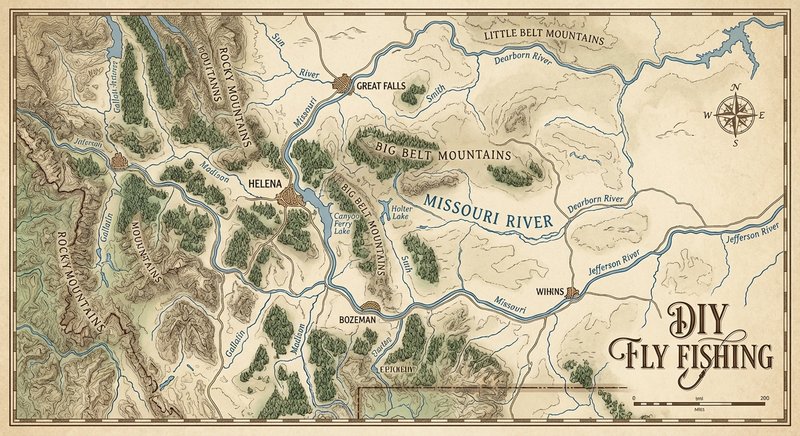
Missouri River
Fly fishing in Montana · Intermediate · Best seasons: Spring, Summer, Fall
Target Species
Rainbow Trout, Brown Trout
About This Water
Below Holter Dam, this legendary tailwater produces trophy rainbow and brown trout. Famous for its trico and PMD hatches with fish averaging 16-20 inches.
Fishing Recommendations
The "Mighty Mo" is often described by guides as the world's largest spring creek. While technically a tailwater flowing from the bottom of Holter Dam, its consistent temperatures, massive biomass of insects, and steady flows create a fertile environment where trout grow fat, fast, and notoriously picky.
🎣 Location Overview
The Missouri River near Craig, Montana, is a blue-ribbon paradise. Unlike the rushing mountain freeways of the Gallatin or the Yellowstone, the Mo is a wide, flat, and powerful river. It is characterized by long, glassy glides, subtle riffles, and "weed islands" that harbor astronomical numbers of insects.
What makes it special is the biomass. There are more fish per mile here (often exceeding 3,000–5,000 trout per mile) than almost anywhere else in the Lower 48. Anglers love it because it offers the ultimate test of "technical" fly fishing—where long leaders, light tippets, and perfect presentations are the currency of success.
🐟 Target Species & Behavior
- Rainbow Trout: These make up the bulk of the population. Missouri River Rainbows are exceptionally strong, often "hot" fish that will peel backing off your reel and jump repeatedly. They typically hold in the faster riffles and "buckets" behind rock shelves.
- Brown Trout: The river holds massive, predatory Browns, particularly in the lower stretches toward Cascade. While they eat dry flies, the bigger specimens are often found tight to the banks or tucked under overhanging vegetation, waiting for a streamer or a high-calorie meal.
- Behavior: These fish have "PhDs." Because of the clear water and high fishing pressure, they are highly selective to fly size, color, and—most importantly—drift. If your fly has even a micro-inch of drag, they will refuse it.
📅 Best Times to Fish
The Missouri is a year-round fishery, but the "Big Three" seasons offer distinct experiences:
- Spring (April – May):
- Why: The season of the Blue Winged Olive (BWO) and Midges.
- Conditions: Cool, often overcast days are best. This is when the river is least crowded, and the nymphing is lights-out.
- Summer (June – August):
- Why: The "Golden Age" of dry fly fishing. Pale Morning Duns (PMDs) hatch in June/July, followed by the legendary Trico hatch in late July and August.
- Window: For Tricos, you must be on the water at dawn. By noon, the "spinner fall" begins, and the river looks like it’s raining fish.
- Fall (September – November):
- Why: The crowds thin out, and the October Caddis and BWO second-act begin. This is also prime time for streamer fishing to aggressive, pre-spawn Brown Trout.
🪰 Recommended Flies & Techniques
Nymphing (The Bread & Butter)
The Missouri is a "scud and sowbug" river. Fish two nymphs under a strike indicator with split shot.
- Patterns: Ray Charles (grey/pink), Firebead Soft Hackle Sowbugs, Zebra Midges (black/silver), and the Weight Fly.
- Technique: Use a long leader (9–12ft) and adjust your depth constantly. The fish often hold in 3–5 feet of water in the "walking pace" current.
Dry Fly (The Holy Grail)
- Patterns: Sparkle Duns (PMD/BWO), Buzzballs (a local favorite), RS2s, and Harrop’s CDC Midge. For Tricos, use a size 20-24 Trico Spinner.
- Technique: Reach casts and pile casts are mandatory. You must achieve a "dead drift" for at least 3-5 feet over the fish’s nose. Use 5X or 6X fluorocarbon tippet.
Streamers (The Big Game)
- Patterns: Kreelex, Skiddish Jig, and any pattern in "Copper" or "Olive/White."
- Technique: The "trout spey" craze is huge here. Swinging streamers with a two-handed rod is highly effective in the fall.
💡 Pro Tips & Local Knowledge
- The "Missouri Twitch": When fishing a dry fly, a microscopic twitch just as the fly enters the fish's window can sometimes trigger a strike from a stubborn trout. But be careful—too much movement will spook the pool.
- Focus on the "Vortex": Look for "sipping" rises in the foam lines and eddies. The biggest fish often sit in the slowest water because they don't want to burn calories.
- The Town of Craig: This is the heartbeat of the river. Stop by The Trout Shop, CrossCurrents, or Headhunters for the daily "hot" fly. The local knowledge there is invaluable.
- Rowing the Mo: If you are in a drift boat, the wind is your biggest enemy. It usually blows upstream. Bring a heavy anchor and be prepared to row hard to stay on your lines.
⚠️ Important Information
- Access: Montana has excellent stream access laws. You can wade anywhere below the high-water mark. Major access points include Holter Dam (Landslide), Wolf Creek Bridge, Craig, and Prewett Creek.
- Regulations: The Missouri is a "General Eastern District" water, but specific sections have "Catch and Release" or "Artificial Lures Only" rules. Always check the current Montana FWP Regulations booklet before casting.
- AIS Pass: If you are bringing your own boat or waders from out of state, you must have a Montana AIS (Aquatic Invasive Species) prevention pass and ensure your gear is "Clean, Drain, Dry."
- Wind & Sun: The Montana sun is brutal and the wind is relentless. Pack high-quality polarized glasses (amber or copper lens) and a heavy-duty windbreaker.
Guide’s Final Thought: Don't get frustrated. The Missouri can be humbling. If you miss ten fish in a row, change your tippet, check your fly for "slime," and take a breath. When it finally clicks, you’ll be hooked on the Mo for life.
Bug Hatches & Matching Flies
| Hatch | Type | Peak months | Time of day | Hook sizes | Matching flies |
|---|---|---|---|---|---|
| Midges Chironomidae | midge | February, March, April | All day | #18-24 | Zebra Midge #18-22, Griffith's Gnat #20-24, Buzzball #18-22 |
| Blue-Winged Olive (BWO) Baetis | mayfly | April, May, September, October | Late Morning/Afternoon | #16-20 | RS2 #18-20, BWO Sparkle Dun #18-20, Little Turbo Baetis #18-20 |
| Pale Morning Dun (PMD) Ephemerella invaria | mayfly | June, July | Late Morning/Early Afternoon | #16-18 | PMD Split Case #16-18, Last Chance Cripple #16-18, Rusty Spinner #16-18 |
| Tricos Tricorythodes | mayfly | July, August, September | Early Morning | #20-26 | Trico Spinner #20-24, Drowned Trico Spinner #22-24, Buzzball #20-22 |
| Caddis Hydropsyche | caddis | May, June, August | Evening | #14-18 | Elk Hair Caddis #14-18, Weightless Peep Show #14-16, Translucent Pupa #16-18 |
| Grasshoppers Acrididae | terrestrial | August, September | Afternoon | #8-12 | Morrish Hopper #10-12, Chubby Chernobyl #8-12, Fat Albert #8-12 |
| March Brown Rhithrogena morrisoni | mayfly | April, May | Afternoon | #12-14 | March Brown Cripple #12-14, Gold Ribbed Hare's Ear #12-14, March Brown Western Red #12-14 |
| Pseudocloeon (Tiny BWO) Pseudocloeon | mayfly | September, October | Afternoon | #20-24 | Student #22-24, Smoke Jumper #20-22, FB Pheasant Tail #20-24 |