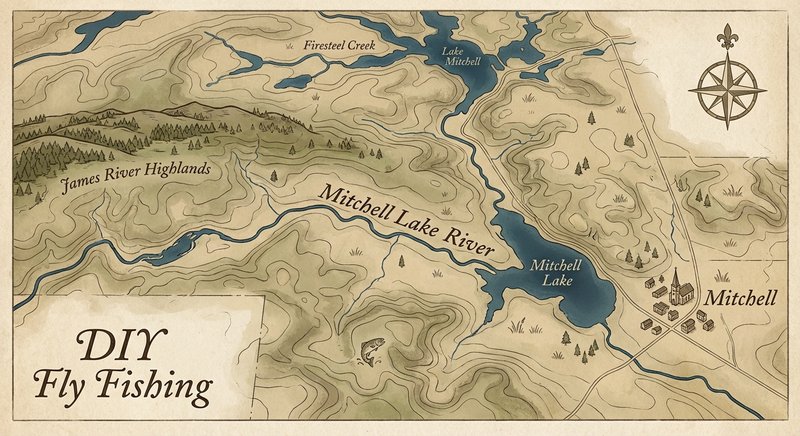
Mitchell Lake
Fly fishing in South Dakota · beginner · Best seasons: spring, summer, fall
Target Species
Rainbow Trout
About This Water
Black Hills lake with stocked trout. Forest Service campground access.
Fishing Recommendations
As your guide to the Black Hills, it is a pleasure to break down Mitchell Lake. Located just outside of Hill City, South Dakota, Mitchell Lake is often overshadowed by its larger neighbor, Sheridan Lake, or the more famous streams like Spearfish Creek. However, for the fly angler, Mitchell is a "gem in plain sight."
It is a small, 8-acre impoundment on Spring Creek that offers a classic Black Hills experience: ponderosa pines, granite outcroppings, and surprisingly eager trout.
🎣 Location Overview
Mitchell Lake is a quintessential Black Hills "small water" fishery. What makes it special is its accessibility paired with its productivity. Because it is an impoundment of Spring Creek, it has a constant flow of cold, oxygenated water and a steady supply of nutrients, which makes it far more "buggy" than a typical high-mountain lake.
The water is generally clear but can take on a slight stain after heavy rains. It features shallow mud flats on the inlet side (west end) and deeper water near the dam (east end). Anglers love it because it’s easy to fish from the bank, but it truly shines for those in a float tube or kayak who can reach the weed lines that the trout use for cover.
🐟 Target Species & Behavior
The primary draw here is the Rainbow Trout.
- Behavior: The trout in Mitchell Lake behave differently depending on the water temperature. In the spring and fall, they cruise the shallow edges and the inlet looking for washed-in insects. During the heat of summer, they retreat to the deeper channel near the dam or hug the bottom where the water stays cooler.
- Feeding: Because this is a dammed creek, the fish feed heavily on midges, scuds, and damselflies. Unlike some sterile mountain lakes, Mitchell has a healthy population of freshwater shrimp (scuds) which keeps the trout's flesh pink and their energy levels high.
📅 Best Times to Fish
- Spring (Late April – June): This is the prime window. As the ice melts and the water warms, trout become extremely active in the shallows. The "ice-out" bite can be legendary.
- Summer (July – August): Focus on early mornings and late evenings. During the heat of the day, the bite slows down significantly. Look for the "evening rise" when the wind dies down.
- Fall (September – November): As temperatures drop, the fish move back into the shallows to bulk up for winter. This is the best time for aggressive streamer strikes.
- Time of Day: The "Golden Hour" (6:00 PM to dusk) is particularly effective here for dry fly action.
🪰 Recommended Flies & Techniques
Top Fly Patterns
- Nymphs/Sub-surface:
- Zebra Midge (Red or Black, sizes 18-22): A staple for Black Hills lakes.
- Ray Charles or Scud patterns (Olive or Orange, sizes 14-18): Essential due to the Spring Creek influence.
- Pheasant Tail Nymph (Size 14-16): Mimics the mayflies found in the inlet.
- Dry Flies:
- Parachute Adams (Size 16-20): The best all-around searcher pattern.
- Griffith’s Gnat (Size 18-22): For the tiny midges that hatch year-round.
- Damselfly Adult (Blue, size 12): Exciting fishing in mid-summer.
- Streamers:
- Woolly Bugger (Thin Mint or Black, sizes 8-12): The universal trout tempter.
- Pine Squirrel Leech (Natural or Olive): Very effective when stripped slowly.
Techniques
- The "Nymph Under Dry" (Hopper-Dropper): In the spring and summer, hang a Zebra Midge or a Scud 2-3 feet under a buoyant dry fly. Cast along the weed edges.
- Slow-Strip Streamers: Use a weighted Woolly Bugger on a floating line with a long leader. Cast out, let it sink toward the bottom, and use very slow, 2-inch "crawling" strips.
- Stillwater Indicator Rigging: If fishing from the bank near the dam, use a slip-indicator to get your flies down 6–10 feet where the water is cooler.
💡 Pro Tips & Local Knowledge
- The Inlet Secret: The western end where Spring Creek enters the lake is the "honey hole." The moving water brings in food and oxygen. If the rest of the lake feels "dead," move to the inlet.
- Float Tube Advantage: While you can fish from the shore, a float tube allows you to cast toward the shore. Many of the best fish hide under the overhanging brush and logs on the southern bank, which is difficult to fish from land.
- Mind the Wind: Mitchell Lake is tucked in a bit of a canyon, but the wind can still whip through. If it's windy, fish the "leeward" side (the side the wind is blowing away from) to find the calmest surface for dry fly presentation.
- The "Mid-Day Deep": If you must fish at noon in July, don't bother with dries. Go small and deep. A size 20 Black Zebra Midge at 12 feet deep is often the only way to trigger a strike.
⚠️ Important Information
- Access: Located right off Highway 16/385, just east of Hill City. There is a convenient parking area and a well-maintained path.
- Regulations: A valid South Dakota fishing license is required. Mitchell Lake is subject to general statewide regulations, but always check the South Dakota Game, Fish & Parks (GFP) handbook for current creel limits and bait restrictions.
- Special Consideration: This is a multi-use area. You may encounter kayakers and families. To find peace, walk further away from the parking lot toward the southern shore or the western inlet.
- Wading: The bottom can be quite silty/mucky in spots. Be careful when wading; it's easy to get a boot stuck or cloud up the water you are trying to fish.
Tight lines! Mitchell Lake is the perfect place to hone your stillwater skills before tackling the larger reservoirs in the Black Hills.
Bug Hatches & Matching Flies
| Hatch | Type | Peak months | Time of day | Hook sizes | Matching flies |
|---|---|---|---|---|---|
| Chironomids Chironomidae | midge | April, May, June, September | All Day | #18-24 | Zebra Midge #18-22, Ice Cream Cone #16-18, Griffith's Gnat #20-22 |
| Callibaetis Callibaetis ferrugineus | mayfly | June, July, August | Late Morning/Afternoon | #12-16 | Callibaetis Spinner #14-16, Hare's Ear Nymph #12-16, Mercer's Poxyback Callibaetis #14-16 |
| Spotted Sedge Hydropsyche | caddis | June, July | Evening | #14-18 | Elk Hair Caddis #14-16, LaFontaine's Deep Sparkle Pupa #14-16, Goddard Caddis #14-16 |
| Blue-Winged Olive Baetis tricaudatus | mayfly | April, May, September, October | Afternoon | #18-22 | RS2 #20-22, Parachute Adams #18-22, Pheasant Tail Nymph #18-20 |
| Terrestrial Ants Formicidae | terrestrial | July, August, September | Afternoon | #14-20 | Black Foam Ant #16-18, Cinnamon Ant #16-18, Transparant #18-20 |
| Little Brown Sedge Lepidostoma | caddis | August, September | Late Afternoon/Evening | #16-20 | CDC Caddis #18-20, Soft Hackle Hare's Ear #16-18 |
| Grasshoppers Acrididae | terrestrial | August, September | Afternoon | #8-12 | Parachute Hopper #10-12, Joe's Hopper #10-12, Amy's Ant #12 |
| Trico Tricorythodes | mayfly | July, August | Early Morning | #20-24 | Trico Spinner #22-24, Drowned Trico #22-24 |