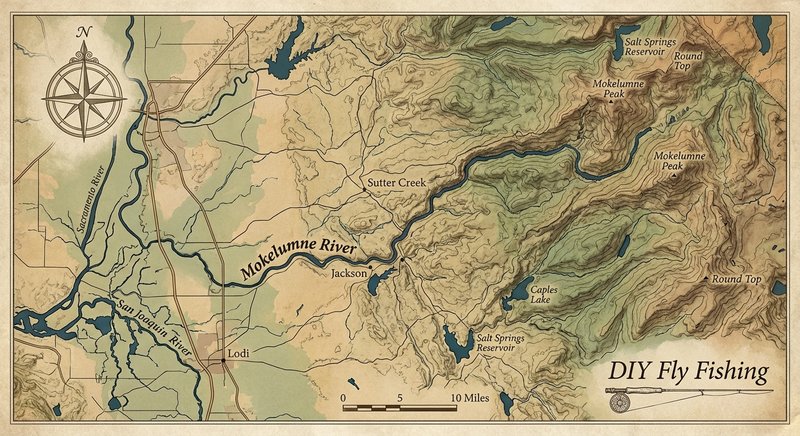
Mokelumne River
Fly fishing in California · Beginner · Best seasons: Spring, Summer, Fall
Target Species
Rainbow Trout, Steelhead
About This Water
Below Camanche Dam with rainbow trout. Accessible fishery in California's gold country.
Fishing Recommendations
Welcome to one of Central California’s most unique fisheries. As a guide, I often describe the Mokelumne River (the "Moke") as a tale of two rivers. We have the upper reaches in the Sierras for wild trout, but most anglers looking for size and the thrill of Steelhead focus on the Lower Mokelumne, specifically the stretch below Camanche Dam.
Here is your comprehensive guide to fly fishing the Mokelumne River.
🎣 Location Overview
The Mokelumne River is a vital waterway originating in the high Sierra Nevada and flowing into the San Joaquin Delta. For the fly angler, the "Lower Moke"—the tailwater section below Camanche Reservoir—is the primary focus.
What makes it special: It is a high-gradient tailwater in a valley setting. Unlike many valley rivers that are slow and silty, the Moke has beautiful gravel bars, classic riffle-run-pool sequences, and surprisingly cold water year-round thanks to the deep-water releases from Camanche Dam. It’s an intimate river; you don't need a drift boat to master it, making it one of the best walk-and-wade fisheries in the Central Valley.
🐟 Target Species & Behavior
Rainbow Trout
The river holds a solid population of resident Rainbows. These fish are "educated" due to proximity to Sacramento and Stockton. They hold in the faster oxygenated water at the heads of riffles during the summer and move into the deeper slots as the sun gets high.
Steelhead (Central Valley Steelhead)
The Moke has seen a massive resurgence in Steelhead runs thanks to the Mokelumne River Fish Hatchery.
- Behavior: These are hard-fighting, chrome-bright fish. They are often found in the "tail-outs" of long pools or holding in the seams of heavy current.
- Feeding: When they enter the river, they are less focused on feeding and more on aggression or egg-gobbling (during the salmon spawn).
📅 Best Times to Fish
Spring (March – May)
This is prime time for resident Rainbows. As the weather warms, we see prolific insect hatches. The water is usually clear before any major irrigation releases.
Summer (June – August)
The "tailwater effect" keeps the water cold (50–55°F) even when the valley hits 100°F. This is peak dry-fly season in the evenings. Focus on the pocket water.
Fall (Late September – November)
The Main Event. This is when the Chinook Salmon arrive to spawn, followed closely by the Steelhead. The resident trout go into a feeding frenzy on loose salmon eggs and displaced nymphs.
- Best Time of Day: Early morning (first light) is critical for Steelhead. For trout, the "Last Light" caddis hatch in the summer is legendary.
🪰 Recommended Flies & Techniques
Nymphing (Most Productive)
This is the bread and butter of the Moke.
- Technique: Indicator nymphing or European Nymphing in the riffles.
- Flies:
- Pheasant Tail (16-20)
- Zebra Midge (18-22) in black or red
- Pudding’s Beadhead Caddy (14-16)
- Glo-Bugs or San Juan Worms (during the fall salmon spawn)
Dry Fly Fishing
- Technique: Target the glassy slicks at dusk. Match the hatch precisely; these fish are picky.
- Flies:
- Elk Hair Caddis (14-18)
- Blue Winged Olive (18-22) on overcast days
- Parachute Adams (16-20)
Streamers
- Technique: Swinging a fly on a sink-tip line for Steelhead.
- Flies:
- Woolly Buggers (Black or Olive)
- Egg Leech patterns
- Small Intruders (in purple or blue)
💡 Pro Tips & Local Knowledge
- The "Egg" Factor: In October and November, if you aren't fishing an egg pattern behind spawning salmon, you’re missing out. However, do not fish directly on top of active spawning beds (redds)—it’s unsportsmanlike and disrupts the cycle. Fish the deeper water behind the beds.
- Flow Rates: Always check the USGS gauge for "Mokelumne River below Camanche Dam."
- Ideal wading: 300–700 cfs.
- Dangerous/Difficult: Anything over 1,500 cfs.
- Stealth Matters: Because the water is often crystal clear, long leaders (9–12 feet) and light tippet (5X or 6X for trout) are mandatory.
- Spotlight: The stretch at Lodi Lake or Van Assen Park offers different dynamics, but the water near the Mackville Road bridge is a local favorite for consistent trout action.
⚠️ Important Information
Access Information
- Camanche Hills / Day Use Area: The most popular access point is right below the dam.
- Lodi Lake Park: Good for lower river access, though the water is slower here.
- Mokelumne River Day Use Area: Managed by EBMUD; requires a small parking fee but offers excellent river access.
Regulations & Permits
- Barbless Hooks Only: Most of the Lower Moke is catch-and-release, barbless hook only.
- Steelhead Report Card: If you are targeting Steelhead, you must have a Steelhead Restoration Card in addition to your CA Fishing License.
- Closures: Sections of the river near the hatchery have specific seasonal closures to protect spawning fish. Always check the current CDFW Title 14 regulations before heading out, as they change annually.
Special Considerations
- Wading Safety: The bottom is exceptionally slippery. Felt soles (where legal) or studded boots are highly recommended.
- Hydration: The valley gets blistering hot. Even though the water is cold, bring more water than you think you need.
Tight lines, and enjoy the "Moke"—it’s a gem of the Central Valley!
Bug Hatches & Matching Flies
| Hatch | Type | Peak months | Time of day | Hook sizes | Matching flies |
|---|---|---|---|---|---|
| Blue Winged Olive Baetis | mayfly | March, April, October, November | Late Morning/Afternoon | #18-22 | RS2 #18-22, Parachute Adams #18-22, WD-40 #20-22 |
| Pale Morning Dun Ephemerella excrucians | mayfly | May, June, July | Morning/Early Afternoon | #14-18 | PMD Sparkle Dun #16-18, Pheasant Tail Nymph #14-18, Quigley Cripple #16 |
| Spotted Sedge Hydropsyche | caddis | May, June, July, August | Evening | #14-18 | Elk Hair Caddis #14-18, LaFontaine's Deep Sparkle Pupa #14-16, Pecka's Hydropsyche #14-16 |
| Golden Stonefly Calineuria californica | stonefly | June, July | Throughout the day | #8-12 | Pats Rubber Legs #8-12, Rogue River Stone #8-10, Golden Twenty Incher #10-12 |
| Midges Chironomidae | midge | January, February, March, December | Morning/Afternoon | #18-24 | Zebra Midge #18-22, Griffith's Gnat #20-24, Mercury Midge #20-22 |
| Salmonfly Pteronarcys californica | stonefly | May, June | Afternoon | #4-8 | Chubby Chernobyl #6-10, Kaufmanns Stone #4-8, Stimulator #8 |
| Little Yellow Stonefly Isoperla | stonefly | June, July | Late Afternoon/Evening | #14-16 | Yellow Sally Foam Dry #14-16, Iron Sally #14-16 |
| Trico Tricorythodes | mayfly | August, September | Early Morning | #20-24 | Trico Spinner #20-24, Sunken Trico #22 |
| Grasshoppers Acrididae | terrestrial | July, August, September | Afternoon | #8-12 | Hopper Juan #10-12, Dave's Hopper #8-12, Morrish Hopper #10 |