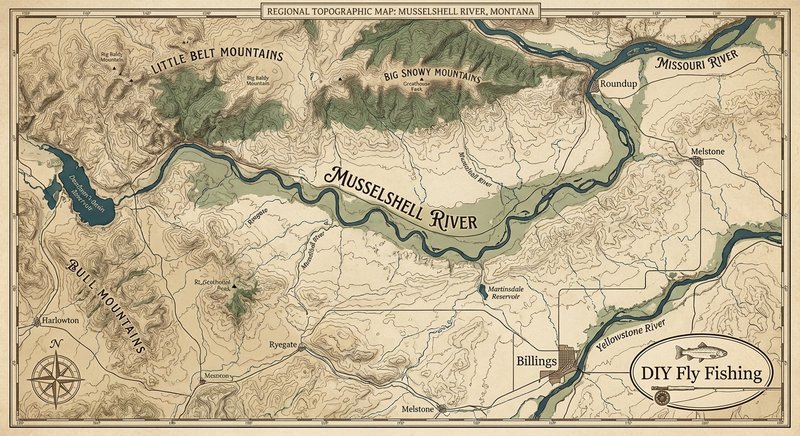
Musselshell River
Fly fishing in Montana · Beginner · Best seasons: Summer, Fall
Target Species
Brown Trout, Smallmouth Bass
About This Water
Central Montana prairie stream with brown trout and smallmouth bass. Underrated fishery.
Fishing Recommendations
The Musselshell River is one of Montana’s best-kept secrets. Flowing from the confluence of its North and South Forks near Martinsdale and winding its way east toward the Missouri River, the Musselshell is a river of two faces. It transitions from a classic cold-water trout stream in its upper reaches to a warm-water fishery as it meanders through the prairie.
For the intrepid angler, the Musselshell offers a "solitude-first" experience. You won't find the drift boat traffic of the Madison or the crowds of the Bighorn here. Instead, you'll find a winding, intimate river characterized by tight bends, undercut banks, and a unique overlap where you can catch a trophy Brown Trout and a feisty Smallmouth Bass in the same stretch of water.
🎣 Location Overview
The Musselshell is a classic "meandering" river. Because it flows through arid ranch land, its character is defined by cottonwood galleries, willow-lined banks, and deep, slow-moving silt-bottom pools interspersed with gravel riffles.
What makes it special is the transition zone. While the upper river is primarily a trout fishery, the middle section (around Harlowton to Ryegate) is a fascinating "mixed bag." The water stays cool enough for trout thanks to bottom-release dams and springs, but warms up enough in the summer to make Smallmouth Bass aggressive and plentiful. It is a rugged, technical river that rewards stealth and accurate casting over long-distance bombs.
🐟 Target Species & Behavior
Brown Trout
The Musselshell’s Brown Trout are notorious for being "bank-huggers." They utilize the heavy willow overhangs and deep undercuts to hide from the sun and avian predators.
- Behavior: They are opportunistic but wary. In the summer, they look for grasshoppers falling from the tall prairie grass. In the fall, they become aggressive and territorial as they prepare for the spawn.
- Holding Spots: Look for the "outside bends" where the current has carved out a deep pocket under the roots of a cottonwood.
Smallmouth Bass
As the river moves east and warms, the "Bronzeback" takes over. These fish are incredibly hardy and punch way above their weight class in the river’s current.
- Behavior: Smallmouth here love structure. They congregate around submerged rock piles, downed timber, and the edges of the slower, deeper pools.
- Feeding: They focus heavily on crayfish and minnows (sculpins and shiners).
📅 Best Times to Fish
Summer (July – August)
- The Draw: Terrestrial fishing. This is the peak of the hopper season.
- Time of Day: Early morning for trout; midday for Smallmouth (as the water warms, the bass become more active).
- Conditions: Look for "Hopper Winds"—a steady breeze that blows insects off the grass and into the water.
Fall (September – October)
- The Draw: The Brown Trout spawn and the "pre-winter gorge" for Bass.
- Time of Day: 10:00 AM to 4:00 PM. The water needs to warm up slightly to trigger activity.
- Conditions: Overcast days are prime for streamers. The Brown Trout lose their wariness and will chase large patterns out of deep holes.
🪰 Recommended Flies & Techniques
Dry Flies (The Hopper Game)
- Patterns: Morrish Hopper (Tan/Pink, size 8-12), Dave’s Hopper, and Amy’s Ant.
- Technique: "Splatt" the fly. Don't be delicate. You want the fish to hear the fly hit the water near the bank.
Nymphing (The Bread and Butter)
- Patterns: Pat’s Rubber Legs (Coffee/Black), Bead-head Prince Nymph, and San Juan Worms (especially after a rain).
- Technique: Use a strike indicator and fish the "seams" where fast water meets slow water.
Streamers (The Big Fish Tactic)
- Patterns: Sculpzilla, Sparkle Minnow, and Clouser Minnows (for the Bass).
- Technique: Use a "strip-strip-pause" retrieve. For Bass, fish the streamer deeper and slower; for Browns, strip it aggressively near the woody debris.
💡 Pro Tips & Local Knowledge
- The "Two-Fly" Rig: In the summer, run a large Hopper on top with a 2-foot dropper to a weighted crayfish pattern or a rubber-leg nymph. This covers the surface feeders and the bottom-dwelling Bass simultaneously.
- Stealth is Mandatory: The Musselshell is often narrow. If you splash into the water or stand tall on a high bank, the trout will see your silhouette against the big Montana sky and vanish. Wear earth-toned clothing and stay low.
- Wade with Caution: The bottom can be very silty and "grabby." Always test your footing; what looks like a solid gravel bar can sometimes be 6 inches of soft muck.
- The Ryegate Stretch: For those seeking the "Mixed Bag," the water around Ryegate offers the best chance at a 15-inch Brown and a 3-pound Smallmouth in the same hour.
⚠️ Important Information
- Access: Much of the Musselshell flows through private ranch land. Montana has excellent Stream Access Laws, meaning you can fish anywhere below the high-water mark, but you must enter the river at public access points (bridges or FWP Fishing Access Sites).
- Key Access Points: Selkirk FAS, Harlowton City Park, and the bridges near Ryegate and Lavina.
- Regulations: Always check the current Montana FWP Fishing Regulations. The Musselshell is generally under "Central District" rules, but specific sections may have different limits or tackle restrictions.
- Wildlife Awareness: This is rattlesnake country in the summer. When walking through tall grass to get to the bank, wear gaiters or heavy boots and watch your step. You are also in a remote area—bring plenty of water, as summer temperatures on the prairie can exceed 90°F.
Bug Hatches & Matching Flies
| Hatch | Type | Peak months | Time of day | Hook sizes | Matching flies |
|---|---|---|---|---|---|
| Blue Winged Olive Baetis | mayfly | April, May, September, October | Late Morning/Afternoon | #18-22 | RS2 #18-22, Parachute Adams #18-22, BWO Sparkle Dun #18-20 |
| Mother's Day Caddis Brachycentrus occidentalis | caddis | May | All Day | #14-16 | Peacock Caddis #14-16, LaFontaine Sparkle Pupa #14-16, Elk Hair Caddis #14-16 |
| Pale Morning Dun Ephemerella excrucians | mayfly | June, July | Morning/Early Afternoon | #14-18 | PMD Sparkle Dun #16-18, Pheasant Tail Nymph #14-18, Split Case PMD #16-18 |
| Golden Stonefly Hesperoperla pacifica | stonefly | June, July | Late Afternoon/Evening | #8-12 | Chubby Chernobyl (Gold) #8-12, Pat's Rubber Leg #8-12, Golden Rogue Foam Stone #10-12 |
| Trico Tricorythodes | mayfly | July, August, September | Early Morning | #20-24 | Trico Spinner #20-24, Sunken Trico Spinner #20-22, CDC Trico Dun #20-24 |
| Yellow Sally Isoperla | stonefly | June, July | Afternoon/Evening | #14-16 | Yellow Sally Foam Stone #14-16, Iron Lotus #16, Little Yellow Sloan #14-16 |
| Grasshoppers Orthoptera | terrestrial | August, September | All Day | #8-12 | Morrish Hopper #10-12, Pantone Hopper #8-12, Dave's Hopper #10-14 |
| Midge Chironomidae | midge | February, March, April | Morning/Afternoon | #18-24 | Zebra Midge #18-22, Griffith's Gnat #18-24, Mercury Midge #20-22 |
| Tan Caddis Hydropsyche | caddis | July, August | Evening | #14-18 | Missing Link Caddis #14-16, Caddis Poopah #14-18, X-Caddis #14-18 |