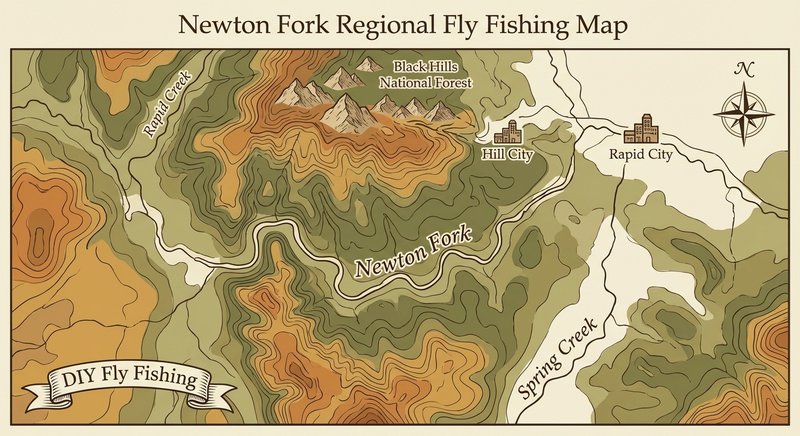
Newton Fork
Fly fishing in South Dakota · intermediate · Best seasons: spring, summer, fall
Target Species
Brown Trout, Brook Trout
About This Water
Black Hills tributary of Castle Creek. Wild trout in forested canyon.
Fishing Recommendations
Welcome to the Black Hills of South Dakota. As a guide in this region, I can tell you that Newton Fork is one of our best-kept secrets for anglers who value solitude and "blue-ribbon" small-stream tactics over trophy sizes. It is a quintessential mountain tributary that feeds into Deerfield Lake and eventually merges with Castle Creek.
Here is your comprehensive guide to fly fishing Newton Fork.
🎣 Location Overview
Newton Fork is a charming, intimate high-country stream located just west of Hill City. It is characterized by its diversity: it transitions from tight, timber-choked headwaters to lush, meandering alpine meadows as it nears Deerfield Lake.
What makes this water special is its wild character. Unlike the larger, more manicured sections of Rapid Creek, Newton Fork feels rugged. It is a "small water" paradise where a 10-inch Brookie is a treasure and a 14-inch Brown is a king. The water is crystal clear and cold, filtered by the limestone and granite of the Black Hills, providing a perfect habitat for wild, self-sustaining trout populations.
🐟 Target Species & Behavior
The stream is a tale of two fish:
- Brook Trout: Found primarily in the upper reaches and the tighter, colder timber sections. They are vibrant, aggressive, and opportunistic. They hide in the "pockets"—behind rocks, under fallen logs, and in small plunge pools.
- Brown Trout: As the creek widens and slows into the meadow stretches, the Brown Trout take over. These fish are significantly more "spooky" than the Brookies. They utilize the deep undercut banks and overhanging grasses for cover.
Behavior: These fish are largely insectivores. Because the growing season is short in the Black Hills, they are generally eager to rise to a well-presented dry fly, though the larger Browns require a stealthy approach and a perfect drift.
📅 Best Times to Fish
- Spring (Late April – June): This is "Green Up" season. As the snow melts, the water rises. This is the best time for nymphing. Once the water stabilizes in June, the first major hatches (Blue Winged Olives and Caddis) begin.
- Summer (July – August): This is the prime window for Newton Fork. The water remains cool due to the elevation. This is the season of the Terrestrial. While other low-elevation streams might get too warm, Newton Fork stays in the "sweet spot."
- Fall (September – October): My personal favorite. The Brookies and Browns both take on their spawning colors. The Brookies become extremely aggressive. The air is crisp, and the aspen trees turn gold.
- Time of Day: In mid-summer, fish early morning or late evening to avoid the high sun. In spring and fall, the "banker’s hours" (10:00 AM – 4:00 PM) are best as the water needs time to warm up to trigger insect activity.
🪰 Recommended Flies & Techniques
Top Fly Patterns
- Dry Flies:
- Parachute Adams (Size 16-20): The gold standard for any Black Hills stream.
- Elk Hair Caddis (Size 14-16): Great for the swifter, "bubbly" water.
- Hi-Viz Ant or Foam Beetle (Size 14-18): Deadly in the meadow sections during August.
- Nymphs:
- Gold-Ribbed Hare’s Ear (Size 16-18): Mimics almost everything in this creek.
- Zebra Midge (Size 18-22): Black or Red; essential for picky fish in slow water.
- Streamers:
- Pine Squirrel Leech (Black or Olive): Small streamers work wonders for the larger Browns in the deeper holes.
Techniques
- The "Dry-Dropper": This is the most effective way to fish Newton Fork. Use a buoyant dry fly (like a Stimulator or Hopper) and hang a small pheasant tail nymph 12–18 inches below it.
- Stealth Approach: Because the water is small and clear, you must stay low. Approach the holes from downstream and cast upward. If the fish see your silhouette, the pool is "done" for thirty minutes.
- The Bow-and-Arrow Cast: In the timbered sections, you won't have room for a backcast. Mastering the bow-and-arrow cast is essential to get your fly into the tight pockets where the Brookies hide.
💡 Pro Tips & Local Knowledge
- Follow the Meadow: The sections where the creek meanders through the meadows near the inlet of Deerfield Lake hold the largest Browns. Focus on the "bends." Every sharp turn creates a deep pool and an undercut bank—fish the fly as tight to the grass as possible.
- Wear Earth Tones: Leave the bright white hats and neon shirts at home. Wear olive, tan, or camo to blend into the brush.
- The "Deerfield Bump": In late spring and again in the fall, larger fish from Deerfield Lake will occasionally move up into Newton Fork to feed or scout spawning gravel. If you're fishing near the mouth, bring a slightly heavier tippet (4X or 5X) just in case you hook a lake-run surprise.
- Don't Overthink the Hatch: These fish aren't as selective as those on the Henry's Fork. Presentation is 90% of the battle here. A drag-free drift is more important than the exact wing-vein count on your fly.
⚠️ Important Information
- Access: Much of Newton Fork runs through Black Hills National Forest land, which is open to public fishing. However, there are pockets of private property. Always look for "Posted" signs and respect landowner rights.
- Regulations: You need a valid South Dakota Fishing License. Newton Fork generally falls under standard Black Hills regulations, but always check the current SD Game, Fish & Parks handbook for any emergency closures or tackle restrictions.
- Gear Recommendation: A 2-weight or 3-weight rod (7' to 8' length) is the perfect tool for this water. A 5-weight is overkill and will feel clumsy in the brush.
- Wildlife: This is mountain lion and black bear country. While encounters are rare, it’s wise to remain aware of your surroundings, especially when fishing solo in thick brush.
Guide’s Final Word: Newton Fork isn't where you go to set a world record; it’s where you go to remember why you started fly fishing in the first place. Take your time, enjoy the scenery, and don't forget to look up from the water every once in a while. Tight lines!
Bug Hatches & Matching Flies
| Hatch | Type | Peak months | Time of day | Hook sizes | Matching flies |
|---|---|---|---|---|---|
| Blue Winged Olive Baetis spp. | mayfly | April, May, September, October | Midday | #18-22 | RS2 #20-22, Parachute Adams #18-22, WD-40 #20-22 |
| Pale Morning Dun Ephemerella invaria | mayfly | June, July | Late Morning/Afternoon | #14-18 | PMD Sparkle Dun #16-18, Pheasant Tail Nymph #14-18, PMD Quigley Cripple #16-18 |
| Trico Tricorythodes | mayfly | July, August, September | Early Morning | #20-24 | Trico Spinner #20-24, Sunray Trico #22-24 |
| Spotted Sedge Hydropsyche | caddis | June, July, August | Evening | #14-18 | Elk Hair Caddis #14-16, Soft Hackle Hare's Ear #14-18, Hydropsyche Larva #14-16 |
| Little Black Stonefly Capniidae | stonefly | March, April | Midday | #16-18 | Zebra Midge #18-20, Black Stonefly Nymph #16-18, Black Stimulator #16-18 |
| Yellow Sally Isoperla spp. | stonefly | June, July | Afternoon/Evening | #14-16 | Yellow Sally Dry #14-16, Iron Lotus #16 |
| Midges Chironomidae | midge | January, February, March, November, December | All Day | #18-26 | Griffith's Gnat #18-22, Morgan's Midge #20-24, Black Midge Larva #20-24 |
| Grasshoppers Acrididae | terrestrial | August, September | Late Morning/Afternoon | #8-12 | Dave's Hopper #10-12, Parachute Hopper #10-14 |
| Ants and Beetles Formicidae / Coleoptera | terrestrial | July, August | All Day | #14-18 | Cinnamon Ant #16-18, Foam Beetle #14-16 |