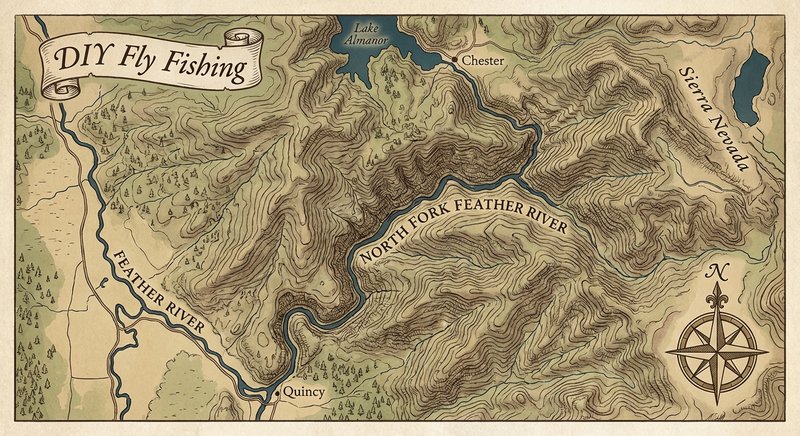
North Fork Feather River
Fly fishing in California · Intermediate · Best seasons: Spring, Summer, Fall
Target Species
Brown Trout, Rainbow Trout
About This Water
Below Lake Almanor with wild brown and rainbow trout. Scenic canyon tailwater fishing.
Fishing Recommendations
The North Fork Feather River (NFFR) is a rugged, beautiful, and often overlooked gem in the Sierra Nevada. Known for its dramatic canyon scenery and the "Stairway of Power" (a series of hydroelectric dams), it offers a unique blend of technical pocket water fishing and classic tailwater stability.
Here is your comprehensive guide to fly fishing the North Fork Feather.
🎣 Location Overview
The North Fork Feather River flows through a deep, granite-walled canyon in Plumas County. What makes this river special is the Caribou Special Regs Section. While much of the Feather River system is impacted by hydroelectric power, the stretch between the Caribou Powerhouse and Belden Forebay acts like a tailwater.
The water stays cold year-round because it is piped from the bottom of Lake Almanor. The river is characterized by high-gradient "pocket water"—think plunging runs, massive granite boulders, and deep, emerald-green pools. It’s a physical river that rewards the athletic angler who isn’t afraid to scramble over rocks to find untouched trout.
🐟 Target Species & Behavior
- Rainbow Trout: These are the primary residents. They are exceptionally hard-fighting, wild fish that thrive in the highly oxygenated riffles. They typically hold in the "cushion" in front of boulders or in the soft seams on the edges of fast water.
- Brown Trout: While less numerous than rainbows, the NFFR holds some truly predatory browns. They are elusive and tend to hug the bottom of deep, dark pools or hide under undercut banks and massive boulders during the day, coming out to hunt during low-light transitions.
- Behavior: Because the water is cold and oxygen-rich, these fish are active feeders. However, the heavy pocket water means they have a small "window of vision." You must get your flies deep and right in their faces.
📅 Best Times to Fish
- Spring (May – June): This is the prime window for the legendary Golden Stonefly hatch. As the canyon warms up, these large insects crawl toward the banks. Fishing large dries or heavy nymphs during this time can result in the biggest fish of the season.
- Summer (July – August): While other California rivers might get too warm, the Caribou stretch remains a "refrigerator." The fishing is consistent all day, though the evening Caddis hatch provides the best dry-fly action.
- Fall (September – October): This is "Big Brown" season. As the October Caddis (large orange sedges) begin to appear, the fish look upward. The cooling air temperatures also trigger the brown trout to become more aggressive before their spawn.
- Best Time of Day: During the heat of summer, the "shadow hour" (when the canyon walls block the sun) is magic. In spring and fall, the midday sun warms the water just enough to trigger insect activity.
🪰 Recommended Flies & Techniques
Nymphing (The Bread & Butter)
This is 80% of the game on the NFFR. The water is fast and deep.
- Patterns: Pat’s Rubber Legs (Orange/Brown), Prince Nymphs (beaded), Copper Johns, and Perdigons (for fast sinking).
- Technique: Euro Nymphing (Tight-line) is arguably the most effective method here. The complex currents make getting a drag-free drift with a traditional indicator difficult. A heavy tungsten nymph dropped into "buckets" behind rocks is lethal.
Dry Fly Fishing
- Patterns: Stimulators (Size 8-12 for Stones), Elk Hair Caddis (Size 14-16), and the October Caddis (Size 8-10) in the fall.
- Technique: "Pound the banks." Use a high-visibility dry fly with a dropper nymph. In the pocket water, the fish don't have long to decide—be bold with your presentation.
Streamers
- Patterns: Wooly Buggers (Olive or Black), Sculpzilla, and Sparkle Minnows.
- Technique: Swing streamers through the tail-outs of large pools or "jig" them through deep slots to entice the big resident Browns.
💡 Pro Tips & Local Knowledge
- The "Caribou Road" Secret: Focus on the stretch along Caribou Road. It’s easily accessible but rugged enough that many anglers don't stray far from their cars. If you walk just 15 minutes away from a turnout, you’ll find significantly less pressured fish.
- Watch the Bubbles: In the heavy whitewater, look for "bubble lines." If you can track your fly down a bubble line, you are in the feeding lane.
- Wading Safety: The rocks here are notoriously "greasy." Studded wading boots and a wading staff are non-negotiable. The granite is slick, and the current is deceptive.
- Check the Flows: Before you leave, check the Dreamflows website or the PG&E flow site for "NF Feather - Caribou." Ideal fishing flows are typically between 200 and 400 CFS. Anything over 600 CFS becomes difficult and dangerous to wade.
⚠️ Important Information
- Regulations: The section from the Belden Fuel Bridge upstream to the Caribou Powerhouses has special regulations: Barbless hooks only, and a zero-limit (catch and release) for trout. Always check the latest CA Department of Fish and Wildlife (CDFW) handbook before heading out.
- Access: Highway 70 follows the river for many miles, but the "Caribou Road" turnoff at Belden is the gateway to the best trout water.
- Environment: This is a deep canyon. Cell service is non-existent once you leave the main highway. Ensure someone knows where you are fishing. Also, keep an eye out for rattlesnakes on the sunny granite slopes during the summer months.
The North Fork Feather is a river that demands respect and physical effort, but for the angler who loves wild trout in a wild setting, it is one of the most rewarding waters in Northern California. Tight lines!
Bug Hatches & Matching Flies
| Hatch | Type | Peak months | Time of day | Hook sizes | Matching flies |
|---|---|---|---|---|---|
| Blue Winged Olive Baetis | mayfly | March, April, October, November | Late Morning/Afternoon | #18-22 | RS2 #18-22, Parachute Adams #18-22, Pheasant Tail Nymph #18-20 |
| Golden Stonefly Hesperoperla pacifica | stonefly | June, July | Morning/Evening | #6-10 | Pats Rubber Legs #6-10, Chubby Chernobyl #8-10, Kaufmanns Stimulator #8-12 |
| Pale Morning Dun Ephemerella excrucians | mayfly | June, July, August | Morning/Early Afternoon | #14-18 | PMD Sparkle Dun #16-18, Mercers Trigger Emp #16-18, Quigley Cripple #14-18 |
| Spotted Sedge Hydropsyche | caddis | June, July, August, September | Late Afternoon/Evening | #14-16 | Elk Hair Caddis #14-16, Pupa-tator #14-16, LaFontaine's Deep Sparkle Pupa #14-16 |
| October Caddis Dicosmoecus atripes | caddis | September, October | All Day/Evening | #8-12 | Morrish October Caddis #8-10, Bird's Nest (Orange) #10-12, Orange Stimulator #8-12 |
| Yellow Sally Isoperla | stonefly | June, July | Afternoon/Evening | #14-16 | Yellow Sally Foam Stone #14-16, Little Yellow Sloan #14-16, Parachute Yellow Sally #14-16 |
| Salmonfly Pteronarcys californica | stonefly | May, June | All Day | #4-8 | Rogue River Stone #4-6, Girdle Bug #4-8, Clark's Stone #6-8 |
| Grasshopper Orthoptera | terrestrial | July, August, September | Late Morning/Afternoon | #8-12 | Dave's Hopper #10-12, Morrish Hopper #8-12, Hopper Juan #10-12 |
| Midges Chironomidae | midge | January, February, March, December | Morning/Afternoon | #18-24 | Zebra Midge #18-22, Griffith's Gnat #18-22, Black Beauty #20-22 |