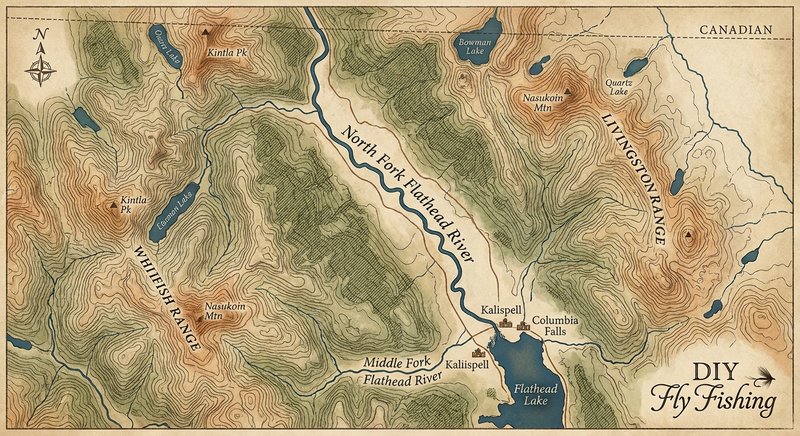
North Fork Flathead River
Fly fishing in Montana · Intermediate · Best seasons: Summer, Fall
Target Species
Cutthroat Trout, Bull Trout
About This Water
Pristine river forming Glacier National Park's western boundary. Native westslope cutthroat in crystal-clear water.
Fishing Recommendations
Greetings, angler. It is a pleasure to guide you through the details of one of the most pristine and visually stunning river systems in the Lower 48. The North Fork of the Flathead River is a wild, free-flowing gem that forms the western boundary of Glacier National Park.
Here is your comprehensive guide to fishing these glacial waters.
🎣 Location Overview
The North Fork of the Flathead is the epitome of "Wild and Scenic." Flowing south from the Canadian border through a remote valley, it is flanked by the towering peaks of Glacier National Park to the east and the Flathead National Forest to the west.
What makes it special is its clarity and sterility. Because it is fed by snowmelt and cold mountain springs, the water is exceptionally clear—often described as "gin-clear" or "aquamarine." This is a freestone river with no dams, meaning it relies on natural flow cycles. Anglers love it for the solitude, the breathtaking scenery, and the opportunity to catch native fish in their ancestral home.
🐟 Target Species & Behavior
Westslope Cutthroat Trout
These are the stars of the show. The North Fork is a stronghold for genetically pure Westslope Cutthroats.
- Behavior: They are famously opportunistic. In this nutrient-poor environment, they cannot afford to be picky. If it looks like food and is presented naturally, they will usually rise.
- Holding Water: Look for "soft" water. They love the edges of main currents, behind large boulders, and in the deep turquoise pools. They often hover just below the surface in the tail-outs of pools.
Bull Trout
The "Grizzlies of the River." These are federally protected migratory fish that can reach massive sizes (24–30+ inches).
- Behavior: They are apex predators. They move into the North Fork to spawn or to follow the Cutthroat populations.
- Holding Water: They sit in the deepest, darkest holes and under submerged timber.
- Note: Intentional fishing for Bull Trout is prohibited in the North Fork. However, you will often see them, and they may even "ride" a Cutthroat you are reeling in. If you hook one incidentally, keep it in the water and release it immediately.
📅 Best Times to Fish
Optimal Seasons
- Summer (July – August): This is the prime window. The river is usually too high and turbid from snowmelt until late June or early July. Once the "runoff" subsides and the water clears, the dry fly fishing is world-class.
- Fall (September – early October): The crowds (which are already small) vanish. The water levels are low, and the fish are aggressive, bulking up for winter. This is the best time for larger Cutthroats.
Best Times of Day
- Mid-Morning to Evening: Unlike some rivers where you need a "crack of dawn" start, the North Fork's cold water means the bugs don't get active until the sun hits the water. 10:00 AM to 6:00 PM is usually the "magic hour" window.
🪰 Recommended Flies & Techniques
Top Fly Patterns
- Dry Flies:
- Attractors: Royal Wulff, H&L Variant, Chubby Chernobyl (Gold or Purple).
- Hatches: Parachute Adams (size 14-18), Elk Hair Caddis (Tan), and Pale Morning Duns (PMDs).
- Terrestrials: In August, use Hoppers, Beetles, and Ants along the cut banks.
- Nymphs (if the dry bite is slow):
- Prince Nymphs, Pheasant Tails, and Pat’s Rubber Legs (Stonefly patterns).
- Streamers:
- Black or Olive Wooly Buggers and Sparkle Minnows (great for deeper pools).
Effective Techniques
- Dry-Dropper: This is the "bread and butter" of the North Fork. Hang a small nymph (like a Copper John) 18-24 inches below a high-visibility foam hopper.
- The "Slow Drift": Cutthroats in this river aren't usually in a rush. A dead drift is essential, but they will often follow a fly for several feet before committing.
💡 Pro Tips & Local Knowledge
- Focus on the "Glides": While the fast riffles look fishy, some of the biggest Westslopes sit in the long, flat glides at the end of a run. You’ll need a long leader (9-12ft) to avoid spooking them in the crystal-clear water.
- The "Big River" Rule: The North Fork is a braided river. If one channel isn't producing, cross over to a side channel. Smaller side channels often hold surprisingly large fish that are seeking refuge from the main current.
- Look for Woody Debris: The river moves a lot of timber during runoff. Root balls and submerged logs are magnets for the larger resident fish.
- Polarized Lenses: These are non-negotiable. The glare on the North Fork can be intense, and spotting the bottom structure (and the fish) is half the battle.
⚠️ Important Information
Access
- The North Fork Road: This is a notorious unpaved, washboard gravel road. It is dusty and can be rough on vehicles. Ensure you have a spare tire.
- Boat Ramps: Major access points include Big Creek, Glacier Rim, and Polebridge. Floating is the best way to see the river, but be wary of "sweepers" (fallen trees) which can be deadly in the current.
Regulations & Permits
- License: You need a Montana Fishing License and a Conservation License.
- Catch & Release: The North Fork is largely a Catch and Release fishery for Cutthroat Trout. Check the current Montana FWP (Fish, Wildlife & Parks) regulations for specific slot limits or closures.
- Bull Trout: Again, do not target them. If you see one, appreciate it from a distance.
Special Considerations (Safety)
- Grizzly Bear Country: You are in one of the densest Grizzly populations in the lower 48. Carry Bear Spray on your person (not in your pack) at all times, even when wading.
- Wading Safety: The rocks are incredibly slippery (often called "river snot"). Felt-soled boots or studs are highly recommended.
The North Fork is a place for the soul as much as the rod. Take a moment between casts to look up at the peaks of Glacier National Park—there truly is nowhere else like it. Tight lines!
Bug Hatches & Matching Flies
| Hatch | Type | Peak months | Time of day | Hook sizes | Matching flies |
|---|---|---|---|---|---|
| Salmonfly Pteronarcys californica | stonefly | June, July | Afternoon | #4-8 | Rogue River Stone #4-8, Pats Rubber Legs #6-8, Cat Puke #6-8 |
| Pale Morning Dun (PMD) Ephemerella excrucians | mayfly | July, August | Late Morning/Afternoon | #16-18 | Sparkle Dun #16-18, Parachute Adams #16-18, Pheasant Tail #16-18 |
| Golden Stonefly Hesperoperla pacifica | stonefly | July | Afternoon/Evening | #8-12 | Chubby Chernobyl (Gold) #8-12, Golden Twenty-Incher #10-12, Water Walker #10-12 |
| Western Green Drake Drunella doddsii | mayfly | July | Late Morning | #10-12 | H & L Variant #12, Drakes Layer Cake #10-12, Green Drake Cripple #12 |
| Blue Winged Olive (BWO) Baetis | mayfly | April, May, September, October | Afternoon | #18-22 | RS2 #20-22, BWO Sparkle Dun #18-20, Baetis Nymph #18-20 |
| Yellow Sally Isoperla | stonefly | July, August | Afternoon/Evening | #14-16 | Yellow Stimulator #14-16, Little Yellow Sloan #16, Iron Sally #14-16 |
| October Caddis Dicosmoecus | caddis | September, October | Late Afternoon/Evening | #8-10 | Orange Stimulator #8-10, October Caddis Pupa #8-10, Morrish October Caddis #10 |
| Gray Drake Siphlonurus | mayfly | July, August | Evening | #12-14 | Gray Wulff #12-14, Parachute Hare's Ear #14, Gray Drake Spinner #12 |
| Short-horned Grasshopper Acrididae | terrestrial | August, September | All Day | #8-12 | Pantone Hopper #10-12, Dave's Hopper #8-12, Morrish Hopper #10 |