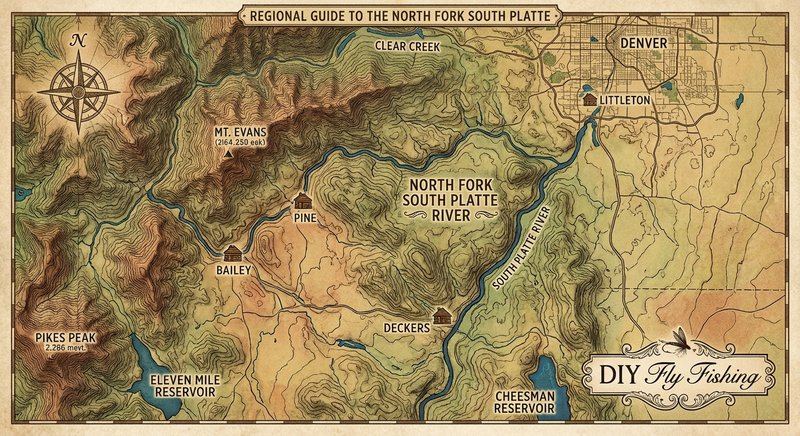
North Fork of the South Platte
Fly fishing in Colorado · Intermediate · Best seasons: Summer, Fall
Target Species
Brown Trout, Rainbow Trout
About This Water
Wild trout stream southwest of Denver. Less pressured than Cheesman Canyon section.
Fishing Recommendations
The North Fork of the South Platte (often simply called the "North Fork") is a gem of the Front Range. While it plays second fiddle in name to the legendary "Dream Stream" or Cheesman Canyon, it offers a distinct, high-gradient mountain experience that is arguably more scenic and, at times, more rewarding for the technical angler.
Here is your comprehensive guide to the North Fork of the South Platte.
🎣 Location Overview
The North Fork is a high-gradient, boulder-choked tributary that flows through the rugged canyons between the towns of Bailey and Pine, eventually joining the main stem at the South Platte Hotel.
What makes this water special is the Roberts Tunnel. This man-made tunnel carries cold, nutrient-rich water from Dillon Reservoir and dumps it into the North Fork at Grant. This essentially transforms a small mountain creek into a powerful, cold-water tailwater. Anglers love it for its "pocket water" character—it is a playground of plunge pools, eddies, and slick runs formed by massive granite boulders.
🐟 Target Species & Behavior
The North Fork is a premier trout fishery with a healthy mix of residents and "visitors."
- Brown Trout: The dominant species in the wilder stretches. They are territorial and predatory. They love the undercut banks and the dark shadows beneath the granite boulders.
- Rainbow Trout: Found throughout, often holding in the faster riffles and the "cushion" in front of large rocks. You will find both wild rainbows and larger "bows" that move up from the private ranch sections or downstream reservoirs.
- Behavior: Because the water is often fast and turbulent, fish here are opportunistic. They don't have long to decide if something is food. However, they are sensitive to "micro-drag," so your drift must be precise.
📅 Best Times to Fish
While you can fish the North Fork year-round (due to the tunnel's bottom-release water), the Summer and Fall are the peak windows.
- Summer (Late June – August): This is the prime time for "Dry-Dropper" fishing. The water is clear, and the fish are looking up.
- Time of Day: Early morning (6 AM – 10 AM) for nymphing; mid-day for terrestrials and attractors.
- Fall (September – Early November): This is the "Golden Window." The Aspen trees turn, the flows usually stabilize, and the Brown Trout become aggressive as they prepare for the spawn.
- Time of Day: 10 AM – 4 PM is the "sweet spot" as the water warms slightly and insects become active.
- Prime Conditions: Look for flows between 100 and 250 CFS. If the Roberts Tunnel is cranking at 500+ CFS, the river becomes dangerous to wade and difficult to fish.
🪰 Recommended Flies & Techniques
Top Fly Patterns
- Attractor Dry Flies: Chubby Chernobyl (Orange or Gold, size 8-12), Amy’s Ant, and the Hippie Stomper.
- Nymphs: Pat’s Rubber Legs (Black/Tan), Prince Nymph (size 12-16), RS2 (Grey/Black, size 18-22), and the Mercury Pheasant Tail.
- Streamers: Pine Squirrel Leech, Wooly Bugger (Olive), and the Gongas (for larger Browns in the Fall).
Techniques
- The Dry-Dropper: This is the most effective way to cover the North Fork. Use a buoyant Stonefly pattern (Chubby) as your "indicator" and hang a weighted nymph 2-3 feet below it.
- Pocket Water Nymphing: Short-line or "Euro" nymphing is deadly here. Since the water is turbulent, a traditional indicator often gets pulled around by conflicting currents. High-sticking through the pockets keeps your line off the water for a natural drift.
- The "Slow Swing": In the Fall, swinging small streamers or leeches through the deeper pools can trigger aggressive strikes from pre-spawn Browns.
💡 Pro Tips & Local Knowledge
- Focus on the "Cushion": Most anglers fish the tail of the pool. Experienced guides look for the "cushion" of water just in front of a large boulder. Big trout often sit there because the water pressure creates a neutral spot with easy access to food.
- The Roberts Tunnel Factor: Always check the CDEC (Colorado Decision Support System) stream gauges before you drive. If the tunnel is shut off, the river can drop to 20 CFS and become nearly un-fishable. If it's wide open, it's a torrent.
- Stealth is Key: The water is incredibly clear. Wear earthy tones and avoid "lining" the fish (casting your fly line directly over their heads). Approach a pool from downstream and work your way up.
- Don't Overlook Pine Valley Ranch Park: This is one of the best public stretches. It offers great access, well-maintained trails, and a mix of meadow water and canyon water.
⚠️ Important Information
Access
- Public Access: Significant public water is available in the Pike National Forest along Highway 126 and near the town of Bailey. Pine Valley Ranch Park (Jefferson County Open Space) is a top-tier public access point.
- Private Water: The North Fork is famous for ultra-exclusive private ranches (like North Fork Ranch and Boxwood Gulch). Respect all "Posted" signs. Trespassing is taken very seriously here.
Regulations & Permits
- License: A valid Colorado Fishing License is required.
- Regulations: Much of the North Fork is Catch and Release Only with artificial flies and lures. Check the current CPW (Colorado Parks and Wildlife) brochure for the specific stretch you are fishing, as regulations can change at property boundaries.
Special Considerations
- Wading Safety: The rocks in the North Fork are notoriously slick and often loose. Felt-soled boots or studs are highly recommended, as is a wading staff.
- Wildlife: This is prime Black Bear and Mountain Lion country. Be aware of your surroundings, especially when fishing at dawn or dusk.
Bug Hatches & Matching Flies
| Hatch | Type | Peak months | Time of day | Hook sizes | Matching flies |
|---|---|---|---|---|---|
| Midges Chironomidae | midge | January, February, March, December | All Day | #18-24 | Zebra Midge #18-22, Griffith's Gnat #20-24, Top Secret Midge #20-24 |
| Blue Winged Olive Baetis | mayfly | March, April, September, October | Late Morning/Afternoon | #18-22 | RS2 #18-22, Parachute Adams #18-22, JujuBaetis #18-22 |
| Pale Morning Dun Ephemerella excrucians | mayfly | June, July, August | Late Morning/Afternoon | #16-18 | Pheasant Tail #16-18, PMD Cripple #16-18, Sparkle Dun #16-18 |
| Golden Stonefly Hesperoperla pacifica | stonefly | June, July | Morning/Afternoon | #8-12 | Pat's Rubber Legs #8-12, Chubby Chernobyl #10-12, 20 Incher #10-14 |
| Brachycentrus Caddis Brachycentrus | caddis | May, June | All Day/Evening | #14-18 | Elk Hair Caddis #14-18, LaFontaine's Deep Sparkle Pupa #14-16, Puterbaugh's Caddis #16-18 |
| Trico Tricorythodes | mayfly | July, August, September | Early Morning | #20-24 | Trico Spinner #20-24, Sunken Trico #20-22, Drowned Trico Spinner #20-24 |
| Yellow Sally Isoperla | stonefly | June, July, August | Afternoon/Evening | #14-16 | Yellow Sally Dry #14-16, Iron Lotus #16, Yellow Stimulator #14-16 |
| Terrestrials Various | terrestrial | July, August, September | Mid-day/Afternoon | #10-16 | Amy's Ant #10-14, Black Foam Beetle #14-16, Hopper Juan #10-12 |
| Red Quill Rhithrogena hageni | mayfly | June, July | Afternoon | #12-14 | Red Quill Dry #12-14, Hares Ear #12-14 |