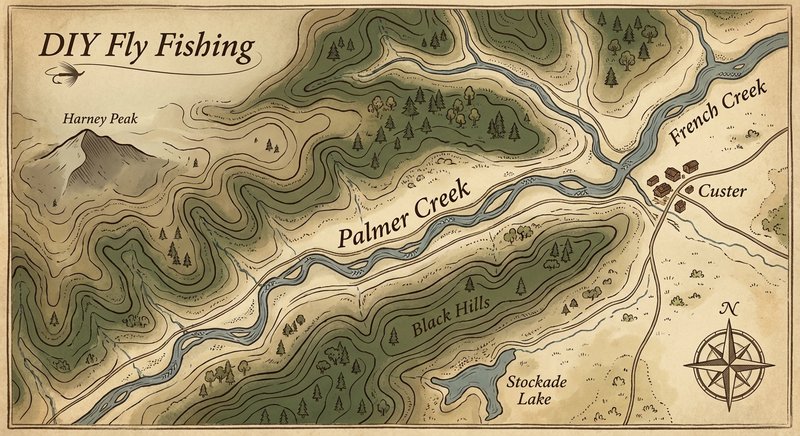
Palmer Creek
Fly fishing in South Dakota · intermediate · Best seasons: spring, summer, fall
Target Species
Brown Trout
About This Water
Black Hills stream with wild brown trout. Remote fishing opportunity.
Fishing Recommendations
Welcome to the Black Hills of South Dakota. As a guide in this region, I can tell you that Palmer Creek is one of our best-kept secrets. While most visiting anglers flock to the larger "Blue Ribbon" stretches of Rapid Creek or the dramatic canyon walls of Spearfish Creek, Palmer Creek offers an intimate, small-stream experience that rewards stealth, precision, and an appreciation for wild fish.
Here is your comprehensive guide to fly fishing Palmer Creek.
🎣 Location Overview
Palmer Creek is a high-elevation tributary located in the central Black Hills, near Hill City and Mount Rushmore. It eventually feeds into Sheridan Lake. What makes this creek special is its classic "Black Hills" character: it meanders through wildflower meadows, tumbles over granite boulders, and carves deep, dark undercut banks beneath Ponderosa pines.
The water is generally crystal clear and cold, as it is fed by high-country springs and runoff. Because it is smaller than the main stems in the region, it feels much more private. It is a "technical small stream"—it isn't difficult because the fish are geniuses, but it is difficult because the fish are incredibly wary.
🐟 Target Species & Behavior
The primary resident of Palmer Creek is the Wild Brown Trout. You may encounter an occasional Brook Trout in the higher reaches, but the Browns own this water.
- Size: Expect fish in the 8–12 inch range, though 14-inchers are the local "trophies" here.
- Behavior: These fish are opportunistic but easily spooked. In the morning, they hold in the riffles and at the heads of pools. As the sun gets high, they retreat under the banks or into the deepest shadows of the granite plunge pools.
- Feeding: They are highly reliant on aquatic insects (Midges, Mayflies, Caddis) but become aggressive hunters of grasshoppers and beetles during the summer months.
📅 Best Times to Fish
Optimal Seasons
- Spring (Late April – June): This is the "prime" window. Once the mountain snowmelt stabilizes, the fish are hungry and less cautious. The Mother’s Day Caddis hatch can be spectacular here.
- Summer (July – August): Excellent for dry fly fishing. However, during drought years, keep an eye on water temperatures. If the water hits 68°F, give the fish a break.
- Fall (September – October): My personal favorite. The Brown Trout begin to color up for the spawn and become more aggressive. The scenery—golden aspens against the granite—is world-class.
Best Times of Day
- Early Morning: Before the sun hits the water.
- Dusk: The "magic hour" when the wind dies down and the Caddis begin to dance.
- Overcast Days: These are the best days to find larger Browns out in the open.
🪰 Recommended Flies & Techniques
Palmer Creek is "short game" water. You rarely need to cast more than 20 feet.
Top Fly Patterns
- Dry Flies:
- Parachute Adams (Size 16-20) - The universal soldier.
- Elk Hair Caddis (Size 14-18) - Tan or Olive.
- Hippie Stomper or Amy's Ant (Size 12-14) - Perfect for "searching" the water in summer.
- Nymphs:
- Beadhead Pheasant Tail (Size 16-18).
- Zebra Midge (Size 18-22) - Black or Red.
- Perdigons - Great for getting deep quickly in the small plunge pools.
- Streamers:
- Small Wooly Bugger (Size 10-12) - Black or Olive. Use these in the deeper holes near the confluence with Sheridan Lake.
Techniques
- Dry-Dropper: This is the most effective way to fish Palmer. Use a buoyant dry (like a Stimulator) with a small nymph tied 18 inches below it.
- Dapping/Bow-and-Arrow Cast: In the brushy sections, you won't have room for a backcast. Master the bow-and-arrow cast to get your fly under overhanging willows.
- Upstream Stealth: Always fish moving upstream. If you walk downstream, the fish will see you before you see them.
💡 Pro Tips & Local Knowledge
- The "Shadow" Rule: Your shadow is your worst enemy on Palmer Creek. Because the creek is narrow, a shadow falling across a pool will "put down" every fish in it for an hour. Keep a low profile—sometimes you have to fish from your knees.
- Focus on the Pockets: Don't just fish the big pools. Some of the biggest Browns hide in "pocket water"—the small cushions of quiet water behind large rocks that are only the size of a dinner plate.
- Gear Selection: Leave the 5-weight at home. A 2-weight or 3-weight rod (7.5 to 8 feet) is perfect. Use a 5x or 6x fluorocarbon tippet; these fish have good eyes.
- The "Sheridan Tailwater": The stretch of Palmer just before it enters Sheridan Lake often holds larger "lake-run" fish that move into the creek to feed or prepare for spawning.
⚠️ Important Information
- Access: Much of Palmer Creek runs through Black Hills National Forest land, which is open to the public. However, there are pockets of private property. Always look for "No Trespassing" signs and use an app like OnX Maps to stay on public land.
- Regulations: You need a South Dakota fishing license. Check the current SD Game, Fish & Parks (GFP) handbook for any specific "Catch and Release" or tackle restrictions, though most of Palmer is under general statewide regulations.
- The "Black Hills Hike": Be prepared for some bushwhacking. Wear sturdy wading boots with felt or studs, as the granite rocks are notoriously slippery.
- Safety: This is mountain lion and northern timber rattlesnake country. While encounters are rare, keep your eyes open and let someone know where you are going, as cell service is spotty at best.
Tight lines, and enjoy the quiet beauty of the Hills!
Bug Hatches & Matching Flies
| Hatch | Type | Peak months | Time of day | Hook sizes | Matching flies |
|---|---|---|---|---|---|
| Blue Winged Olive Baetis | mayfly | April, May, September, October | Midday | #18-22 | Parachute Adams #18-22, RS2 #20-22, Pheasant Tail Nymph #18-20 |
| Pale Morning Dun Ephemerella inermis/infrequens | mayfly | June, July | Late Morning/Afternoon | #16-18 | PMD Sparkle Dun #16-18, Split Case PMD #16-18, Hare's Ear Nymph #14-16 |
| Little Brown Caddis Hydropsyche | caddis | May, June, July | Evening | #14-18 | Elk Hair Caddis #14-18, LaFontaine's Deep Sparkle Pupa #14-16, Godzilla Caddis #16 |
| Yellow Sally Isoperla | stonefly | June, July | Afternoon/Evening | #14-16 | Yellow Sally Foam Stone #14-16, Little Yellow Sloan #16, Iron Lotus #16 |
| Trico Tricorythodes | mayfly | August, September | Early Morning | #20-24 | Trico Spinner #20-24, Sunken Trico Spinner #22, Griffith's Gnat #20-22 |
| Midges Chironomidae | midge | February, March, April | Anytime | #18-24 | Zebra Midge #18-22, Morgan's Midge #20-22, Top Secret Midge #20-24 |
| Terrestrials Formicidae/Acrididae | terrestrial | July, August, September | Afternoon | #10-18 | Cinnamon Ant #16-18, Dave's Hopper #10-12, Black Foam Beetle #14-16 |
| Grannom Caddis Brachycentrus | caddis | April, May | Midday/Evening | #12-16 | Peacock Caddis #14-16, Holy Grail Caddis #14-16, Green Weenie #14-16 |