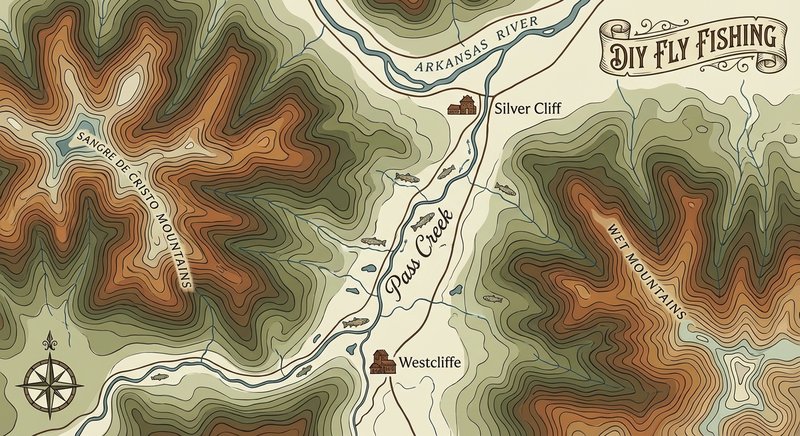
Pass Creek
Fly fishing in Colorado · Intermediate · Best seasons: Summer
Target Species
Brook Trout, Brown Trout
About This Water
Small stream near Wolf Creek Pass with brook and brown trout. High altitude fishing adventure.
Fishing Recommendations
Pass Creek, Colorado, is a hidden gem for the angler who values solitude and the "small water" experience over trophy hunting. Flowing through the high country of the San Juan Mountains (near Wolf Creek Pass) or the tributary near Silverthorne (depending on which specific drainage you find yourself in—though both share similar characteristics), we will focus on the Pass Creek that feeds the upper Rio Grande drainage, as it is a quintessential high-country trout stream.
Here is your guide to mastering the tight water and wild fish of Pass Creek.
🎣 Location Overview
Pass Creek is the definition of "Blue Lining." It is a high-altitude, willow-lined tributary that offers classic pocket water, beaver ponds, and undercut banks. What makes it special is its accessibility paired with its ruggedness. While it may run near the highway in sections, the thick brush and steep gradients keep the casual crowds away.
The water is crystal clear and cold, even in the heat of July. It is a technical fishery not because the fish are picky, but because the casting environment is demanding. You’ll be dealing with "tunnel" casting under overhanging willows and navigating slippery, rocky plunges.
🐟 Target Species & Behavior
The creek is dominated by Brook Trout in the higher reaches and Brown Trout as you move toward the confluence with larger water.
- Brook Trout: These are the "jewels" of Pass Creek. They are opportunistic and aggressive but highly spooked. They hold in the bubble lines and at the very head of small plunge pools.
- Brown Trout: The Browns here are wild and wary. They tuck deep into undercut banks and under large boulders. Unlike the Brookies, the Browns will often require a more subtle presentation and will retreat to cover the moment they see a silhouette or a sloppy line slap.
- Behavior: Because the growing season is short, these fish are "upward looking." They spend the summer looking for terrestrials and hatching mayflies to pack on calories before the long winter.
📅 Best Times to Fish
- Optimal Months: Late June through September. Before late June, snowmelt makes the creek a torrent and dangerous to wade. By July, the "Golden Window" opens.
- Best Time of Day: Unlike lower elevation rivers, you don't need to be there at dawn. The water is cold; the bugs start moving once the sun hits the water (around 9:30 AM or 10:00 AM). The 11:00 AM to 3:00 PM window is often the most productive.
- Conditions: Overcast days are rare but magical for the larger Browns. On bright, sunny days, stick to the shadows and fish the "dark water" under the willows.
🪰 Recommended Flies & Techniques
Top Fly Patterns
- Dry Flies:
- Royal Wulff (#14–16): High visibility and floats well in turbulent pocket water.
- Amy’s Ant (#12–14): A fantastic attractor/terrestrial hybrid that Brookies can't resist.
- Parachute Adams (#16–18): For when the fish get picky during a Blue Winged Olive or Trico hatch.
- Elk Hair Caddis (#14–16): A staple for the evening rise.
- Nymphs (as droppers):
- Bead-Head Pheasant Tail (#16–18): Mimics almost anything moving in the film.
- Prince Nymph (#14–16): The extra flash helps in the bubbly plunge pools.
- Streamers:
- Black or Olive Woolly Bugger (#10–12): Strip these through the deeper beaver ponds to find the "boss" Brown Trout.
Techniques & Presentation
- The Dry-Dropper: This is the most effective rig. Use a buoyant dry (like a Stimulator) and hang a small nymph about 12–18 inches below it.
- The "Bow and Arrow" Cast: You will spend 70% of your time in tight quarters. Master this cast to flick your fly into tiny pockets under willow branches without a backcast.
- Stealth: Crawl if you have to. If you can see the fish, they have likely already seen you. Always fish upstream so you are approaching the fish from behind their field of vision.
💡 Pro Tips & Local Knowledge
- Focus on the Undercuts: In Pass Creek, the depth is often hidden. A bank that looks 3 inches deep might have an 18-inch undercut. Drop your fly as close to the grass edge as humanly possible.
- Wading Staff: The rocks in Pass Creek are notoriously slick and unstable. A lightweight wading staff or a sturdy stick will save your knees.
- The "One Cast" Rule: In small water like this, your first cast is your best chance. Subsequent casts in the same small pocket usually just serve to spook the pool. Make the first one count.
- Gear: Leave the 5-weight at home. A 7’6” or 8’ 3-weight rod is the perfect tool for this water. It allows for delicate presentations and makes a 10-inch Brookie feel like a monster.
⚠️ Important Information
- Access: Much of Pass Creek is within the Rio Grande National Forest. It is public land, but always carry a topographical map (or OnX) to ensure you aren't wandering onto private ranch holdings near the lower confluences.
- Regulations: A valid Colorado Fishing License is required. Always check the current Colorado Parks and Wildlife (CPW) Fishing Brochure for specific bag limits, though Catch and Release is highly encouraged to preserve these fragile wild populations.
- Wildlife: This is high-country bear and moose territory. Carry bear spray, make noise while moving through thick willows, and give moose a very wide berth—they are more dangerous than the bears.
- Safety: Rapid weather changes are common. Bring a rain shell even if the sky is blue; afternoon thunderstorms at 10,000 feet are no joke.
Bug Hatches & Matching Flies
| Hatch | Type | Peak months | Time of day | Hook sizes | Matching flies |
|---|---|---|---|---|---|
| Blue Winged Olive Baetis | mayfly | April, May, September, October | Late Morning/Afternoon | #18-22 | RS2 #18-22, Parachute Adams #18-22, Pheasant Tail #18-20 |
| Midges Chironomidae | midge | March, April, May, September | All Day | #18-24 | Zebra Midge #18-22, Griffith's Gnat #18-22, Top Secret Midge #20-24 |
| Golden Stonefly Hesperoperla pacifica | stonefly | June, July | Morning/Afternoon | #8-12 | Pats Rubber Legs #8-12, Chubby Chernobyl #10-12, Golden 20-Incher #10-14 |
| Yellow Sally Isoperla | stonefly | July, August | Afternoon/Evening | #14-16 | Yellow Sally Stimulator #14-16, Iron Sally #14-16, Puterbaugh Caddis (Yellow) #14-16 |
| Pale Morning Dun Ephemerella excrucians | mayfly | July, August | Late Morning/Afternoon | #16-18 | PMD Sparkle Dun #16-18, Military Mayfly #16-18, Pale Morning Done #16-18 |
| American Grannom Brachycentrus | caddis | May, June | Afternoon/Evening | #14-16 | Elk Hair Caddis #14-16, Holy Grail Caddis #14-16, Peacock Caddis #14-16 |
| Western Green Drake Ephemerella doddsi | mayfly | July, August | Afternoon/Evening | #10-12 | Green Drake Cripple #10-12, Hairwing Green Drake #10-12, 20-Incher Stone #10-12 |
| Terrestrials Formicidae / Orthoptera | terrestrial | August, September | Late Morning/Afternoon | #12-16 | Parachute Hopper #12-14, Cinnamon Ant #16-18, Black Foam Beetle #14-16 |