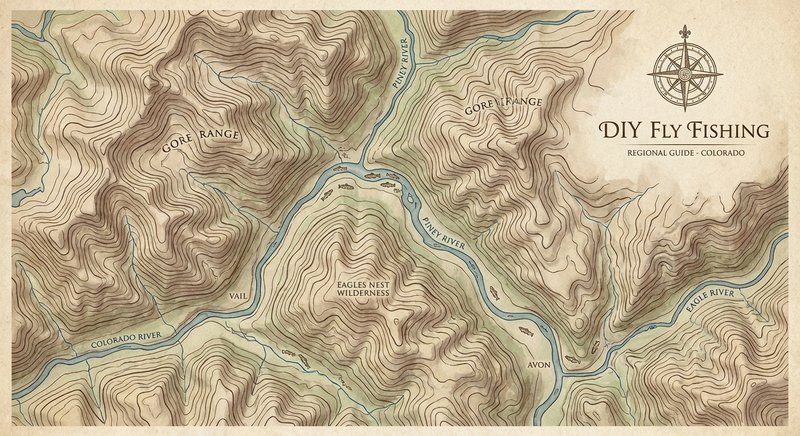
Piney River
Fly fishing in Colorado · Beginner · Best seasons: Summer, Fall
Target Species
Rainbow Trout, Brown Trout, Brook Trout
About This Water
Near Vail with wild rainbow, brown, and brook trout. Less crowded than Gore Creek.
Fishing Recommendations
The Piney River is one of Colorado’s true "hidden in plain sight" gems. While the nearby Eagle and Colorado Rivers get the lion's share of the pressure, the Piney offers a rugged, high-alpine experience characterized by stunning views of the Gore Range and eager, wild trout.
As your guide, here is the deep dive into fishing the Piney River.
🎣 Location Overview
The Piney River is a primary tributary of the Colorado River, originating high in the Eagle Nest Wilderness. It is a quintessential freestone stream. The upper section, near Piney Lake, flows through a wide, glacial valley with slow-moving meanders and marshy banks. As it moves downstream, it transforms into a classic high-gradient mountain stream with pocket water, plunge pools, and tight canyons.
What makes it special: The scenery is arguably the best in the state. Fishing beneath the jagged spires of the Gore Range provides a backcountry feel without requiring a multi-day trek. The water is pristine, and the fish, while often smaller than those in the main stems, are exceptionally colorful and wild.
🐟 Target Species & Behavior
The Piney is a "Grand Slam" water where you can realistically catch three or four species in a single afternoon.
- Brook Trout: Dominant in the upper reaches and smaller tributaries. They are aggressive and will often strike at anything that floats. They hold in the softest water and under undercut banks.
- Rainbow Trout: Found throughout the middle and lower sections. They prefer the faster "bubble line" water and the heads of deep pools.
- Brown Trout: The "kings" of the lower canyon sections. They are more nocturnal and cautious, often holding in deep shadows or under large boulders.
- Cutthroat Trout: Occasionally found in the highest headwaters, though less common than the others.
Feeding Behavior: Because the growing season is short at this elevation (9,000ft+), these fish are opportunistic. They don't have the luxury of being overly picky; if a meal looks natural and is presented well, they will usually take it.
📅 Best Times to Fish
The Piney is a high-altitude fishery, meaning its window of prime fishability is shorter than the valley floor rivers.
- Summer (Late June – August): This is the peak. Once the snowmelt (runoff) subsides in late June, the dry fly fishing is world-class.
- Fall (September – October): My personal favorite time. The Aspen trees turn gold, the Brown trout become aggressive as they prepare to spawn, and the water levels drop, concentrating fish in deeper holes.
- Time of Day: In mid-summer, the morning "trico" or "blue-winged olive" hatches are great, but the 10:00 AM to 4:00 PM window is prime for terrestrial (grasshopper/ant) action.
🪰 Recommended Flies & Techniques
Top Fly Patterns
- Dry Flies:
- Chubby Chernobyl (Size 10-14): The ultimate "searching" fly and a great hopper imitation.
- Parachute Adams (Size 14-18): The gold standard for any mountain stream.
- Stimulator (Size 12-16): Mimics the large stoneflies and caddis found here.
- Amy’s Ant: Excellent for the late summer "terrestrial" bite.
- Nymphs:
- Flashback Pheasant Tail (Size 16-20): Mimics the ubiquitous mayfly nymphs.
- Pat’s Rubber Legs (Size 8-12): Essential for the deeper canyon pools.
- Zebra Midge (Size 18-22): Always effective when things get technical.
- Streamers:
- Black or Olive Woolly Bugger (Size 8-10): Best for the deeper holes in the lower canyon.
Techniques
- Dry-Dropper: This is the most effective way to fish the Piney. Hang a small nymph (like a Pheasant Tail) 18-24 inches below a buoyant dry fly (like a Chubby Chernobyl).
- Pocket Water Picking: In the steeper sections, don't overlook the small "pockets" of calm water behind rocks. A quick, accurate cast is more important than a long one.
- Short Line Nymphing: In the canyon, you rarely need to cast more than 15 feet. Keep as much fly line off the water as possible to avoid drag.
💡 Pro Tips & Local Knowledge
- The "Hike-In" Rule: The further you walk from the Piney Lake parking lot or the lower access points, the better the fishing gets. Most people stay within 500 yards of their car.
- Be Stealthy: The water is crystal clear. If you can see the fish, they have likely already seen you. Wear earthy tones and approach the banks slowly.
- Watch the Afternoon Storms: In the summer, monsoon rains hit the Gore Range almost every afternoon around 2:00 PM. These can cause flash floods in the canyon—if the water turns muddy/red, get out immediately.
- Lower Piney vs. Upper Piney: If you want Brookies and easy wading, stay near the lake. If you want larger Browns and a physical challenge, head to the lower canyon access near State Bridge.
⚠️ Important Information
- Access:
- Upper Piney: Accessed via Red Sandstone Road out of Vail. It’s a long, bumpy dirt road (4WD/High clearance recommended).
- Lower Piney: Accessed via Hwy 131 near State Bridge.
- Regulations: Standard Colorado fishing regulations apply (a valid CO fishing license is required). Always check for seasonal closures or specific "catch and release" zones which can change year-to-year.
- Wildlife: This is prime Moose and Bear country. Moose are frequent in the willows near Piney Lake and can be very aggressive. Give them a wide berth (at least 50 yards).
- Gear: A 3-weight or 4-weight rod (7'6" to 8'6") is perfect for this water. You don't need heavy gear here; it’s about finesse and fun.
Tight lines! The Piney is a special place—treat it with respect, pack out your trash, and enjoy the silence.
Bug Hatches & Matching Flies
| Hatch | Type | Peak months | Time of day | Hook sizes | Matching flies |
|---|---|---|---|---|---|
| Blue Winged Olive (BWO) Baetis | mayfly | April, May, September, October | Late Morning/Afternoon | #18-22 | Parachute Adams #18-22, RS2 #20-22, Pheasant Tail #18-20 |
| Pale Morning Dun (PMD) Ephemerella | mayfly | July, August | Late Morning/Early Afternoon | #14-18 | PMD Sparkle Dun #16-18, Barr's PMD Emerger #16-18, Military Mayfly #16-18 |
| Golden Stonefly Hesperoperla pacifica | stonefly | June, July | All Day | #8-12 | Chubby Chernobyl #8-12, Pat's Rubber Leg #8-12, Golden Twenty-Incher #10-12 |
| Yellow Sally Isoperla | stonefly | July, August | Afternoon/Evening | #14-16 | Yellow Sally Foam Run #14-16, Iron Sally #14-16 |
| Brachycentrus (Mother's Day Caddis) Brachycentrus occidentalis | caddis | May, June | Late Afternoon/Evening | #14-16 | Peacock Elk Hair Caddis #14-16, Guide's Choice Hare's Ear #14-16 |
| Spotted Sedge Hydropsyche | caddis | July, August, September | Evening | #14-18 | Puterbaugh's Foam Caddis #16-18, LaFontaine's Deep Sparkle Pupa #14-16 |
| Midges Chironomidae | midge | March, April, September, October | Morning | #18-24 | Griffith's Gnat #18-22, Zebra Midge #18-22, Top Secret Midge #20-24 |
| Grasshoppers Acrididae | terrestrial | August, September | Late Morning/Afternoon | #8-14 | Amy's Ant #10-14, Morrish Hopper #8-12 |
| Green Drake Ephemera guttulata | mayfly | July | Afternoon | #10-12 | Green Drake Hairwing Dun #10-12, 20-Incher Stone #10-12 |