Pit River
Fly fishing in California · Advanced · Best seasons: Spring, Summer, Fall
Target Species
Rainbow Trout, Brown Trout
About This Water
Multiple sections with wild rainbow trout. Challenging wading but excellent fishing.
Fishing Recommendations
The Pit River in Northeastern California is not a river for the faint of heart. Known among fly anglers as "The Pit," it is a rugged, volcanic, and physically demanding tailwater that offers some of the most productive wild trout fishing in the Western United States. If you are willing to work for it, the rewards are stout, hard-fighting rainbows in a spectacular canyon setting.
🎣 Location Overview
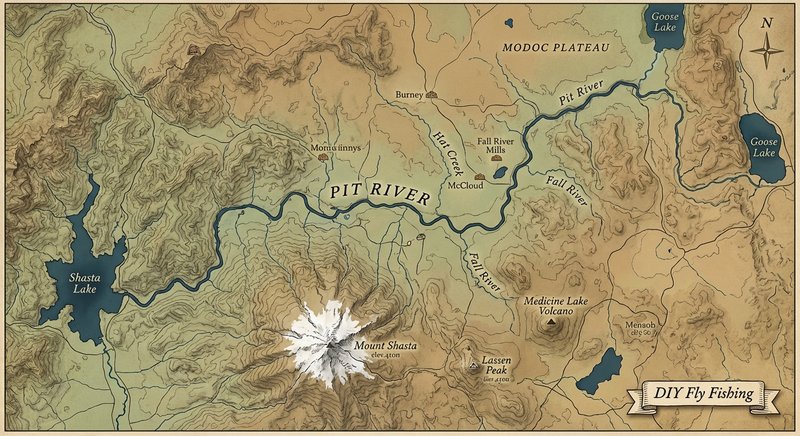
The Pit River flows through a deep basalt canyon between Lake Britton and Shasta Lake. It is a "working" river, heavily utilized for hydroelectric power by PG&E, which creates a series of reaches (Pit 3, 4, and 5 being the primary fishing grounds).
What makes the Pit special is its productivity. The water is nutrient-rich and stays cold year-round due to bottom-releases from the dams. However, it is legendary for its difficult wading. The riverbed is comprised of "greased bowling balls"—slick, volcanic rocks of varying sizes hidden under heavy, turbulent flows. Anglers love it because the fish are exceptionally strong, "shouldery" rainbows that live in fast water and rarely see the amount of pressure found on the nearby McCloud or Upper Sacramento rivers.
🐟 Target Species & Behavior
- Rainbow Trout: The star of the show. These are wild, native-strain fish. They are deep-bodied, incredibly strong, and thrive in the heavy "pocket water." They don't just sit in pools; they hold in the fast, oxygenated riffles and behind large boulders.
- Brown Trout: Present but less common than rainbows. They tend to haunt the deeper, slower pools or the undercut banks near the tail-outs of the reaches.
- Behavior: Because the water is so turbulent, these fish are opportunistic. They don't have long to decide if something is food. They hold tight to the bottom and require you to get your flies deep into their "strike zone" quickly.
📅 Best Times to Fish
- Spring (Late April – June): This is the window for the legendary Golden Stonefly hatch. As the water warms slightly, the fish become highly active. Wading can be tougher due to higher runoff/releases, but the fishing is world-class.
- Summer (July – August): While other California rivers might get too warm, the Pit stays icy cold. This is the prime time for evening Caddis hatches. Expect "Ovaltine" colored water occasionally due to algae—don't let it deter you; the fish can still see the flies.
- Fall (September – October): Arguably the best time. The weather cools, the October Caddis begin to move, and the fish feed aggressively to bulk up for winter. The crowds (which are already small) disappear.
- Optimal Windows: Mid-day is best for nymphing. The last two hours of light are the "magic hour" for dry fly action when the caddis emerge.
🪰 Recommended Flies & Techniques
Techniques
- High-Sticking / Tight-Line Nymphing: This is the most effective way to fish the Pit. Because the currents are so complex, a traditional indicator often gets pulled in three different directions. Keeping your line off the water allows you to feel the take in the heavy pocket water.
- Indicator Nymphing: Use a large, buoyant indicator (like a Thing-a-ma-bodger) to suspend heavy tungsten nymphs through the deep slots.
- Dry-Dropper: Effective in the flatter sections of Pit 3 during the summer.
Top Fly Patterns
- Nymphs:
- Pat’s Rubber Leg Stonefly (Size 4–8) in Brown/Orange or Black.
- Pulsating Prince Nymph (Size 12–16).
- Perdigons (Size 14–16) in Dark Olive or Hot Spot Black (they sink fast!).
- Sucker Spawn (during the spring).
- Dries:
- Golden Stimulator (Size 8–10).
- Elk Hair Caddis (Size 14–16) in Tan or Olive.
- Morrish October Caddis (Size 8–10) for the fall.
- Streamers:
- Olive or Black Woolly Buggers swung through deep holes for the occasional big Brown.
💡 Pro Tips & Local Knowledge
- The "Pit River Pivot": Every local guide will tell you: Bring a wading staff and wear studded boots. Felt soles with cleats are highly recommended. Do not attempt to wade this river without a staff; the rocks move and are incredibly slick.
- Focus on Pit 3: The reach between Lake Britton and the Pit 3 powerhouse is the most popular and has the highest fish count per mile.
- Pit 4 and 5: These reaches are more rugged and harder to access. If you want solitude and don't mind a "climb" down to the water, these areas hold larger, though perhaps fewer, fish.
- Short Leash: When nymphing the pockets, you don't need a 12-foot leader. A shorter, stouter leader (7.5 ft 3X or 4X) helps you control the heavy flies and manhandle the fish out of the fast current.
⚠️ Important Information
- Access: Access is via Forest Service roads off Highway 299 or near Burney, CA. These roads can be rough; a high-clearance vehicle is recommended, especially after rain.
- Regulations: The Pit River has specific regulations that can change by reach. Generally, it is barbless hooks only. Much of the river is "Wild Trout Water" with a zero-limit or highly restricted bag limit. Always check the current CDFW Regulations.
- Powerhouse Releases: This is a hydroelectric river. PG&E can change flow rates at any time. Check the Dreamflows website for current CFS (Cubic Feet per Second) before heading out. Anything over 600-700 CFS makes wading extremely dangerous.
- Safety Hazards: The canyon is home to Rattlesnakes and plenty of Poison Oak. Wear long pants while hiking down to the water and keep an eye on where you place your hands.
Bug Hatches & Matching Flies
| Hatch | Type | Peak months | Time of day | Hook sizes | Matching flies |
|---|---|---|---|---|---|
| Salmonfly Pteronarcys californica | stonefly | May, June | All day | #4-8 | Rogue River Stone #4-8, Pats Rubber Legs #4-8, Chubby Chernobyl #6-10 |
| Golden Stonefly Hesperoperla pacifica | stonefly | June, July | Morning/Evening | #8-12 | Golden Demon #8-12, Twenty Incher #8-12, Norm Wood Special #10-12 |
| Spotted Sedge Hydropsyche | caddis | June, July, August | Evening | #14-18 | Elk Hair Caddis #14-18, Mercer's Gidget #14-16, LaFontaine's Deep Sparkle Pupa #14-16 |
| Blue Winged Olive Baetis | mayfly | March, April, September, October | Afternoon | #18-22 | RS2 #18-22, Pheasant Tail #18-20, Parachute Adams #18-22 |
| Pale Morning Dun Ephemerella excrucians | mayfly | June, July | Morning/Afternoon | #16-18 | Split Case PMD #16-18, PMD Sparkle Dun #16-18, Quigley's Hackle Stacker #16-18 |
| October Caddis Dicosmoecus | caddis | September, October | All day | #8-12 | Peery's October Caddis #8-10, Morrish's Deep Child #8-12, Stimulator (Orange) #8-12 |
| Yellow Sally Isoperla | stonefly | June, July, August | Afternoon/Evening | #14-16 | Yellow Sally Hammer #14-16, Little Yellow Sloan #14-16, Stimulator (Yellow) #14-16 |
| Mother's Day Caddis Brachycentrus | caddis | April, May | Afternoon | #14-16 | Peacock Caddis #14-16, Holy Grail #14-16, Z-Caddis #14-16 |