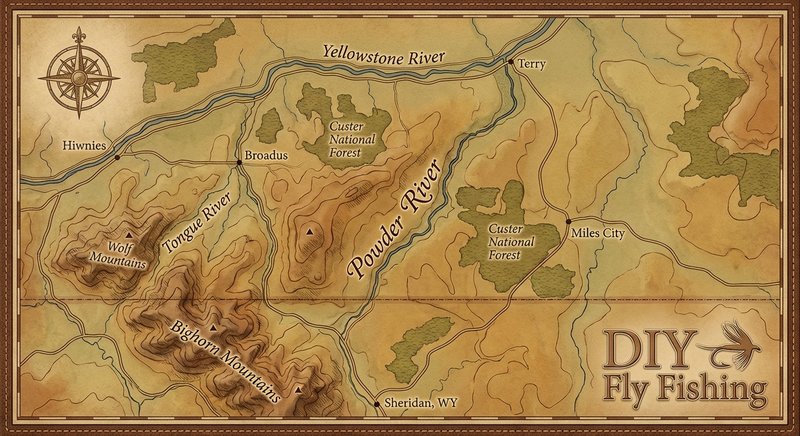
Powder River
Fly fishing in Montana · Beginner · Best seasons: Summer, Fall
Target Species
Channel Catfish, Sauger
About This Water
Eastern Montana prairie river with catfish and sauger. Unique plains fishing experience.
Fishing Recommendations
The Powder River in southeastern Montana is not your typical blue-ribbon trout stream. Flowing through the rugged, arid high plains, this is a "warm water" prairie river characterized by its high sediment load—which gives it its namesake "powdery" appearance—and its wild, meandering nature.
For the fly angler, the Powder River offers a unique, frontier-style experience. While most head to Montana for rainbows and browns, the Powder is a stronghold for native prairie species. It is one of the last remaining undammed rivers in the West, providing a rare glimpse into a prehistoric ecosystem.
🎣 Location Overview
The Powder River is a study in resilience. It is often described as "a mile wide, an inch deep, too thick to drink, and too thin to plow." It winds through sandstone bluffs and sagebrush flats before joining the Yellowstone River near Terry, Montana.
What makes this water special is the turbidity. Because the water is often stained or silty, fish rely more on their lateral lines and sense of smell than sight. For the fly fisher, this presents a fascinating challenge: you aren't matching a delicate hatch; you are creating vibration, silhouette, and movement to trigger predatory instincts in a low-visibility environment.
🐟 Target Species & Behavior
Channel Catfish
Contrary to popular belief, Channel Catfish are excellent fly rod targets. They are aggressive predators, especially in moving water.
- Behavior: They hold in deeper pools, undercut banks, and just below riffles where oxygen is high.
- Feeding: They are opportunistic. While they scavenge, they actively hunt baitfish, crayfish, and large aquatic insects (like Dobsonfly larvae).
Sauger
The Sauger is the "wild cousin" of the Walleye, perfectly adapted to the silty waters of the Powder.
- Behavior: Sauger are light-sensitive. They hug the bottom during the day and move into shallower flats or the heads of pools to hunt during low-light hours.
- Feeding: They are piscivorous (fish-eaters). They focus on fathead minnows, emerald shiners, and young-of-the-year suckers.
📅 Best Times to Fish
Summer (June - August)
- Conditions: The water is warm, and fish metabolism is high. This is the peak time for Channel Catfish.
- Window: Early morning and late evening are best. Night fishing with high-vibration flies can be incredibly productive for large cats.
Fall (September - November)
- Conditions: As water temperatures drop, Sauger activity spikes. They begin to congregate as they prepare for winter.
- Window: Overcast days are prime for Sauger. The "golden hour" just before sunset is often the most frantic bite of the day.
🪰 Recommended Flies & Techniques
Top Fly Patterns
- For Catfish:
- The Dirty Hippy: A large, articulated streamer with plenty of flash and movement.
- Meat Whistle (Black or Olive): The jig-style hook keeps the point up (less snagging) and the rabbit strip creates massive vibration.
- Clouser Minnow (Chartreuse/White): A classic that cuts through the silt and reaches the bottom quickly.
- For Sauger:
- Gummy Minnows: Effective when Sauger are keyed in on small shiners.
- Wooly Buggers (Size 4-6): Use dark colors (Black or Purple) to create a strong silhouette against the murky water.
- Zonkers: The lateral line of the rabbit strip mimics a wounded minnow perfectly.
Techniques & Presentation
- The "Slow Crawl": Use a Type 3 or Type 6 Sinking Tip. Cast across the current, let the fly sink to the bottom, and use a slow, pulsing strip. If you aren't occasionally "ticking" the bottom, you aren't deep enough.
- Vibration is Key: Choose flies with spinning blades (like a Pistol Pete) or heavy hackles that push water.
- The Swing: For Sauger, use a traditional down-and-across swing. As the fly straightens out at the end of the swing, let it dangle for a few seconds; Sauger often follow the fly and strike when it "struggles" against the current.
💡 Pro Tips & Local Knowledge
- Find the "Confluence Points": Focus your efforts near where small coulees or creeks enter the main river. These areas often have slightly different temperatures or clarity and attract baitfish.
- Watch the Flow: The Powder can rise and get "thick" very quickly after a rainstorm. If the river looks like chocolate milk, the fishing will be tough. Look for "clearing" water—greenish-brown is the sweet spot.
- Heavy Tackle: Use a 6 or 7-weight rod. While the fish aren't always massive, you need the backbone to throw heavy sinking lines and pull large Catfish out of submerged timber.
- Scent is Legal: In Montana, you can use scent on flies. If the water is particularly muddy, a small amount of crawfish or minnow scent on your streamer can drastically increase your hook-up rate for Channel Cats.
⚠️ Important Information
Access
- Much of the Powder River runs through private ranch land. Montana’s Stream Access Law allows you to fish the river as long as you stay below the ordinary high-water mark.
- Public access points are found at bridge crossings (e.g., Highway 10 or near the town of Broadus) and BLM (Bureau of Land Management) parcels. Always use a GPS app like OnX to ensure you are on public land when entering or exiting.
Regulations & Permits
- A valid Montana Fishing License and the Conservation License are required.
- Check the current Montana FWP (Fish, Wildlife & Parks) Central District regulations for daily bag limits on Sauger and Catfish, as these can change seasonally.
Special Considerations
- Rattlesnakes: This is prime prairie rattlesnake country. Be extremely cautious when walking through tall grass or sagebrush to get to the river.
- Mud: The "Powder River Mud" is notorious. It is slick and sticky. Studded wading boots are highly recommended.
Bug Hatches & Matching Flies
| Hatch | Type | Peak months | Time of day | Hook sizes | Matching flies |
|---|---|---|---|---|---|
| Midges Chironomidae | midge | March, April, November | Late Morning | #18-24 | Zebra Midge #18-22, Griffith's Gnat #20-22 |
| Blue Winged Olive Baetis spp. | mayfly | April, May, September, October | Overcast Afternoons | #16-20 | RS2 #18-20, Parachute Adams #16-20 |
| Spotted Sedge Hydropsyche | caddis | June, July | Evening | #14-16 | Elk Hair Caddis #14-16, Hydropsyche Larva #14-16 |
| Trico Tricorythodes | mayfly | August, September | Early Morning | #20-24 | Trico Spinner #20-24, Sunken Trico #22 |
| Grasshoppers Acrididae | terrestrial | July, August, September | Afternoon | #8-12 | Morrish Hopper #8-12, Joe's Hopper #10-12 |
| Water Boatman Corixidae | other | May, September, October | All Day | #14-16 | Boatman Pattern #14-16, Prince Nymph #14-18 |
| Damselfly Zygoptera | other | June, July | Mid-day | #10-14 | Marabou Damsel #12-14, Adult Damsel #12 |
| Ants & Beetles Formicidae / Coleoptera | terrestrial | July, August | All Day | #12-18 | Chernobyl Ant #12-14, Fat Albert #12-14 |