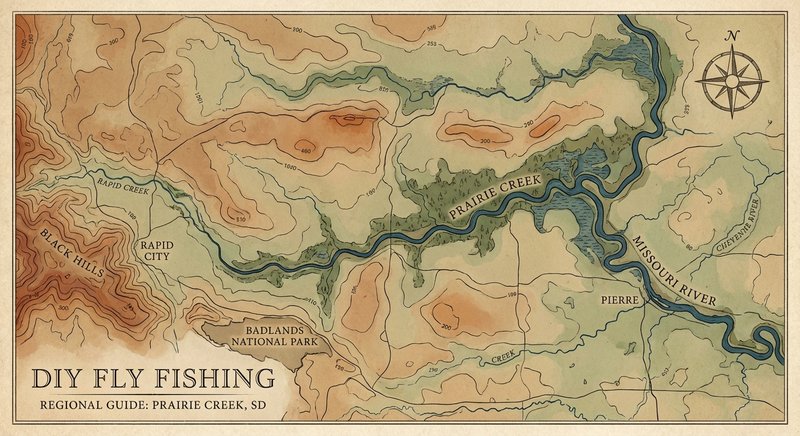
Prairie Creek
Fly fishing in South Dakota · intermediate · Best seasons: spring, fall
Target Species
Brown Trout, Rainbow Trout
About This Water
Black Hills fringe stream with wild trout. Transition zone fishing.
Fishing Recommendations
As an expert guide with years of experience navigating the limestone-influenced streams of the Black Hills, I can tell you that Prairie Creek is one of the region's best-kept secrets. While most visiting anglers flock to the famous Spearfish Creek or the urban reaches of Rapid Creek, Prairie Creek offers a more intimate, "small water" experience that rewards stealth and precision.
Here is your comprehensive guide to fly fishing Prairie Creek, South Dakota.
🎣 Location Overview
Prairie Creek is a charming, small-volume tributary located in the central Black Hills, eventually flowing into the larger Spring Creek drainage. What makes this water special is its intimate character. This is classic small-stream fly fishing: willow-lined banks, tight casting lanes, and a mix of plunges, riffles, and deep undercut banks.
The water is generally clear and cool, thanks to the high-altitude springs that feed it. Anglers love Prairie Creek because it offers a sense of solitude. You aren't likely to see a crowd here; instead, you'll find wild fish in a rugged, "tucked-away" canyon setting. It is the perfect place for the angler who prefers a 3-weight rod and a stealthy approach over long-distance casting.
🐟 Target Species & Behavior
The creek is home to a healthy population of Wild Brown Trout and Rainbow Trout.
- Brown Trout: These are the primary residents. They are notoriously spooky in the clear, shallow water. They prefer to hold deep under the overhanging willows or in the dark shadows of undercut banks. They are opportunistic but cautious; a shadow on the water will send them darting for cover.
- Rainbow Trout: Found more frequently in the faster-moving riffles and the heads of the larger pools. They tend to be slightly more aggressive than the browns and will often move further to take a fly.
- Behavior: During the day, fish remain tucked against structure. During low-light hours or heavy hatches, they move into the tail-outs and shallower riffles to feed. Because the stream is small, the trout have a high "metabolic demand"—if you present a fly naturally without scaring them, they will usually eat.
📅 Best Times to Fish
While the Black Hills offer year-round fishing, Prairie Creek shines during your requested windows:
- Spring (Late March – Early June): This is the "waking up" period. As water temperatures hit the 45–50°F mark, the fish become very active.
- The Window: Mid-day is best (11:00 AM – 3:00 PM).
- Conditions: Look for the Blue Winged Olive (BWO) hatches on overcast, drizzly days in April.
- Fall (September – Early November): This is arguably the prime time. The Brown Trout are preparing to spawn and become more aggressive and territorial.
- The Window: Morning and late afternoon.
- Conditions: The water is usually at its clearest and lowest. The fall colors in the canyon are spectacular, and the terrestrial fishing (hoppers/ants) can be world-class until the first hard freeze.
🪰 Recommended Flies & Techniques
Top Fly Patterns
- Dry Flies:
- Parachute Adams (#16-20): The gold standard for general prospecting.
- Elk Hair Caddis (#14-18): Great for the riffles and skittering across pools.
- BWO Sparkle Dun (#18-22): Essential for spring afternoons.
- Morrish Hopper or Foam Ants (#12-16): Vital for late summer and fall.
- Nymphs:
- Beadhead Pheasant Tail (#16-20): Mimics almost everything in the creek.
- Flashback Hare’s Ear (#14-18): Excellent for the deeper plunge pools.
- Zebra Midge (#18-22): Black or Red; a must-have for technical winter/spring fishing.
- Streamers:
- Pine Squirrel Leech (Black/Olive): Small, jiggy streamers are lethal for larger browns in the fall.
Effective Techniques
- The "Dry-Dropper": This is the most effective way to fish Prairie Creek. Use a buoyant hopper or a high-vis Parachute Adams as your indicator, with a small Pheasant Tail dropped 12–18 inches below it.
- Stealth Approach: Because the creek is narrow, you must fish upstream. Start at the bottom of a pool and work your way up to avoid sending "pressure waves" or debris down to the fish.
- Dapping & Bow-and-Arrow Casts: You will encounter tight brush. Mastery of the bow-and-arrow cast is often more important here than a traditional overhead cast.
💡 Pro Tips & Local Knowledge
- The "Willow Tap": In the fall, the banks are loaded with beetles and ants. If you can’t get a clean cast under a willow, try to "drift" your fly as close to the leaves as possible. Often, the vibration of the fly hitting the water near the bank triggers a strike.
- Light Tackle is Key: Leave the 5-weight at home. A 7.5-foot to 8.5-foot 3-weight rod is the perfect tool for this water. Use a 9-foot leader tapered to 5X or 6X fluorocarbon for nymphs.
- Focus on the Confluence: The areas where Prairie Creek nears its junction with Spring Creek often hold larger "transient" fish that move up from the larger river to feed or spawn.
- Watch Your Shadow: The sun can be bright in the Hills. Always keep the sun in front of you or to the side; if your shadow falls across a pool, the fishing in that hole is done for the next hour.
⚠️ Important Information
- Access: Much of Prairie Creek runs through US Forest Service land (Black Hills National Forest), providing good public access. However, there are pockets of private land. Always look for "Posted" signs and use a mapping app like OnX to ensure you are on public ground.
- Regulations:
- A valid South Dakota Fishing License is required.
- Check the latest SD Game, Fish & Parks (GFP) South Dakota Fishing Handbook for specific creel limits, though Catch and Release is strongly encouraged to preserve this fragile ecosystem.
- Safety: The Black Hills are home to mountain lions and northern Pacific rattlesnakes (though snakes are less common at higher elevations). Be aware of your surroundings and always carry a small first-aid kit and water.
- Cell Service: Expect zero to spotty cell service once you drop into the canyon. Let someone know your plan before you head out.
Tight lines, and enjoy the solitude of Prairie Creek!
Bug Hatches & Matching Flies
| Hatch | Type | Peak months | Time of day | Hook sizes | Matching flies |
|---|---|---|---|---|---|
| Blue-Winged Olive Baetis spp. | mayfly | March, April, September, October | Late Morning/Afternoon | #18-22 | Parachute Adams #18-22, RS2 #20-22, Pheasant Tail #18-20 |
| Pale Morning Dun Ephemerella excrucians | mayfly | June, July | Late Morning/Early Afternoon | #16-18 | PMD Sparkle Dun #16-18, Split Case PMD #16-18, Trigger Finger PMD #16-18 |
| Trico Tricorythodes | mayfly | July, August, September | Early Morning | #20-24 | Trico Spinner #20-24, Drowned Trico #22-24 |
| Mother's Day Caddis Brachycentrus occidentalis | caddis | May | Afternoon/Evening | #14-16 | Peacock Caddis #14-16, Holy Grail #14-16, Deep Sparkle Pupa #14-16 |
| Little Black Stonefly Capniidae family | stonefly | February, March | Midday | #16-20 | Black Zebra Midge #18-20, Little Black Sloan #16-18 |
| Spotted Sedge Hydropsyche | caddis | June, July, August | Evening | #14-18 | Elk Hair Caddis #14-18, LaFontaine's Emergent Pupa #16-18 |
| Grasshoppers Orthoptera | terrestrial | August, September | Late Morning/Afternoon | #8-12 | Hopper Juan #10-12, Dave's Hopper #8-12 |
| Chironomids Midge | midge | January, February, November, December | All Day | #18-26 | Zebra Midge #18-22, Griffith's Gnat #20-24, Morgan's Midge #20-22 |