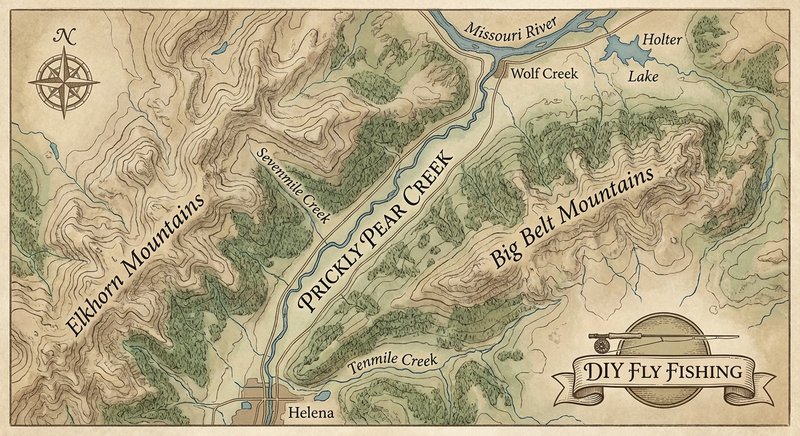
Prickly Pear Creek
Fly fishing in Montana · Beginner · Best seasons: Summer, Fall
Target Species
Brown Trout, Rainbow Trout
About This Water
Near Helena with wild brown and rainbow trout. Good fishing close to the capital city.
Fishing Recommendations
Prickly Pear Creek is one of Montana’s best-kept "open secrets." While the crowds flock to the "Mighty Mo" (the Missouri River) just downstream, the Prickly Pear offers an intimate, technical, and highly rewarding small-stream experience. Flowing through the Helena valley and eventually into Lake Helena and the Missouri, it provides a diverse range of water from pocket water in the canyon to slow, meandering oxbows in the meadows.
🎣 Location Overview
Prickly Pear Creek is a classic Montana meadow stream with a split personality. It begins in the mountains south of Helena, flows through a rugged canyon near Montana City, and then opens up into a rich, spring-fed meadow environment.
What makes it special is its productivity. Despite its modest size, the nutrient-rich water supports a massive biomass of insects and crustaceans. This leads to trout that are surprisingly large for a stream you can often jump across. Anglers love it because it requires "stealth and skill"—it is a thinking-man’s creek where a well-placed cast is more important than a long one.
🐟 Target Species & Behavior
- Brown Trout: The kings of the Prickly Pear. They are notorious for living under the deeply undercut banks and tangled willow roots. They are wary and will spook at the slightest shadow.
- Rainbow Trout: Generally found in the faster riffles and "bubbly" water at the heads of pools. They tend to be more opportunistic than the browns but are hard fighters in the tight current.
Behavior: These fish are highly "structure-oriented." If there is a downed log or a cut bank, there is a fish under it. During the summer, they become very "upward-looking," waiting for terrestrials to fall from the overhanging grasses.
📅 Best Times to Fish
Optimal Seasons
- Summer (Late June – August): This is the prime window for dry fly action. As the surrounding hay fields grow, the terrestrial fishing (hoppers, ants, beetles) becomes world-class.
- Fall (September – October): My personal favorite. The Brown trout become aggressive as they prepare to spawn. The water cools, and the crowds (which are already thin) disappear completely.
Best Times of Day
- Summer: Start early (6:00 AM – 11:00 AM) to beat the heat. Late evening "spinner falls" can also be productive.
- Fall: The "banker's hours" window (10:00 AM – 4:00 PM) is best as the sun warms the water and triggers insect activity.
Prime Windows
Look for overcast days in September. This often triggers massive Blue Winged Olive (BWO) hatches, leading to some of the best dry fly fishing of the year.
🪰 Recommended Flies & Techniques
Top Fly Patterns
- Terrestrials: Chubby Chernobyl (Size 12-14), Dave’s Hopper (Size 12), Morrish Hopper, and Foam Ants (Size 16-18).
- Nymphs: Ray Charles (Grey or Tan, Size 16-18) — a local staple due to the scud population. Gold-ribbed Hare’s Ear and Flashback Pheasant Tails.
- Dries: Sparkle Duns (PMD or BWO), Elk Hair Caddis (Size 14-16), and Griffith’s Gnat for midge clusters.
- Streamers: Small Wooly Buggers in olive or black, and the "Sculpzilla" for hunting big browns in the canyon.
Effective Techniques
- Dry-Dropper: This is the "bread and butter" on the Prickly Pear. Use a buoyant hopper or Chubby on top and hang a small Scud or Pheasant Tail 18–24 inches below it.
- The "Reach Cast": Because of the meandering nature of the creek, various currents will pull your line. A reach cast is essential to get a drag-free drift.
- Tight-Line Nymphing: In the canyon sections, use Euro-nymphing or tight-line techniques to probe the deep pockets between boulders.
💡 Pro Tips & Local Knowledge
- The Stealth Factor: I cannot stress this enough—stay low. The banks are often high, and your silhouette against the Montana sky will spook every fish in the hole. Wear earthy colors and crawl into position if you have to.
- Focus on the "Outside Bends": The creek is incredibly twisty. The deep water is almost always on the outside bend under the willows. If your fly isn't within 2 inches of the grass, you're out of the strike zone.
- The "Scud" Secret: Because this creek has limestone characteristics, scuds (freshwater shrimp) are a primary food source year-round. If the fish aren't rising, a Tan or Orange scud pattern fished deep is your "get out of jail free" card.
- The Bridge Strategy: Many anglers fish right at the bridge access points. If you walk just 15 minutes away from any road crossing, you will find fish that haven't seen a fly in weeks.
⚠️ Important Information
Access & Regulations
- Montana Stream Access Law: You can fish anywhere below the high-water mark, but you must enter through public access points (bridges or Fishing Access Sites). Much of the land surrounding Prickly Pear is private ranch land—respect fences and stay in the water.
- Permits: A valid Montana Fishing License and Conservation License are required.
- Hoot Owl Restrictions: In mid-to-late summer, Montana FWP may implement "Hoot Owl" rules (no fishing after 2:00 PM) if water temperatures get too high. Always check the FWP website before heading out.
Special Considerations
- Rattlesnakes: The canyon sections and the dry grassy banks around the Helena valley are prime rattlesnake territory. Watch your step and wear sturdy wading boots.
- Brushy Banks: This is not a "clean" stream. Expect to lose a few flies in the willows. Use a shorter rod (7'6" to 8'6") for better maneuverability in tight quarters.
Bug Hatches & Matching Flies
| Hatch | Type | Peak months | Time of day | Hook sizes | Matching flies |
|---|---|---|---|---|---|
| Blue Winged Olive Baetis tricaudatus | mayfly | April, May, September, October | Late Morning/Afternoon | #18-22 | RS2 #18-22, Parachute Adams #18-22, BWO Sparkle Dun #18-20 |
| Pale Morning Dun Ephemerella invaria | mayfly | June, July | Late Morning | #14-18 | Pheasant Tail Nymph #14-18, PMD Sparkle Dun #16-18, Quigley Cripple #16-18 |
| Trico Tricorythodes | mayfly | July, August, September | Early Morning | #20-24 | Trico Spinner #20-24, Sunken Trico Spinner #20-22, Drowned Trico #22 |
| Mother's Day Caddis Brachycentrus occidentalis | caddis | May | Afternoon/Evening | #14-16 | Peacock Caddis #14-16, Soft Hackle Hare's Ear #14-16, LaFontaine's Deep Sparkle Pupa #14-16 |
| Spotted Sedge Hydropsyche | caddis | June, July, August | Evening | #14-18 | Elk Hair Caddis #14-18, Iris Caddis #16-18, Hydropsyche Larva #14-16 |
| Yellow Sally Isoperla | stonefly | June, July | Afternoon/Evening | #14-16 | Yellow Sally Stimulator #14-16, Iron Sally #14-16 |
| Midges Chironomidae | midge | March, April, September, October | All Day | #18-24 | Zebra Midge #18-22, Griffith's Gnat #18-22, Morgan's Midge #20-22 |
| Terrestrials (Hoppers/Ants/Beetles) Orthoptera/Formicidae | terrestrial | July, August, September | Late Morning/Afternoon | #10-18 | Morrish Hopper #10-14, Black Foam Ant #16-18, Flash Beetle #14-16 |
| October Caddis Dicosmoecus gilvipes | caddis | September, October | Afternoon | #8-12 | Orange Stimulator #8-12, October Caddis Pupa #10-12 |