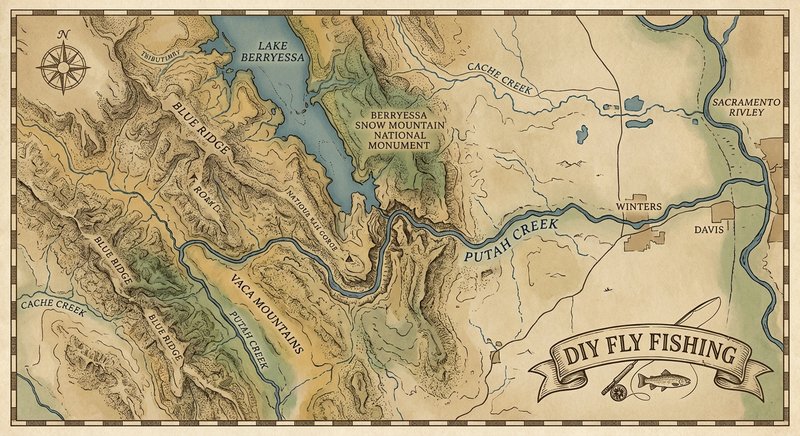
Putah Creek
Fly fishing in California · Advanced · Best seasons: Spring, Summer, Fall, Winter
Target Species
Rainbow Trout, Brown Trout
About This Water
Below Lake Berryessa with wild rainbow and brown trout. Technical tailwater fishing near Davis.
Fishing Recommendations
Welcome to the "University of Putah Creek." As an expert guide, I can tell you that Putah Creek is one of the most rewarding, yet humbling, technical tailwaters in the Western United States. Located just an hour from San Francisco and Sacramento, it is a blue-ribbon fishery that demands your "A-game."
Here is your comprehensive guide to mastering Putah Creek.
🎣 Location Overview
Putah Creek is a classic tailwater located below the Monticello Dam (Lake Berryessa). What makes it special is the combination of constant cold water releases and a high nutrient load, which creates a year-round "trout factory."
The creek is characterized by deep, slow-moving pools, fast riffles, and dense riparian vegetation. Because it is a "bottom-release" dam, the water stays cold (50–58°F) even in the heat of a California summer. It is a technical fishery where the fish are legendary for their size, strength, and incredible wariness. You aren't just fishing; you are solving a puzzle.
🐟 Target Species & Behavior
- Rainbow Trout: These are the stars of the show. They are wild, thick-bodied, and incredibly strong. Putah rainbows are known for their "football" shape—short but very deep. They are notoriously selective and have a PhD in detecting poor drifts.
- Brown Trout: Present but more elusive. They tend to hold in the deeper, darker undercut banks and under heavy overhanging brush.
Behavior: These fish are "lazy" because they don't have to move far for food. They hold in very specific seams and slots. If your fly is six inches off their line, they likely won't move for it. They feed primarily on tiny midges and baetis (BWO) nymphs year-round.
📅 Best Times to Fish
- Winter (Dec–Feb): This is prime time for big fish. The Baetis hatches are strong on overcast days, and the crowds are thinner. Note: Spawning occurs in winter; stay off the gravel "redds" to protect the next generation.
- Spring (March–May): Excellent fishing as water flows stabilize. Caddis begin to appear, and the fish become very active as metabolic rates rise.
- Summer (June–Aug): High flows (for irrigation) make wading difficult but push fish to the edges. This is "San Juan Worm" and "Caddis" season.
- Fall (Sept–Nov): Perhaps the most beautiful time. Flows drop, making more of the creek accessible. Great BWO hatches and aggressive fish preparing for winter.
Best Time of Day: Early morning and "the witching hour" (last 90 minutes of light) are most productive. On overcast days, the BWO hatches can trigger a midday feeding frenzy.
🪰 Recommended Flies & Techniques
Top Fly Patterns
- Midges (Sizes 18–24): Zebra Midges (Black, Red, Olive), Zebra Midge with a mercury bead, or the "Z-Midge."
- Baetis/BWOs (Sizes 18–22): Pheasant Tails (slim profile), JujuBaetis, RS2s, and BWO emergers.
- Caddis (Sizes 14–18): Fox’s Poopah, Peeking Caddis, and Weightless Bird’s Nest.
- Attractors: San Juan Worms (Red or Pink) are lethal after a rain or during high summer flows. Small Egg patterns in late winter.
Techniques & Presentation
- Technical Nymphing: This is 90% of the game. A Tactical Nymphing (Euro) setup or a very sensitive indicator rig is required.
- Micro-Shot: Because the current is deceptive, you must use small split shot to get the flies into the "zone" instantly without creating a splash.
- The Drift: You need a 100% drag-free drift. Use long, 5X or 6X fluorocarbon leaders. If you see your indicator twitch, set the hook—these fish spit flies in a heartbeat.
- Dry Fly: Occasional opportunities exist during BWO or Caddis hatches, but you must be stealthy. Use a "Reach Cast" to avoid lining the fish.
💡 Pro Tips & Local Knowledge
- The "Putah Hookset": Because you use light tippet (6X) for large fish, a violent vertical hookset will snap your line. Use a "downstream trout set"—a firm, low pull toward the bank.
- Wading Stealth: The fish here are extremely sensitive to vibration. Do not "stomp" through the water. Move slowly and stay out of the water whenever possible.
- Focus on the "Buckets": Don't waste time in flat, featureless water. Look for "buckets"—depressions in the creek bed that are slightly darker/deeper than the surrounding area.
- Check the Flows: Putah flows fluctuate wildly due to agricultural demand. Anything under 200 CFS is easy wading; 500+ CFS is dangerous and requires fishing from the banks.
⚠️ Important Information
- Regulations: Putah Creek (from Monticello Dam to Solano Lake) is a Catch and Release only fishery. Only barbless hooks are permitted. Always check the current CDFW regulations before heading out.
- Access: There are 5 main public access points (Access 1 through 5) along Hwy 128. Access 5 is the furthest downstream; Access 1 is closest to the dam.
- Safety: The rocks in Putah are notoriously slippery. Studded wading boots and a wading staff are highly recommended.
- Etiquette: This is a popular spot. If a pool is occupied, give the angler plenty of space (at least 50–100 yards).
Guide’s Final Word: Don't get discouraged if you get "skunked" your first time. Putah Creek rewards persistence and precision. When you finally land one of those 20-inch, slab-sided rainbows, you'll know exactly why we keep coming back.
Bug Hatches & Matching Flies
| Hatch | Type | Peak months | Time of day | Hook sizes | Matching flies |
|---|---|---|---|---|---|
| Midges Chironomidae | midge | January, February, March, December | All Day | #18-26 | Zebra Midge #18-22, Palomino Midge #20-24, Griffith's Gnat #20-24 |
| Blue-Winged Olive (BWO) Baetis | mayfly | February, March, October, November | Late Morning/Afternoon | #18-22 | Juju Baetis #18-22, RS2 #20-22, Parachute Adams #18-22 |
| Spotted Sedge Hydropsyche | caddis | May, June, July | Evening | #14-18 | Peeping Caddis #14-16, Elk Hair Caddis #14-18, Pupa Sedge #16-18 |
| Pale Morning Dun (PMD) Ephemerella | mayfly | May, June, July | Morning/Early Afternoon | #16-18 | Mercer's Poxyback PMD #16-18, Split Case PMD #16-18, PMD Sparkle Dun #16-18 |
| Trico Tricorythodes | mayfly | July, August, September | Early Morning | #20-24 | Trico Spinner #20-24, Tiny Nelson #22-24 |
| Little Yellow Stonefly Isoperla (Yellow Sally) | stonefly | May, June | Afternoon/Evening | #14-16 | Little Yellow Stone Nymph #14-16, Yellow Sally Dry #14-16 |
| Crane Fly Tipulidae | other | August, September, October | Morning/Evening | #8-12 | Crane Fly Larva #8-12, Daddy Long Legs #10-12 |
| Cinnamon Caddis Ceraclea | caddis | August, September | Evening | #16-18 | Cinnamon Sedge #16-18, Fox's Poopah #16-18 |