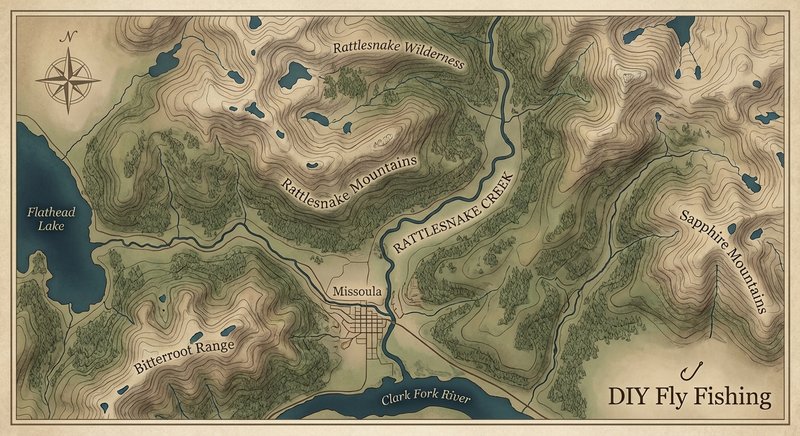
Rattlesnake Creek
Fly fishing in Montana · Intermediate · Best seasons: Summer, Fall
Target Species
Cutthroat Trout, Bull Trout
About This Water
Near Missoula with wild cutthroat and bull trout. Wilderness area fishing close to town.
Fishing Recommendations
Rattlesnake Creek is a hidden gem located just minutes from downtown Missoula, Montana. It serves as a vital cold-water tributary to the Clark Fork River and offers a "wilderness-lite" experience for anglers who want high-alpine scenery without a five-hour drive.
Here is your comprehensive guide to fly fishing Rattlesnake Creek.
🎣 Location Overview
Rattlesnake Creek flows out of the Rattlesnake Wilderness and National Recreation Area, carving a path through rugged canyons and lush riparian corridors before meeting the Clark Fork. What makes this water special is its character: it is a classic, high-gradient mountain freestone stream.
The water is crystal clear and remains cold even in the heat of August. The upper reaches feature "pocket water" dominated by boulders, plunges, and deep crystalline pools. As it nears the city, it levels out slightly but retains its quick pace. Anglers love it because it offers high-density trout populations and the ability to find solitude simply by hiking a few miles past the main trailhead.
🐟 Target Species & Behavior
The Rattlesnake is a critical spawning ground and nursery for the Clark Fork system.
- Westslope Cutthroat Trout: These are the stars of the show. They are beautiful, native, and highly opportunistic. In this fast water, they don't have long to decide—if it looks like food and is presented well, they will smash it. They hold in the "cushion" in front of boulders, in the soft seams next to fast current, and in the tail-outs of pools during the evening.
- Bull Trout: The Rattlesnake is home to a significant population of federally protected Bull Trout. These are the apex predators of the creek. Note: You generally cannot "target" Bull Trout here; however, you will see them (some quite large) lurking in the deepest, darkest pools.
- Rainbow/Brown Trout: Found primarily in the lower reaches near the confluence with the Clark Fork.
📅 Best Times to Fish
Summer (July – August)
This is the prime window. Once the spring runoff subsides (usually by late June or early July), the creek becomes a dry-fly paradise.
- Optimal Window: 10:00 AM to 4:00 PM for peak hatch activity.
- Conditions: Clear, dropping water levels.
Fall (September – October)
The crowds thin out, and the larger Cutthroats are looking to bulk up before winter.
- Optimal Window: Mid-day as the sun warms the water.
- Conditions: Crisp mornings and golden larches. Look for the "Hecuba" (Great Red Quill) hatch in late September.
🪰 Recommended Flies & Techniques
Because the water is fast and the fish are opportunistic, you don't need a massive fly box. You need flies that float high and are easy to see.
Top Fly Patterns
- Dry Flies:
- Purple Haze (Size 14-16): A Montana staple that works inexplicably well here.
- Chubby Chernobyl (Size 10-12, Gold or Olive): Great for high-floating visibility and as a hopper imitation.
- Royal Wulff or Stimulator: Classic attractor patterns for turbulent pocket water.
- Nymphs:
- Bead-head Prince Nymph (Size 14-16).
- Pat’s Rubber Legs (Size 10-12) in coffee/black.
- Terrestrials:
- Morrish Hopper or Ant imitations in August.
Techniques
- The Dry-Dropper: This is the most effective way to fish the Rattlesnake. Use a buoyant dry (like a Chubby) and hang a weighted nymph (like a Pheasant Tail) 18–24 inches below it.
- Short Line Nymphing: In the heavy boulder sections, you don't need a long cast. Keep a short line, high-stick your rod, and keep as much fly line off the water as possible to avoid drag.
- The "Splat" Cast: When fishing terrestrials in the summer, don't be afraid to let the fly hit the water with a little force. It mimics a grasshopper falling in and triggers an instinctive strike.
💡 Pro Tips & Local Knowledge
- Bikes are Best: The main corridor is closed to motorized vehicles but open to bicycles. To reach the best water (5+ miles in), bring a mountain bike. You can cover more ground and reach fish that rarely see a fly.
- The "Three-Cast" Rule: Cutthroats in the Rattlesnake are not usually shy. If you put a good drift over a pocket three times and don't get a rise, move on to the next pocket. Covering water is the key to a high-count day.
- Wading Safety: The rocks here are notoriously "greased" with algae and are very round. Studded wading boots and a wading staff are highly recommended.
- Stealth Matters: Despite their appetite, these fish live in very clear water. Avoid lining the fish (casting your fly line directly over their heads) and try to approach pools from downstream.
⚠️ Important Information
Access
- Main Trailhead: Located at the end of Rattlesnake Drive north of Missoula. There is ample parking and a well-marked map.
- The "Main Corridor" trail follows the creek for miles, with numerous social paths leading down to the water.
Regulations & Permits
- License: A valid Montana Fishing License and an AIS (Aquatic Invasive Species) Prevention Pass are required.
- Bull Trout: It is illegal to intentionally target Bull Trout. If you hook one incidentally, do not remove it from the water. Release it immediately.
- Catch & Release: Most anglers practice strict catch and release here to preserve the native Westslope Cutthroat population. Check the current Montana FWP (Fish, Wildlife & Parks) Central District regulations for specific harvest limits (though harvest is discouraged).
Wildlife Warning
- Bears: This area is a major corridor for both Black Bears and Grizzly Bears. Always carry bear spray in an accessible location (not in your backpack) and make noise while moving through thick brush along the creek.
Bug Hatches & Matching Flies
| Hatch | Type | Peak months | Time of day | Hook sizes | Matching flies |
|---|---|---|---|---|---|
| Skwala Stonefly Skwala americana | stonefly | March, April | Late Morning/Afternoon | #8-12 | Skwala Stone #10-12, Pat's Rubber Leg #8-12, Bullet Head Skwala #10-12 |
| Blue Winged Olive Baetis | mayfly | April, May, September, October | Midday | #16-20 | Parachute Adams #16-20, RS2 #18-20, Pheasant Tail Nymph #16-20 |
| March Brown Rhithrogena morrisoni | mayfly | April, May | Afternoon | #12-14 | March Brown Western Deceiver #12-14, Gold Ribbed Hare's Ear #12-14, March Brown Soft Hackle #14 |
| Salmonfly Pteronarcys californica | stonefly | June | All Day | #4-8 | Rogue River Stone #4-8, Cat Puke #6-8, 20 Incher Stone #6-8 |
| Golden Stonefly Hesperoperla pacifica | stonefly | June, July | Morning/Evening | #8-12 | Chubby Chernobyl (Gold) #8-12, Golden Stone Nymph #8-12, Water Walker #10-12 |
| Pale Morning Dun Ephemerella excrucians | mayfly | June, July | Late Morning/Early Afternoon | #14-18 | PMD Sparkle Dun #16-18, Trigger Finger PMD #14-16, Military Mayfly #16-18 |
| Spotted Sedge Hydropsyche | caddis | June, July, August | Evening | #14-16 | Elk Hair Caddis (Tan) #14-16, LaFontaine's Deep Sparkle Pupa #14-16, Goddard Caddis #14 |
| Terrestrials Formicidae / Acrididae | terrestrial | July, August, September | Afternoon | #10-16 | Morrish Hopper #10-14, Cinnamon Ant #16-18, Black Foam Beetle #14-16 |